I bought and downloaded Unfinished Swan back when it originally released after podcasting cohort Blake went on and on and on about damn great it was. He said if I liked games like Journey and Flower, I would definitely like Unfinished Swan. Well, I hadn’t played Journey at the time, but I really liked how unique Flower was, so hey, I’ll give it a whirl. And then it sat in my PSN downloads for months.
Right before Christmas, I finally played it. It started out really promising, but by about halfway through, I was long ready for the game to be over.
Unfinished Swan is about a young orphan whose mother never completed any of the paintings she started. When she died, he was only allowed to take one of her paintings to the orphanage (which instantly triggered all of these problems with probate code and family law and inheritance, but that’s besides the point), and he chose the painting of a swan she of course did not finish. In the middle of the night, the boy woke up to find that the swan had disappeared, and he went on a journey to go find where the swan ran off to. Along the way, he learns of his mother’s past, the swan’s past, and other stuff that was not entirely surprising by the end of the tale.
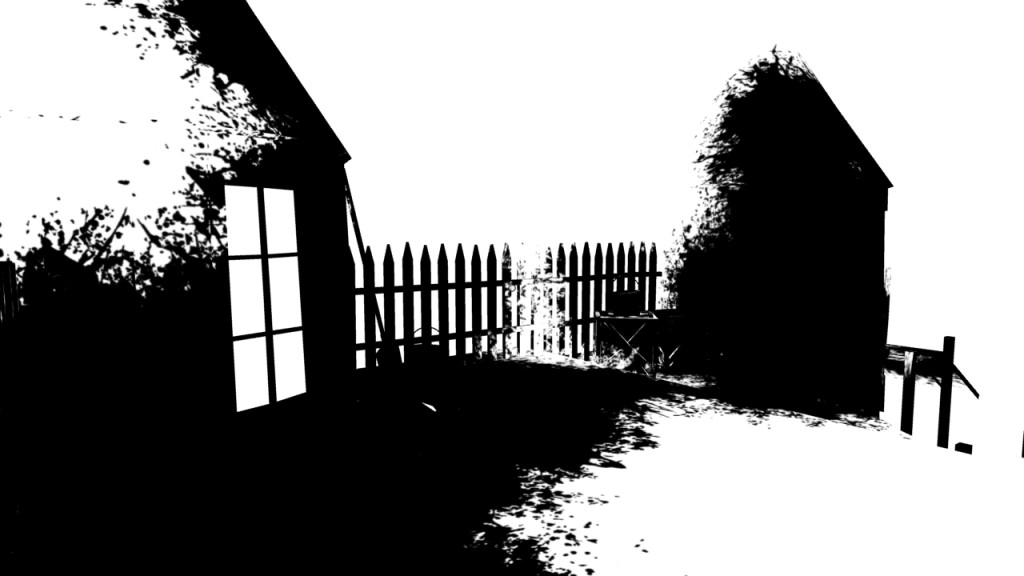
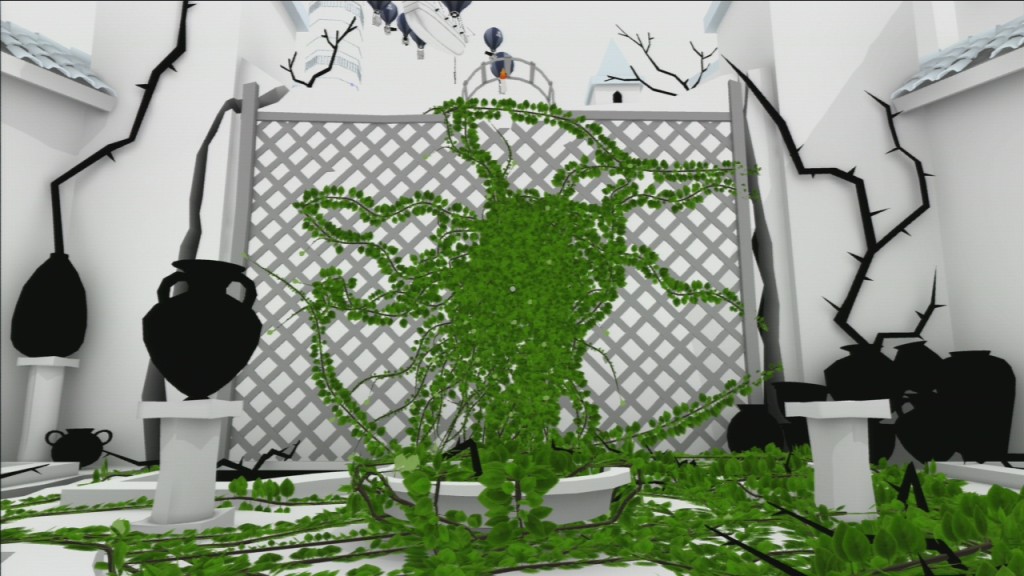
Obviously, with a game like Unfinished Swan, the story isn’t the forte. It’s all about the unique gameplay. The game essentially has four levels, each requiring a different method of playing. For starters, the first level is completely white. It’s literally blinding, it’s so white. The only way you can find your way–other than looking for the swan’s golden footprints–is to throw black paint on the white canvas. The black paint splashes on actual objects that are in the white room, that you couldn’t see since they’re all the same color. You don’t want to go too crazy with the black paint, though, or everything will turn solid black as it was solid white. So it’s all about tossing enough black paint around to see depth, shapes, and how the area really looks. In the next level, you no longer have the black paint; you now throw blobs of water in an effort to attract vines to grow up walls, across ravines, through pipes, etc. You then climb these vines.
It sounds really intriguing and different, right? Well, it is, at first. However, the second level went way, way too long. I was really bored and ready for it to be over before I finished the second level. I had stopped hunting for the hidden collectibles at this point as well, because I just wanted it to be over. And then when the third level arrived, pitching me in a somewhat scary scenario where I had to avoid the dark as long as possible or die from most likely a horrific spider monster…you all know what a pansy I am, so I hated this part with a passion. I didn’t even try to look for collectibles here, I just wanted to survive and be done.
At least the last two levels were extremely short, so I was able to finish the game in about three hours.
While I’m glad I got to experience Unfinished Swan, if I had to do it over again, I wouldn’t have paid the full $15. Not that I will do it over again; all those balloons will stay uncollected, thank you very much.

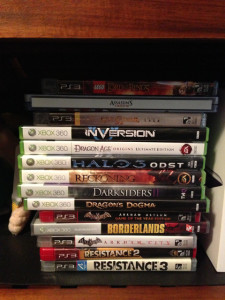 As I’m sure you all have noticed, we’re in a bit of a gaming lull right now. I don’t know about you, but I’m extremely thankful for the break. I have until about mid-February to catch up on my stack of shame. Something tells me I should be excited about
  If it was not for this strategy guide, I would not have gotten far in the game at all, much less finished the game with a completed Sticker Museum. It held my hand in every way I needed it to, which was sadly quite a lot, due to my inexperience with Super Mario games.
 Spec Ops: The Line wasn’t a particularly difficult game in that it didn’t require too much strategy to get through firefights, not unlike most other military shooters. The most I used it for firefight help was for tips on which gun to use in certain situations, such as the shotgun tip when that heavy seems to disappear and reappear closer to Walker in the mall. However, Spec Ops was not as much about being a shooter as it was telling a story and making the player feel like the worst person on the planet. The strategy guide was more important for outlining all of the choices Walker had to make, and it was thanks to the guide that I was able to make the non-obvious, non-stated third choices available.
 The Witcher 2, by far, is the hardest video game I have ever played, even with the added-on tutorial for the Enhanced Edition. After taking over two hours just to get through the first scene in the game (not the first battle…don’t be mean), I had to knock the difficulty down to Easy, and even then, it was no picnic. The strategy guide made sure I came fully prepared to every situation with potions, traps, and spells, thus ensuring I only died once or twice in each battle instead of fifteen times. I have never had to bring so many specific items into every battle in any other game I played. Usually it’s bring a health potion, a bomb, maybe a specific weapon. In The Witcher 2, you need brown oil for your sword (now are you fighting a monster or a human? that affects which sword you coat), a potion for rejuvenating health at a faster rate, fire traps, a grapeseed bomb, and make sure you have learned a specific rune. Um, what?
 As I said when I reviewed the Final Fantasy XIII-2 strategy guide, I was extremely hesitant about the contents of this guide. I was less than pleased with the Final Fantasy XIII strategy guide, and that really carried over to the guide’s sequel, whether that was fair or not. The strategy guide ended up, as you can guess, blowing my mind with how absolutely stellar it was. The strategy guide sat by my side, literally, during the 60+ hours I played the game. The strategies for boss fights were flawless, I had no problems completing all of the side quests and alternate endings, and I found all the collectibles (I cared about finding) with ease.
 I swear, selecting the Mass Effect 3 strategy guide as the top strategy guide of 2012 isn’t some sly move to push my love and affection for Mass Effect. If you don’t believe me, go read my review of the Mass Effect 2 strategy guide, which was terrible. In fact, it was so bad, when I learned Prima Games was doing Mass Effect 3 strategy guide–which of course they were, since they work exclusively with EA–my heart sank as low as it did when I learned Piggyback was publishing the strategy guide for Final Fantasy XIII-2. Like that strategy guide, the strategy guide for Mass Effect 3 greatly exceeded all expectations. Not only did the strategy guide provide excellent strategies for surviving some intense battles–thank you, in particular, for the one-on-one battles with Reapers–but it highlighted how your decisions in previous games affected what decisions you could make in this game. It really showed how sometimes I didn’t make the best decision I could have, even in my Paragon route.