• Home
  • About Us
  • Podcast
  • Strategy Guide Wit
  • Contact

Strategy Guide Reviews

A Strategy Guide for your Strategy Guides

  • Reviews
    • Strategy Guide Reviews
    • Video Game Reviews
    • Mini-Reviews
  • Features
    • Interviews
  • News
  • Unboxing Strategy Guides
  • Columns
    • Gaming Diary
    • Corner of Randomness
  • Videos

Strategy Guide Writer Interview: Colin Moriarty

March 17, 2011 By Keri Honea 2 Comments

Colin MoriartyIf you’ve listened to the IGN PlayStation Podcast (Beyond!), then you are very familiar with the former Guides Guru, Colin Moriarty. I have thought about asking him for an interview for awhile now, particularly to get his point of view on web vs. print guides, and when I heard he was moving from guides to editorials, I pretty much pounced on him on Twitter. Lucky for me, he didn’t take offense and agreed to do an interview.

So without further ado, here’s a strategy guide writer interview from the world of online strategy guides: Colin “He-Only-Does-Everything” Moriarty.

1. How did you get into guide writing?
Back in January of 2000, I wrote my very first FAQ on GameFAQs for Mega Man on the NES. As gaming fansites really began to take off in the late 1990s, I got involved in some of them too, but eventually realized that my calling was to write technical manuals for old NES games. I did this for a couple of years, late during my high school days.

Thankfully, that segued into a freelance offer from IGN to write for IGN Guides. That happened in October of 2002. I freelanced for IGN throughout college (and even interned for a while), and when I graduated college in 2007, I got a full-time job there. And now, here I am (although I don’t write guides anymore as of January).

2. What elements do you like to personally ensure go into a guide?
I think it’s a legacy of my FAQ-writing days, but what’s most important in any guide is exhaustive detail. It’s not necessarily writing to the lowest common denominator, but rather making sure that any question a reader might have is answered for them before they can even ask it. Even if it’s a question you don’t think necessarily warrants an answer. You’d be surprised what confuses some people in any game.

I also think personality is important. Entertaining your reader might not be obvious in a technical guide, but I’ve gotten many compliments over the years for not sounding like a robot.

3. What do you think separates a great guide from a horrible one?
The same two things as in question #2 – exhaustive detail and personality. Organization is important, too. You have to answer all of the readers’ questions, but you have to make sure they know where to look for those answers.

There are a lot of horrible guides in both print and on the internet, and I think they speak for themselves. Half-assed, rushed, not full of the pertinent information. The authors do themselves a great disservice by even releasing them at all. I stand by everything I’ve written. I wonder if the authors of bad guides can say the same?

4. Can you take us through the general process of what it takes to develop and publish a guide on IGN?
We have several in-house guide editors, and then an army of freelancers that write everything we can’t do in-house. Each writer goes about his or her business in their own way, but for me, I like to jump right into the walkthrough, fleshing out the ancillary parts of the guide (like collectibles) as I go along. I wrap everything up with a robust Basics section, and then put it on the site. Naturally, we capture screens and video as we go.

As you may have noticed, we’ve segued in recent years from only putting our guides up when they’re done to putting them up incomplete, and then updating them as we go. The latter is useful for our readers, letting them know that we’re working on this guide, and also giving them information that they may find useful early or midway through the game.

5. How do you decide which games will get guides and which will not?
It’s easy, really. We only have so many writers, and so many resources. Only the biggest games, and the games we think will require the most help for the most readers get our attention. We’d love to write guides for every game released, but it’s simply not possible.
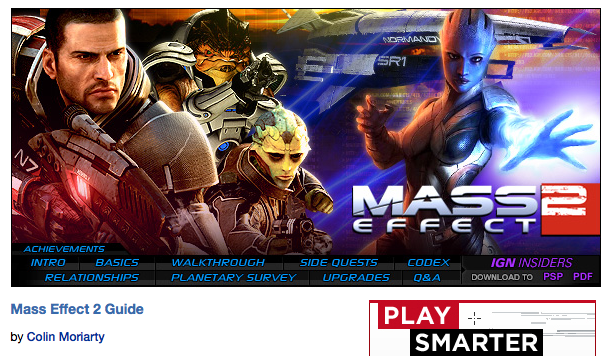
IGN Mass Effect 2 Guide & Walkthrough6. It sometimes appears that IGN doesn’t really have a timetable when it comes to guide releases. Some guides are out on gameday release, and others appear in piecemeal over time. What is the general timeframe that you like to set for a guide’s release?
We like to get our guides up as soon as we possibly can. But we also don’t want to sacrifice quality, and that’s something we put before everything else. It’s all about what we can get done when we can get it done in the most quality-oriented fashion possible. If a guide isn’t ready for primetime the day a game comes out, we don’t release it.

7. What is your biggest pet peeve when writing a guide?
I don’t really have one. When I left guides to become a regular editor at IGN, I went back and counted all of the IGN Guides I wrote. It was almost 100 in an eight year period. When you write that many strategy guides, you get into a groove. If anything, writing guides has made me more organized, a better writer, and prepared me for the unexpected time-sucks that all sorts of games can unexpectedly throw at you.

8. What do you like most about guide writing?
Guide writing is a process, and one that experienced guide writers get better and better at maneuvering through the more they write. What I really like is sitting down with a huge game – Mass Effect, or Red Dead Redemption, or Fallout 3 – and 500,000 words later seeing the end product. And of course, I love knowing that my hard work has paid off for gamers who found the help they need. Their continued e-mails of thanks are what make writing guides so rewarding.

9. Has guide writing affected how you view video games? In what way?
It’s certainly made me more of a perfectionist, more of a completionist. I rarely go through games just to beat them now. I like to see and do everything, find the collectibles, do side quests, earn all of the Trophies. Having to do that for so many guides just to make them as complete as possible has allowed me to explore a product in greater depth.

10. What is your favorite genre of game to play and what is your favorite to write about?
Back in the day, I was a huge J-RPG nerd. Now that that genre has effectively fallen off the cliff, I’ve in recent years become enamored with W-RPGs. Some of my favorite guides – Fallout 3 and New Vegas, Mass Effect 1 and 2, et cetera – are all of that genre. I also love sandbox games. Infamous comes to mind. And then there are shooters which I enjoy too. I’ve written all sorts of guides, and play all sorts of games, but I suppose my three favorite genres would be W-RPGs, Sandbox, and FPS. But honestly, I can find something to love in every genre.

11. Before you became the guides guru of IGN, where did you originally write and publish your guides?
I started off at GameFAQs. You can still find my guides there under the name CMoriarty. But my content has called IGN home since 2002.

12. Of all the guides you have written, which one is your favorite?
That’s a tough question. I think a lot of my guides since I became an editor have been top notch. My swan song on IGN Guides, New Vegas, is a guide I’m especially proud of. But really, there are probably a solid dozen guides that I look back on fondly.
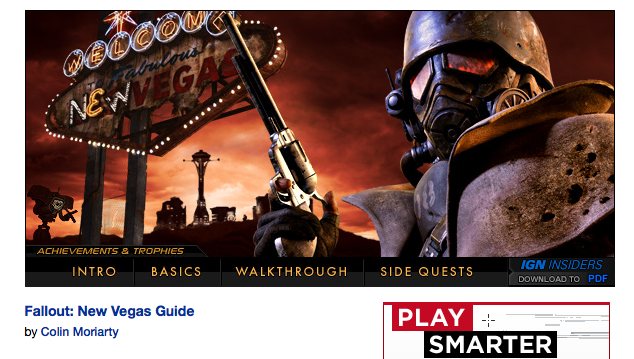
IGN New Vegas Guide & Walkthrough

13. Now which one do you think is the best?
I think the readers have pretty resoundingly answered that question: Fallout 3.

14. Do you have any advice for writers/gamers who would like to break into guide writing?
You have to have passion. You have to have focus. You have to have an eye for detail. And you have to have a lot of time. You need to be willing to write for no money to get your foot in the door, and you need to be willing to take the risk, put your name out there, and realize that it may or may not pan out for you.

If there’s one thing I’m well-aware of, it’s that while I had talent when IGN recruited me to freelance for them, I worked with a lot of talented writers who didn’t get that break over at GameFAQs. I’m blessed, and I was lucky, but not everyone is so fortunate.

Work hard, get your name out there, make great guides, and see where the cards fall.

15. In terms of online vs. print guides, what advantages and disadvantages do you see?
Print guides don’t really have an advantage. They’re dinosaurs. The only advantage the reader has in a print guide is expediency. Print outlets have access to games very, very early, so if a gamer needs help right away, print might be the only solution for them, since the final product is ready to go on day one.

But if you can wait a week (or even less), online alternatives will crop up that are almost always better written, more detailed and more useful than their print counterparts.

I still don’t understand why someone would spend $20 on a print guide. I’ve asked myself that question for over ten years.

16. Do you think that online guides are the way of the future and print guides are on their way out?
Absolutely. I’m surprised print guides are still going, to be honest. free alternatives.

17.  Now for the hard question. What is your favorite video game of all time?
Oh, that’s easy. Mega Man 3 on the NES.

Thank you so much, Mr. Moriarty, for your time in answering this interview. However, I think I may have a couple of more questions for you, based on your responses:

  1. Do you think I’m crazy for buying print guides?
  2. Do you think my overall purpose for this site is crazy?

Please don’t answer them.
Filed Under: Strategy Guide Interviews

Kingdom Hearts Re: Coded Mini-Review

March 16, 2011 By Keri Honea Leave a Comment

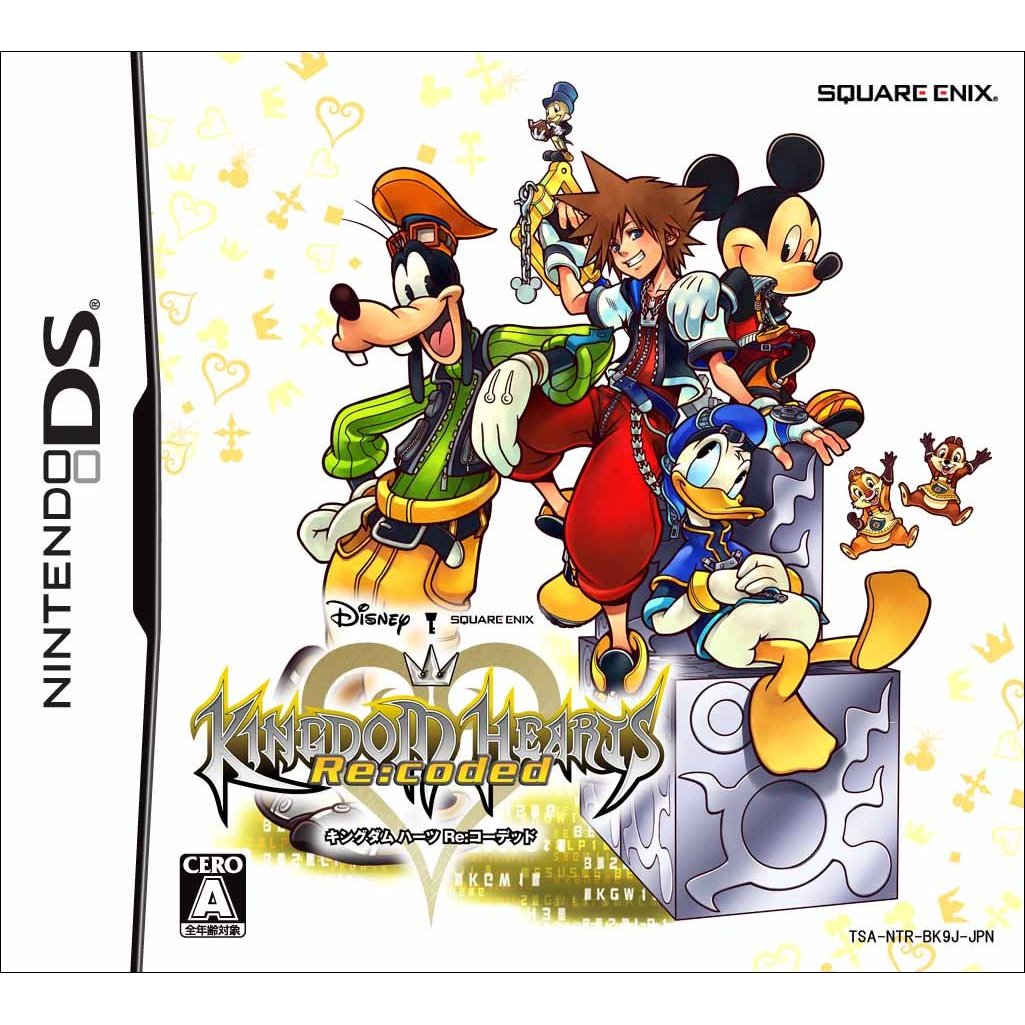
Kingdom Hearts Re:Coded boxartKingdom Hearts is undoubtedly one of Square Enix’s most beloved franchises despite the fact that the series hasn’t had a release on a major console since 2005. If I have to count Re: Chain of Memories, then it was 2008. Since KH2’s release, Kingdom Hearts has only been found on three portable games: 358/2 Days, Birth by Sleep, and now, Re:Coded. Re:Coded is actually a conglomeration of a set of episodes of phone-only games from Japan, which started in 2005 not long after KH2’s release and only finished shortly after the release of BBS. As one might expect, Re:Coded plays like a bunch of ported phone games–which is as great as it sounds–and the story plays out like the writers were writing it off the cuff–which they probably were.

For those who are just dying to replay the first Kingdom Hearts game with a bunch of twists in game mechanics, then you will love everything about the gameplay, especially if you’re a fan of retro games. Without getting into the story too much, the basic premise is that Jiminy’s Journal has been riddled with bugs and it’s up to King Mickey and the gang to debug the journal and uncover the mystery as to why the journal is completely blank for the Chain of Memories sequences. Since the CoM portions are blank, the entries from the first game will have to be fixed. So yes, get ready to revisit most of the worlds Sora visited in both the first Kingdom Hearts and  CoM.

Players do control Sora yet again–although this time he’s a virtual version (seriously, don’t ask)–and he does pretty much what he’s always done: beat up Heartless. This time though, he also has to clear all of the bug blox littered in the worlds and eliminate the sources of the bugs in each world. The sources are sometimes boss fights and sometimes they are extra levels within the world. Sora has the same arsenal of attacks, magic, and items and accessories as he usually has, although this time around, accessing them and selecting them comes straight from the user manual of BBS. Another noticeable difference is how Sora levels up, which is through his virtual motherboard complete with data chips, and this format should be very familiar to anyone who has played either Final Fantasy X or Final Fantasy XIII.

Instead of consisting of straight up action like Sora’s other games, Re:Coded offers a few throwbacks to gameplay of older, 2D games. For some boss fights, Sora will fight in a 2D side-scroller like one would find in MegaMan. At other times, Sora will have to traverse a 2D arena of platforming to get to the next world. In the Olympus Coliseum, since Sora can recruit Cloud into his party, all battles are fought via turn-based play–which made me laugh really hard. Even though I’m not a fan of 2D retro mechanics or traditional turn-based play, incorporating these here in this game about data was actually fun and refreshing from the typical KH gameplay. If I’m going to have to fight all the same bosses from the first game, might as well make the battles more interesting.

One more note: beware of boss fights. Since this is a collection of games, be prepared to sit through 3-5 boss fights in a row with no save points at various points in the game. I have to assume that these were how the episodes ended, but it didn’t make them any more bearable.

The story, something which is usually the franchise’s strong point, is possibly the weakest of the series, if not tied with 358/2 Days. The fact that Mickey created a virtual Sora to debug the journal nabbed an instant eye-roll, and the fact that the developers thought to include Maleficent and Pete at all also earned an annoyed sigh. At first it seemed like maybe they were going to explain what happened to the duo at the end of KH2, but then that was never addressed. They decided that they wanted to rule the virtual world of the journal, which really made little sense. Riku’s inclusion was also very unnecessary, but at the same time, he had to be there for proper fanservice. I just think they could have brought him in a better way than making him be Sora’s embodiment for the Journal’s heart.

As the story continued, the plot points tying it to the other games became weaker and weaker. I don’t want to spoil what happened, but basically, the ending to Re:Coded explains what was in the message in the bottle that King Mickey sent to Sora at the end of KH2. What was in that message could all be explained by playing the last two episodes of the game. The first few had little to nothing to do with the ending of the game. Somewhere along the line of writing the episodes, the developers decided to turn Re:Coded into a core game, so the game shifted toward the plotlines of CoM and BBS. The shift is very obvious when it occurs, which really gives the player the feeling that the writing of the episodes was done on the fly.

Can I recommend this game to others? Only if you’re a die-hard KH fan. If you’ve never played any of the games, do not pick up this one. In fact, I wouldn’t pick it up unless you’ve played all of the others, because otherwise the ending will make zero sense to you. In addition, you really don’t need to play this game to know what’s going on in the story. Sure, I learned what Mickey told Sora, but I would have found that out anyway at the start of Kingdom Hearts 3.

Hopefully this is the last of the un-numbered KH games so we can move on to what should be the final piece in Sora and Roxas’ story. If you don’t understand what I mean by that, then go play Birth by Sleep.

SGR Rating: 3/5

Filed Under: Mini-Reviews

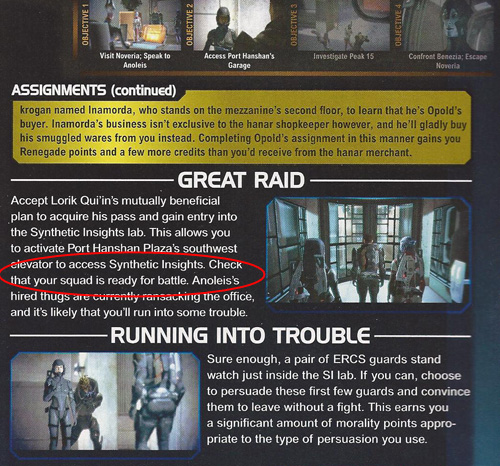
Strategy guide pet peeve: “Prepare yourself for battle”

March 8, 2011 By Keri Honea 1 Comment

While playing through Mass Effect these past couple of weekends, I’ve noticed that the strategy guide likes to repeatedly tell me to make sure I’m prepared for battle. Every time I see it, I think, “Really? Because battle happens so little in this game?”

This phrase is littered throughout the ME guide, but I know I’ve seen this same piece of advice in multiple other guides (those just didn’t state it as often, but that’s not the point here).

The point is, this phrase should never be mentioned in any strategy guide for a game that has fighting, unless the fighting happens very, very sparsely. [Read more…]

Filed Under: Strategy Guide Advice

Strategy Guide Collector’s Edition Giveaway – Epic Mickey

March 7, 2011 By Keri Honea 4 Comments

Epic Mickey Collector's Edition Strategy GuideThanks to everyone who participated in the last strategy guide giveaway, where the Collector’s Editions of the Alan Wake and Tekken 5 strategy guides found new, loving homes. This week, I have another Collector’s Edition guide that needs a loving owner: Epic Mickey.

From Prima Games’ website, here are the features included with this Collector’s Edition in addition to the gorgeous hardcover shown to the right:

• Collector’s Edition includes the complete Disney Epic Mickey game guide!
• 40+ fully labeled world maps and extensive walkthroughs reveal the secrets behind every quest, puzzle, boss battle, and hidden area to help Mickey in his quest to save Wasteland!
• Exclusive developer content! Foreword written by the game’s creator, Warren Spector. Plus, Warren Spector answers questions about the game and its creation in our 16-page bonus section.
• Limited edition art: 8″ by 10″ reproduction cel of artwork inspired by the game! [Read more…]

Filed Under: Strategy Guide Collector's Editions

March Poll: Boss fights?

March 7, 2011 By Keri Honea 1 Comment

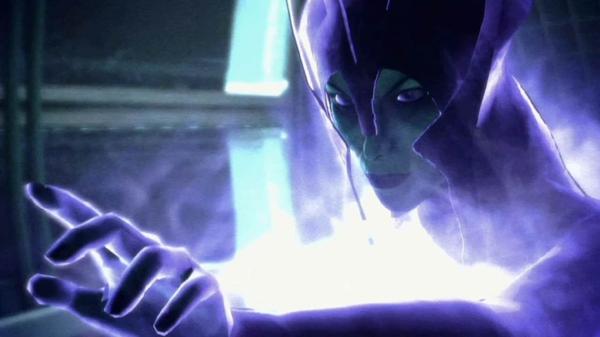
Matriarch BeneziaIt’s clear to me that either my poll questions are lousy or no one really has any interest in participating in the polls, because for the last couple of weeks, I’ve had meager responses. And that’s fine. So I’ve decided to make these polls monthly, and this first poll I’m bringing over from my article at Games Are Evil, where I question the necessity of boss fights at all.

Depending on the game, I don’t mind boss fights. In the case of one game I’m playing now, Mass Effect, I really don’t mind them because they are implemented well. The types of boss fights that I hate are those that are giant time sinks. You know, the ones that take several minutes to chip away at their health bars or those that morph into multiple phases with no save points (sometimes, no checkpoints either).

I understand the need for boss fights, but I just don’t think that as a whole they are presented well. There are so many instances where a boss fight makes little sense, and it’s quite obvious the developer needed some padding or they couldn’t think of a better way to spice up the gameplay.

I’m about halfway through Mass Effect, and so far, every boss fight has been my ideal. Bosses come in at specific plot points. They aren’t there for mindless and frustrating leveling up. It actually makes sense why you have to fight them right there and then. And best of all, they don’t take longer than a couple of minutes to defeat.

So strategy guide-loving community, do you love or hate boss fights?

Filed Under: Strategy Guide Polls, This Has Nothing to Do with Strategy Guides!

  • « Previous Page
  • 1
  • …
  • 140
  • 141
  • 142
  • 143
  • 144
  • …
  • 183
  • Next Page »

Follow us!

Subscribe!

Upcoming Strategy Guides

 Nothing here. Come back later. 😢

Latest Strategy Guide Reviews

The Walkthrough by Doug Walsh Review

Red Dead Redemption 2 Strategy Guide Review

Mega Man 11 Strategy Guide Review

God of War Strategy Guide Review

Far Cry 5 Strategy Guide Review

Friends of SGR

  • BradyGames
  • Dan Birlew – Guide Writer
  • Doug Walsh – Guide Writer
  • Future Press
  • Game Enthus
  • GameWires.com
  • Piggyback
  • Press the Buttons
  • Prima Games
  • Racing Games

Top Posts & Pages

  • Unboxing the Breath of the Wild Deluxe Edition Strategy Guide (Video)
  • Unboxing The Legend of Zelda: Breath of the Wild Collector's Edition Strategy Guide (Video)
  • Comparing the The Legend of Zelda: Wind Waker HD Strategy Guide
  • Why Buy the Wolfenstein II Collector's Edition Strategy Guide?
  • One A Wednesday: Wolfenstein: The New Order Online Strategy Guide

Copyright © 2026 · Web crafted by Warkhammer


Loading Comments...