• Home
  • About Us
  • Podcast
  • Strategy Guide Wit
  • Contact

Strategy Guide Reviews

A Strategy Guide for your Strategy Guides

  • Reviews
    • Strategy Guide Reviews
    • Video Game Reviews
    • Mini-Reviews
  • Features
    • Interviews
  • News
  • Unboxing Strategy Guides
  • Columns
    • Gaming Diary
    • Corner of Randomness
  • Videos

Art Book Review: Super Famicom: The Box Art Collection

August 12, 2016 By Blake Grundman 2 Comments

Super Famicom The Box Art Collection ReviewIt is hard to understate the importance of the Super Nintendo when discussing the legacy of gaming giant, Nintendo. Following fresh on the heels of the insanely successful Nintendo Entertainment System, the console cemented the corporation’s power position in the industry, while simultaneously fending off the vicious onslaught of SEGA in both the United States and abroad. Sure, any retro enthusiast worth their salt looks back fondly on the console, but even the most passionate of gamers lose sight of one key component of the gaming purchase: the box.

For North American folks this general apathy towards the game’s packaging makes quite a bit of sense. Nintendo of America insisted on virtually every game having the exact same design template, with very little opportunity for deviation. What little room was left on the box tended to contain a generic press shot or two, along with the title in big goofy lettering. In Japan, however, it was the Wild Friggin’ West. There were very few restrictions on how games were bundled at retail, let alone any attention paid to the art that these boxes featured. The result was an amazing variety of different types of designs and artistic expressions that were absolutely worth remembering.

In enters Super Famicom: The Box Art Collection from stage left, to inform the rest of the gaming world what we were missing out on. Published by the team over at Bitmap Books, this collection helps to revive the lost art of the coffee table book, while also preserving over two hundred and fifty of Japan’s most memorable pieces of box art. Admittedly the appeal of a compilation like this might be a bit more limited than most historical gaming publications, but as someone who has fawned over classic games since childhood, this was just something that I had to own for myself. Thankfully, it doesn’t disappoint.

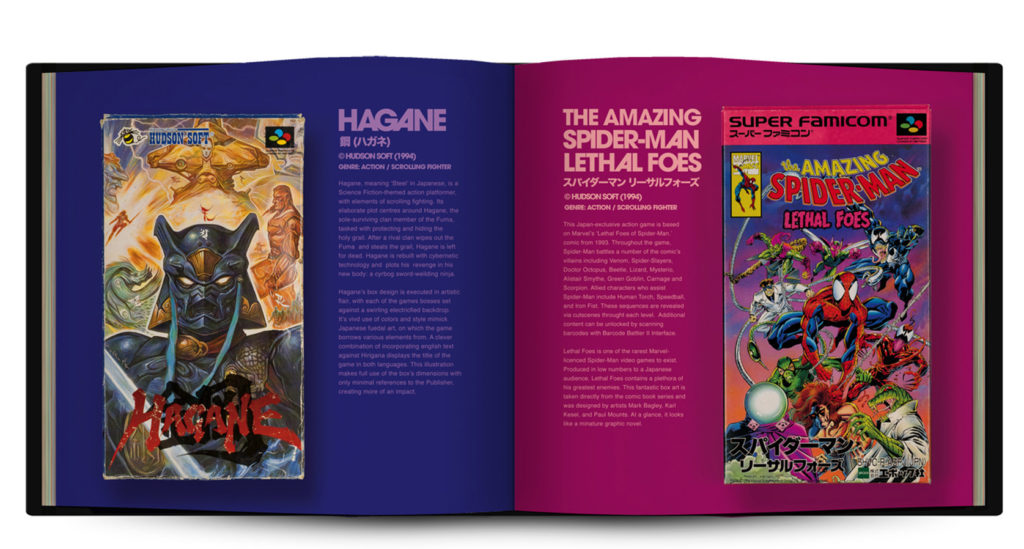
As soon as the introductions are out of the way and the contributors have had the chance to share their own personal blurbs about “why the Super Famicom was so important to them,” and, “how this project was a labor of love,” the meat this tome kicks in. Each page consists of what has to be a damn near scale image of a specific piece of box art, accompanied by the game’s title (in both English and Japanese) the publisher, year of release and genre. This is then followed by what is essentially a synopsis of the game, a few additional interesting anecdotes, and an occasional note about the artist responsible for the actual art featured on the front of the box.

Though this may sound rather pedestrian as far as content goes, it is in the crisp detail of the images and the more off-the-wall behind the scene stories of each game that makes this worth reading. For example, did you know that the game Contra Sprits originally used Arnold Schwarzenegger’s film Raw Deal as its inspiration? Apparently Konami was worried that the game would be deemed too aggressively named for its European release, hence them renaming the title Super Probotector. If that wasn’t enough publisher mandated intervention for you, the developers were also forced to go in and swap out the main characters with robots, just so it was guaranteed to get past the notoriously strict German certification board. Call me crazy, but details like this are absolutely fascinating to read about. Oh, and for those of you wondering if this game came out in North America, you might remember it better as Contra III: The Alien Wars.

Page after page, I was riveted by what I was reading and seeing. Granted, the previous example of deep dives into a title’s background isn’t present for every game, but I can guarantee that each blurb will have at least an interesting detail or two that isn’t widely known by the general public.
Super Famicom The Box Art Collection Review

My biggest takeaway from this compilation is related to the extremely compelling pieces of art. First off, the image quality is far and away the best I have ever seen for an anthology of this magnitude. The sheer amount of time it must have taken to both photograph and clean up some of these boxes would have to be far more than I could ever image. It is very obvious that there has been careful attention to detail in preserving each and every piece, as if it were hanging on a wall in a gallery. Secondly, it is fascinating to see just how amazing marketing can look when teams are given the freedom to think outside of the box. (See what I did there?) It makes me wish that North America had the same freedoms with their packaging. Who needs uniformity when you have creativity, right?

Though the content actually printed on the page is the most critical element to any coffee table book, another key piece of the puzzle is the quality of the materials that the book is made from. The hardcover edition that currently resides on my shelf is extremely high quality. Both front and back covers have a finish that almost reminds me of our old, gigantic school dictionaries. It looks very well put together when sitting on a shelf, and even more impressive when laying out on a flat surface. Each actual page is a thick, glossy stock that reminds me more of a classic reference material than a book about game art. Lastly, the binding itself is tightly woven into the hardcover, which means that readers are treated to that satisfying, “new book crinkle,” sound when opening the cover. It is a personal pet peeve of mine when the bindings of a book are way too lose. It results in a product that doesn’t feel as well put together. Luckily this dodges that bullet with ease. Though I will say there are some pages that seem to have not been cut as crisply as others, leading to a few visible rough patches when looking at the book from the side profile. I know that criticism is being nitpicky, but when the actual build quality is this high, you have to dig a little deeper to find problems.

There are only three other areas where I have minor criticisms. For one, it seems like the amount of written content on each page was fairly inconsistent. While some descriptions seemed to be bursting at the seams with information, others seemed a bit more barebones, only filling a quarter of the page. As I have iterated on previous occasions, I am not a fan of blank real estate on a page, unless it was made for a stylistic reason. Secondly, the commentary on each title seemed to steer clear of most information about their North American releases. Obviously the majority of the information revolves around the Japanese release, but why the European releases get so much more attention than the folks on the other side of the Atlantic is beyond me. If there was a legitimate explanation for this, I would be very interested to know. Lastly, I really wish we could see the back cover of these games are well. And before you say anything, yes I do realize that I wouldn’t be able to read a goddamn word of it. I just think it would be interesting to see if some of these full front spanning images carry over to the back, or if there is even more original art on the opposite side. Once again before you run to the comments to tell me I am nuts, just know that I realize that would necessitate a complete change in the layout of the book. This is just more of an, “It would have been nice if…” commentary, rather than an actual criticism.

If the quality of this release is consistent with the rest of the releases in the Bitmap Books stable, I will definitely be checking out more of their back library. Super Famicom: The Box Art Collection is a fantastically well put together book looks as good closed on the table than it does opened. Each page is vibrantly printed and has content that is guaranteed to entertain the inner fanboy in everyone. This is a piece that is well worth adding to any retro-leaning gamer’s library.
Filed Under: Art books, Extended Lore

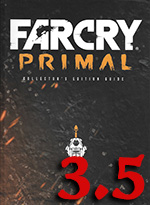
Far Cry Primal Strategy Guide Review

April 25, 2016 By Blake Grundman Leave a Comment

Far Cry Primal strategy guide reviewI have had the fantastic opportunity to review some very amusing games lately. Fortunately, one just so happened to line up with a strategy guide that I could cover in my first ever strategy guide video review. There are several pieces of the Far Cry Primal strategy guide that are constructed very solidly. However, by virtue of it being an open world game, the organization of the guide itself needed to be a bit more open-ended. That is where the problems began…

There are quite a few things to discuss about the guide itself, both good and bad, so I will let my review speak for itself.

Author: Will Murray, Michael Owen
Publisher: Prima Games
Editions available: Hardcover
Acquire via publisher

PS: I just ask that you be gentle. This is my first time being in front of the camera by myself, so naturally I may come off as a bit nervous. Hopefully this is just a tentative first step into a much bigger world. Thanks for indulging this n00b!

Filed Under: Collectors Editions, Strategy Guide Collector's Editions, Strategy Guide Reviews

Titanfall Strategy Guide Review

July 16, 2014 By Blake Grundman Leave a Comment

Titanfall strategy guide reviewIt goes without saying that the folks over at Respawn have been fighting an uphill battle since the studio’s inception. Originally birthed out of the strife and subsequent implosion of Call of Duty developer Infinity Ward, Respawn set out to create a new IP that bank in on what the team’s design strength: multiplayer. And thus, Titanfall was born, as an online-only multiplayer FPS. Can Prima Games’ Titanfall Strategy Guide manage to live up to the high standards established with their well crafted Battlefield 4 guide or will the print version fall victim to the constantly evolving state of online titles?

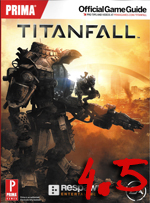
Before even cracking the cover of the Titanfall Limited Edition hardcover guide, it would be a tragedy to overlook how fantastic the exterior of this book looks. The sleek cover art spans across both the front and back of the binding, featuring an amazing rendition of a hulking Titan, with its pilot perched on its arm, overlooking a sun-bleached cityscape vista. The game’s title is the only typeface on the cover, and only appears in the top-right corner as an afterthought, probably in an effort to not draw attention away from the amazing piece of artwork

Cracking the cover treats the reader to a beefy behind the scenes look at Titanfall, clocking in at more than thirty pages. There are interviews with several key members of the development staff, including the likes of Respawn CEO Vince Zampella, Lead Artist  Joel Emslie, and Game Director Steve Fukuda, just to name a few. The very thoughtfully constructed section provides an impressively candid look behind the curtain that runs the gamut from talks about the difficulty of starting a new studio and IP from scratch, to admissions of moral issues early on in the development process. Each interviewee has a series of questions that are structured around their specific role on the project, which ends up painting a very in-depth picture of the entire game, from damn near every angle possible.

Of course, both in-game assets and concept art are interspersed throughout the intro. The layout of this particular segment of the book is very flexible, adjusting margins and column sizes to give extra room for artwork to “breathe,” while still not giving the impression of excessive white space on the page. Overall, this turns out to be one of the better featurettes in recent memory.

After all of the fun has come to end, it is time to get down to the nitty gritty and tear into the actual introduction. The next fourteen pages initiate the reader into the game, its universe, and the mythos surrounding the conflict that players are dropped into. This wraps up with the actual campaign overview, which also marks the first actual advice that the book doles out, in the form of light team tactics recommendations on each stage of the “storyline.” The matter-of-fact presentation of this information almost trivializes the mission’s objectives, instead opting to point the reader in the best way to accomplish an overall victory by working together as a team. This guidance seems to work fairly well if team members are on the same page, but it is also far more effective when used in tandem with the later map section.

Ironically, all of this information has been dolled out, without ever explaining to the reader the core game mechanics and controls. That actually comes as the very next segment of the text. Though it can almost be assumed that if you are playing Titanfall this isn’t your first FPS rodeo, it still seems like this “Pilot Certification” section may have been better served appearing in the introduction, before actually delving into information about the campaign structure. Key concepts like the control scheme, and a rundown of each stage of the pre-game tutorial make up the majority of the next twenty six pages

An important area not to miss in “certification” is the breakdown of the new mechanics introduced by using Titans like effective shield use, the three different equipible tactical abilites, and titan auto-pilot. Also be sure not to miss out on information about the persistent elements such as burn cards, loadout customization and minion usage. There are several invaluable “Developer Tip” callouts that further detail what otherwise might be considered mechanics that you would have to experience in-game first, in order to fully understand. Newcomers should be sure to get all they can from these very valuable chunks of information. Lastly, the different combat scenarios such as “Titan vs. Pilot” or “Pilot vs. Minion” are all spelled out, from both side of the conflict. The tactical information provided is the kind of evergreen advice that would only otherwise come from logging countless hours of trial and failure. Taking a few of these notes to heart before stepping foot in the multiplayer will help to shave hours of unnecessary frustration from the reader’s life.

Tactical information then gives way to over fifty pages of information about the different pilot classes, their specific strong suits, and Titanfall’s impressive lineup of on-foot weaponry. Most firearms are given an impressive two pages of real estate, to give the reader an in-depth analysis of strengths and weaknesses, the in-game unlocks associated with the item and kill counts of how many shots it takes to kill equally sized adversaries, when aiming at either the head or torso. There are also performance charts that give general info about damage, accuracy, range and rate of fire, but there are no pieces of numerical data to back up the chart’s scale. Most likely this is a conscious choice, made to keep the information in the guide relatively correct, even after the development team makes balance adjustments, post-release. This is a clever way to get around this obvious shortcoming of print media in a digital age, but the lack of any sort of scale somewhat renders these graphs moot.

“Pro Tips” from the guide’s team of writers/pro gamers or developers usually lead off the second page, and contain key tidbits about how the weapon in question’s effectiveness can be maximized through uses of different modifications or burn cards. This is all concluded by a list of every challenge and the number of experience points that are rewarded for completing said task, for that given firearm. All-in-all, though some of the information is purposely vague to avoid being rendered invalid over time, there are still plenty of reasons to read up on your gear of choice, in order to craft the perfect loadout for the reader’s specific style of play.

Wrapping up the pilot analysis are a series of custom designed loadouts, meant to emphasize the different playstyles that can be used in teamwork scenarios. Featuring names like “Defender” and “Hacker,” it is pretty easy to figure out who these bundles are targeted. What is more interesting is checking out the profession players’ loadouts. These tend to be more eclectic hybrids, that straddle the line between playstyles, but provide much more flexibility in a evolving game scenario.

The same level of detail applied to the pilots and their weaponry is also applied to the different titans and their weaponry. Different customizable titan elements such as kits, chassis, and ordinance join the typical weaponry sections. These are laid out very similarly to their equivalents in the pilot portion of the text, with the exception of lacking the pro tips callouts. Easily the most valuable portion is once again the concluding loadout suggestions for each mech. Considering that this is a fairly new experience for multiplayer shooters, both newcomers and veterans of the genre will find plenty of new information to glean from these scant four pages. But good things in live come in small packages, right?

Then we get to the actual meat of the guide: maps. One hundred and eighty of this guide’s three hundred and thirty pages, which is well over half of the book for those of you keeping track at home, are tied up in map analysis. This is not a bad thing by any stretch of the imagination, especially given the lack of any form of genuine single player content in the game itself. It just helps illustrate how this guide very much lives by the mantra, “a picture is worth a thousand words.”

Every map in the game is led off with a two primer containing a kill/death heatmap, giving the reader a basic idea of where most of the slaughter will take place and a full page, top-down view of the map. From the map, there are a series of key landmarks that are called out in image form along the the binding of the left page, but not explained why they are so important. Be sure to remember those points, because they will come in handy in the pages that follow.

Once the foundation has been laid, the same layout of a blown up and numbered map on the first page, flanked with a legend at the bottom, and second page of tactics are repeated on loop five times. Why five times, you ask? This is done to emphasize the different strategies for each of Titanfall’s five core modes. It is a testament to Respawn’s forward thinking design that this is so necessary, but in each case there is very little repeat in the strategy sections between each mode. Make sure to take note of the pro tip callouts, because it tends to give a bit of a glimpse into the mind of a high level player. If readers can begin to think like like these skilled players, they will ultimately be a better teammate.  Also, be sure not to miss the zipline location and parkour hints embedded throughout. Utilizing these moves take a bit of practice, but have the potential to provide players with an instant jump on the competition.

Bringing the guide to a close is the standard quick reference guide of achievements, experience scoring charts and reprints of details on the different burn cards. In one neat conclusion, the last page before the credits is crammed full of last minute developer tips, not already included in the text. Though some of these concepts are rather simplistic and almost, “well, duh…” there are enough gems scattered throughout to warrant a quick skimming.

The last of the lose ends in regards to Prima’s Titanfall Strategy Guide is their online based eGuide. Unlike the previously reviewed Plants vs. Zombies: Garden Warfare guide, it Titanfall counterpart seems far more up to date. All of the maps included in the Expedition map pack have been added to the guide, though they have notably left out strategies for the Attrition and Pilot Hunter gametypes. Maybe the maps don’t support these modes, but it would have been nice to see some sort of explanation in the primer as to why they are absent. It is also worth noting that Respawn went on the record at E3, stating that at least two new modes will be coming to the game this fall. Hopefully all of the existing maps included in the book, as well as in the DLC will be updated with new coverage pertaining to these modes. However, given their hit-or-miss updating history of eGuides, I am not holding my breath.

The sum total of the Prima Games’ Titanfall Strategy Guide ends up being one of the more helpful guides released, as of late, while still providing a very stylistic presentation. The book’s effective use of art to both illustrate key points as well as just showcase the game’s fantastic artwork is what helps set this apart from other, more lackluster efforts. When combined with the great guidance from professional players as well as the developers, this is the perfect companion to any aspiring Titan pilot. Hopefully its electronic incarnation will continue to evolve with new DLC and uphold the same level of quality put forward in this stellar guide.

SGR Rating: 4.5/5

Author: David Knight and Michael Cavanaugh
Publisher: Prima Games
Editions available: Paperback and Hardcover
Acquired via publisher

Filed Under: Strategy Guide Reviews

Plants vs. Zombies: Garden Warfare Strategy Guide Review

May 23, 2014 By Blake Grundman Leave a Comment

Plants vs. Zombies: Garden Warfare strategy guideWhen Popcap Games decided to take on the tower defense genre with Plants vs. Zombies back in 2009, it was safe to assume that it was met with a fair share of skepticism. Fortunately not only did the studio do a fantastic job winning over gamers on every playable platform of the era, but they managed to continue to grow that audience with their recent free-to-play sequel on both iOS and Android. So when it was announced that Plants vs. Zombies: Garden Warfare would be making the jump to third person shooter with the help of DICE, you can imagine that people were more than a little curious to see what Popcap had up their sleeve. Can Prima Games’ Plants vs. Zombies: Garden Warfare strategy guide manage to help ease tower defense fans into the world of class/squad based shooters, or will supporters of the franchise be left slowly sauntering out to pasture?

When looking into the future of the Plants vs. Zombies series, you would be hard pressed to predict that their next logical turn would’ve been jumping into the shooter space. The overlap between the squad based shooter audience and strategy/tower defense fans would most likely be fairly limited, hence the reason that Prima Games’ team really had their work cut out for them. Thankfully, the Garden Warfare game itself was designed with approachability in mind, so the writing team did their best to follow suit and start with the building blocks and then move on from there. This plan worked out fairly well, but the result was a series of hits and misses, accompanied by a disappointing online implementation. But how did they get there, you ask? Let’s start at the beginning.

As with any guide, the ever-predictable “How to Play” section leads things off and covers general controls, ability slots, and simple mechanics like strafing, reloading and jumping. Sure those might seem like a given to anyone familiar with shooters, but with the existing fanbase of the Plants vs. Zombies brand, it makes sense to spell things out explicitly. Additionally, elements like the HUD design, menu navigation and special attacks are detailed. Closing the intro out are overviews of the different game modes, hints on how to improve skills through the game’s coin and card pack system, and a breakdown of how to beat adversaries to both the literal and figurative punch. Also, it is important to mention that the mode page is very good about detailing the differences in mode availability between the Xbox 360 and Xbox One version, because there are several features missing from the 360 release.

Diving right into the action, the next mini-chapter outlines the Xbox One exclusive Boss Mode. The extremely brief collection of 4 pages very roughly outlines what can be expected from this top-down mode and features extremely rudimentary explanations of what perks can be unlocked at different sunlight levels. This “me-too” area to start out the book is both lacking enough screen shots or even information describing what is actually going on, and will most likely end up leaving readers (especially those on Xbox 360) confused as to what exactly is being described in the text.

Luckily, the weak start is followed up by something that at least applies to every version of Garden Warfare: the class breakdowns. Each type of both plant and zombie is spelled out, along with their numerous variants. For example, the standard peashooter has a fire, ice, toxic, commando and stealth variants. The details area of each base class variant consists of two rather large screenshots that take up easily three quarters of the page, with very small text sections that highlight the ammo type, damage style, reload speed and best use case scenario. Also, a callout will also run down the upgrades that are exclusively available to the sub-class. Though the initial class information is very helpful, the majority of the sub-class sections look almost like glorified screenshot galleries, meant to pad the size of the guide. Simply put, get ready to see a ton of unoccupied white space on each page. All of the information contained in the sub-class details could have most likely been summed up on a single, page-spanning chart for each class. This proceeds to go on for seventy five pages, which accounts for almost a third of the guide’s pagecount.

Next up on the hit list is another mini-chapter dedicated to the game’s “Sticker Shop” unit customization system. All of the separate types of sticker “packs” are explained in a way that will help understand the patience vs. payout dynamic that comes from purchasing different types of packs. One particularly important selection of text breaks down the critical differences between consumable vs. customizable items and why the distinction is so critical, as well as what kinds of items are included in each. Lastly, it closes with a basic overview of the stickerbook, and how that relates to the unlocked characters, items, and tattoos that are available once players shift back to the combat.

Team Vanquish is the first genuine mode that gets serious attention in this guide. The glorified team deathmatch is led off with talk of the slightly modified “classic” version of the mode, which consists of only the base classes, and utilizes none of the upgrades or customizations made available through the sticker system. Following that callout is a set of “must knows” for succeeding in vanquish. Many of the items on that list are once again common sense to veterans of the genre, but to the newcomers that this title may entice, it may be useful.

As opposed to the sub-class breakdowns, in the map overviews, the screenshots are welcome, plentiful, and effectively used to demonstrate specific points from the commentary. All of the maps included in this section have several call-out “points of interest,” selections that are specifically tied to a collection of screenshots and full-text explanations as to why these locations are so important. Items such as key choke map points, areas of cover or sniping overlooks are all mentioned, as well as way to avoid falling victim to said mini-arenas of combat.

The Gardens and Graveyards segment of the guide continues along the same lines, once again leading off with a primer, meant to lay down hints for success, specific to both the plant and zombie factions. Also, the map breakdowns have a very similar look and feel, though they also spell out key map locations that are unique to the mode such as zombie spawn points, turrets, cannons, and teleporters. Much like the guide for DICE’s earlier multiplayer shooter, Battlefield 4, the Gardens and Graveyards phases are also broken down intuitively, helping both friend and foe gain the upper hand across what could be as many as 7 different phases and map shifts. This is definitely where the book begins to hit its stride, because almost every hint stated in the text are evergreen pieces of information that are immune to the types of balance tweaks that spell doom for many physical guides.

Wrapping up the actual strategy portion of the book are forty pages dedicated to the Co-op Garden Ops. This hybrid of tower defense and horde is a plants-only mode, so the guidance is quick to point out the difference between common, shielded, armored, hero, special and boss zombies, as well their biggest attacks. The problem is, for the higher level zombies, there is very little said about how to actually dispatch them. These are the critical bits of information that guides are most useful for and the answers are nowhere to be found. Thankfully the requisite map coverage lives up to the quality delivered in the earlier sections and proves to be its saving grace.

After the appendices that list off all of the unlockables and achievements, which is oddly packaged at the end of the co-op segment despite applying to all game modes, we get to my favorite part: behind the scenes coverage. What follows are twenty pages of concept art, and an interview with members of Garden Warfare’s development team. Call me a nerd for enjoying a sneak peek behind the curtain, but it is always interesting to see what was going on through a title’s development process. Will it be at all helpful to the gamer? Not really, but fans will most likely enjoy seeing how the game evolved into what they ultimately ended up playing.

One last piece of this equation is the evolution of the guide in electronic form, which is used to cover the new maps and modes included in Garden Warfare’s subsequent downloadable content. Unfortunately the only one of the DLC map guides is what might be considered complete and only features overhead shots, with commentary for the “points of interest.” The more granular shots associated with the callouts are no longer there, which is a genuine disappointment, because it makes it far more difficult to discern the context of where locations are on the map, especially while in the thick of the action. In the case of the Cactus Canyon map included in the Zomboss Down DLC in particular, there aren’t even points of interest or written hints, just maps and an excuse that says updated coverage is coming soon. Over a month after the content’s release, this is inexcusable. Let’s hope that content is in the pipeline, because what is the purpose of an e-guide if it isn’t updated?

As a game, Plants vs. Zombies: Garden Warfare is an interesting attempt to switch gears with an entire brand. Much like the game itself, Prima Games’ Plants vs. Zombies: Garden Warfare strategy guide had both high and low points, that ended up resulting in a mediocre end product. While far from terrible, instances of content padding, compounded with unhelpful boss descriptions, and unfinished online content resulted in an ultimately unpolished end product.

SGR Rating: 3/5

Author: Alex Musa and Geson Hatchett
Publisher: Prima Games
Editions available: Paperback
Acquired via publisher

Filed Under: Strategy Guide Reviews

Call of Duty: Ghosts Strategy Guide Review

January 6, 2014 By Blake Grundman Leave a Comment

Call of Duty: Ghosts strategy guide reviewMore often than not, shooters have been given the benefit of the doubt when it comes to strategy guide design. Most books have either focused too little on the multiplayer or were so hung up on the multiplayer coverage that the single player campaign was almost neglected entirely. There have been very few that managed to strike a fair balance between the two modes, so upon seeing that BradyGames’ new Call of Duty: Ghosts strategy guide had a decent split, at least in terms of page count, it seemed like an interesting change of pace. Can the most recent outing in Activision’s financial workhorse also yield a rare win for FPS guides as well? Only time will tell…

If you are a newcomer to the Call of Duty franchise, it is essential to jump into the guide’s first ten pages of what amounts to “FPS 101,” with a significant amount of fervor. However, if you are among the majority of the gaming audience, this is far from your first rodeo. It’s at least important to check and see if the early commentary about general first-person shooter strategy differs from what most might consider to be common sense. Probably the most useful of the lead-in section are the lists and screenshots of each weapon, explaining each of its strong suits. Also, take note that there are no detailed stats like the obligatory refill time, clip size, power, and accuracy in this section, because that is covered exhaustively in the multiplayer rundown.

Without much fanfare, the text abruptly delves into the single-player walkthrough. Consisting of a total of eighty-six pages, the observations should help players better navigate their way through the campaign on the “hardened” difficulty. Once again, it is worth noting that the player may be playing at a lower difficulty, meaning that enemies encountered and general attack strategies may be slightly different.

Each of the game’s eighteen missions (of which some are broken down into sub-missions) start out with a full page, top-down view of the map, along with a call-out section containing the character that the player is controlling, as well as the name of any supporting troops. For those who are new to Call of Duty, understanding who you are controlling is essential to comprehending the story because the perspective jumps around from person-to-person throughout. Also included in many of the mission intros are bullet points of the objectives and the weaponry available at the start.

Within every mission walkthrough, there are several interesting pieces of information that are presented to the reader. For one, special encounter based achievements are spelled out directly in the body of the rundown. Those who have always complained about having to go back and re-play missions in order to accomplish special tasks should finally be silenced. The same actually goes for the in-game collectible, “Rorke Files.” Directly where they would occur within the text of the commentary, it is cut away to, along with a location screenshot as well. This helps keep the flow tight, while also minimizing backtracking. Hopefully more guides will move away from the disjoined call-outs in the margins of a page and instead adopt this approach. In the long run it probably saves the writer time, while also helping to alleviate a player’s frustration. It is a win-win for all parties involved.

The campaign layout itself isn’t that different from what most readers are familiar with. All pages consist of two columns, one larger than the other, punctuated with many, and I mean MANY screenshots. Along with objective specific images, there are also more cinematic shots that are probably meant to provide a better idea of the setting of each mission. In many cases this layout does tend to feel a smidgen claustrophobic, but is mediated by the select few call-outs that are utilized. A useful example of this is the “Know Your Enemy” sections, which are meant to help the reader differentiate between the often similarly dressed adversaries and teammates. Sure, it is silly that these sections actually need to exist from a game design standpoint, but it was nice that the author saw the need and worked to proactively mediate the confusion for the reader.

After the single player mode has been completed, there is always the series’ coveted multiplayer waiting to be conquered. Given that every dudebro under the son is waiting to saw a player’s head off at a moment’s notice, it should go without saying that the more than two hundred pages of coverage should be a must-read for anyone hoping to put up a decent fight. Luckily the “Basic Training” section should be extremely helpful in getting players up to speed on everything from the basics of the mode, down to the more minutia based strategies like proper reloading technique involving both timing and canceling, useful explosive tactics, and how to use cover to its fullest. HUD (heads up display) highlights, effective mini-map use and strategic kill-cam tips are also outlined. Lastly, it wraps up by spelling out changes that have been handed down since previous games, such as adjustments to killstreak bonuses, dynamic map events, and the sharing of field orders between squadmates. All-in-all, even veterans would be better off checking out this section, if for nothing other than seeing the newest updates to the game engine.

If you were worried about the lack of weapon detail in the single player campaign, rest assured that the multiplayer coverage more than makes up for any deficits. There is an impressive total of thirty pages focused on absolutely anything that a player could ever want to know about how the arsenal is tuned. All weapons have their own sections dedicated to each variety of firearm. They even go as far as to include cluster plots, laying out how the spray of repetitive shots will play out over time, grouped by the add-ons that are equipped. Then there are a bevy of bar charts demonstrating things such as how many shots are needed to kill an enemy over assorted distances, variations on the same formula demonstrating how that changes depending upon what firing method is being used (burst fire vs. automatic, and so on…), reload times, and even mag capacities depending upon the add-ons in use. For those that only need a more generalized impression of each class of weapon, there are also simple pro and con lists for all weapons, and generalized traits that are worth understanding. Regardless of the needs of the player, every reader should be impressed with what is easily the most analytically sound weapons section ever compiled in print.

Another extremely key component to achieving online success in all Call of Duty titles is crafting the most complimentary perk package, depending upon a given player’s style of combat. The perks are broken down item-by-item, discussing why it is important and the ways that it can be most efficiently utilized. More importantly, the author also saw fit to explain why certain perks are bad when used by certain play styles. This is ultimately more valuable than knowing the upsides, because it helps newbies become aware of habits that could ultimately lead to their downfall. Lastly, there is a significant amount of time spent discussing the various killstreaks and support drops that are at a player’s disposal. Each individual event, the number of kills needed to unlock the attack, and how it explicitly works is spelled out at a level that only the most dedicated members of the audience would ever want to know. Granted, that isn’t a bad thing by any stretch of the imagination, it just makes for rather dry reading in general.

What follows these impressive walls of technical text is essentially eighty seven pages of pictures. In this case, the pictures are maps of every online multiplayer arena. There are several maps for each stage, showing critical locations in the different game modes, as well as an overhead view with hints as to which weapons should be used at certain locations on the map. At the very least, being able to get an idea of the scale of each location makes looking over each full-page shot ideal for the inner strategist in every soldier.

Wrapping up both the multiplayer coverage and the book as a whole are a bevy of different breakdowns, specific to each online mode. Though this may seem more rudimentary for veterans of former Call of Duties, newer modes like “Kill Confirmed,” as well as “Grind” and “Blitz” are worth looking into, in order to prevent the inevitable making a fool of one’s self. This is then flanked by a pro-tips section that specifically relates to custom class design. Really, this should be more required reading for the target audience, to help prevent from manic trial and error later on down the road. Rounding things out are basic gloss-overs of the “Extinction” stages, as well as general talk about the included Clan Wars metagame. Virtually everything included in this last area are worth looking into for even the most experienced of players.

Judging by the impressive breadth of content covered in the Call of Duty: Ghosts strategy guide, the team over at BradyGames had their hands full. Luckily they were more than up to the task and delivered one of the better FPS guides on the market. The fair balance between single player and multiplayer coverage did a great job of highlighting key concepts, while still providing an insane amount of depth where the need existed. All levels of player will find very valuable information to glean, without feeling like the text is pandering or talking over their head. If you are even considering making the jump to hardcore Call of Duty-dom, this would be a fantastic place to start.

SGR Rating: 4.5/5

Author: Phillip Marcus, Thom Denick, Jason Fox, Rich Hunsinger, Trevor Martin, Arthur Davis, Jon Toney, Daniel Herrera, and Jamison Carroll
Publisher: BradyGames
Editions available: Paperback and Collector’s Edition
Acquired via Publisher

Filed Under: Strategy Guide Reviews

  • « Previous Page
  • 1
  • 2
  • 3
  • 4
  • 5
  • 6
  • Next Page »

Follow us!

Subscribe!

Upcoming Strategy Guides

 Nothing here. Come back later. 😢

Latest Strategy Guide Reviews

The Walkthrough by Doug Walsh Review

Red Dead Redemption 2 Strategy Guide Review

Mega Man 11 Strategy Guide Review

God of War Strategy Guide Review

Far Cry 5 Strategy Guide Review

Friends of SGR

  • BradyGames
  • Dan Birlew – Guide Writer
  • Doug Walsh – Guide Writer
  • Future Press
  • Game Enthus
  • GameWires.com
  • Piggyback
  • Press the Buttons
  • Prima Games
  • Racing Games

Top Posts & Pages

  • Scribblenauts = Happy
  • Been Jonesing for some RPG Action
  • LEGO Star Wars III: The Clone Wars Strategy Guide Review
  • Monday Gaming Diary: Happy Memorial Day!
  • The Corner of Randomness: Extra Life is Done

Copyright © 2026 · Web crafted by Warkhammer


Loading Comments...