• Home
  • About Us
  • Podcast
  • Strategy Guide Wit
  • Contact

Strategy Guide Reviews

A Strategy Guide for your Strategy Guides

  • Reviews
    • Strategy Guide Reviews
    • Video Game Reviews
    • Mini-Reviews
  • Features
    • Interviews
  • News
  • Unboxing Strategy Guides
  • Columns
    • Gaming Diary
    • Corner of Randomness
  • Videos

BioShock Infinite Strategy Guide Review

May 3, 2013 By Keri Honea 1 Comment

BioShock Infinite strategy guide reviewThe first BioShock took gamers to a disturbing utopia at the bottom of the ocean, and BioShock Infinite took players to an equally disturbing utopia high in the clouds. Both games were filled with well-hidden collectibles and plenty of venues for exploration, which is exactly why I wanted the strategy guides in the first place. The collectibles in both games included audio files that really fill in the overall story, and since I missed a few audio files with the first game, I really wanted to make sure I found them all the first time with BioShock Infinite. As such, I had almost as high of expectations with the BioShock Infinite strategy guide as I did the video game itself. While I was able to find all of the Voxophones in this game thanks to the guide, the strategy guide completely failed me on finding another collectible. Couple this with the fact that I had problems with the strategy guide’s overall presentation, I was almost as disappointed with the BioShock Infinite strategy guide as I was with the game.

Plenty of the strategy guide was absolutely fantastic. I admit that I rarely look through the front sections of strategy guides unless I need help choosing a character or class or if the game absolutely fails in properly teaching me the control scheme. However, as I flipped through the strategy guide one day, my eyes caught two tidbits that made me stop, turn back, and give the front sections more attention. The first was the code players could tap in to unlock the 1999 Mode, which traditionally unlocks after you complete the game for the first time. It turns out you don’t have to wait for the punishing difficulty level; you only need to enter in the world famous Konami Code. A few other websites posted this after the game’s release, but I was blissfully unaware (as usual) until I noticed this in the strategy guide, and yes, it garnered a chuckle.

The second thing that surprised me about the front section of the guide was the breakdown of Gear combinations to create specific builds for Booker. For example, for the Wizard build of Booker, the strategy guide suggests wearing the Storm Hat, the Blood to Salt Shirt, the Overkill Boots, and the Head Master Pants so that Booker can primarily focus on using elemental Vigors such as Shock Jockey and Devil’s Kiss. Since I focused on staying alive as long as possible, I wish I had looked at this section sooner, so I could have tried out the Defender combination, which looks like it would have been far more effective than the combination I used.

I primarily used the strategy guide to ensure I did not miss any collectibles in the game, since this is actually the most challenging portion of the game (unless you’re playing on the hard or 1999 difficulties). The world of BioShock Infinite is massive, and it’s incredibly easy to miss the large number of collectibles scattered about, especially since so many are hidden in high places or only appear after going through Tears. I am very pleased to say that thanks to the strategy guide, I did find every telescope, Kinetoscope, and Voxophone. There is absolutely no way I would have found them all without assistance, as there was more than one occasion that I would have overlooked them when coming through a Tear, while they hid behind signs on top of buildings, or as they popped up during high action sequences that spurred me to move on instead of exploring like I should have.
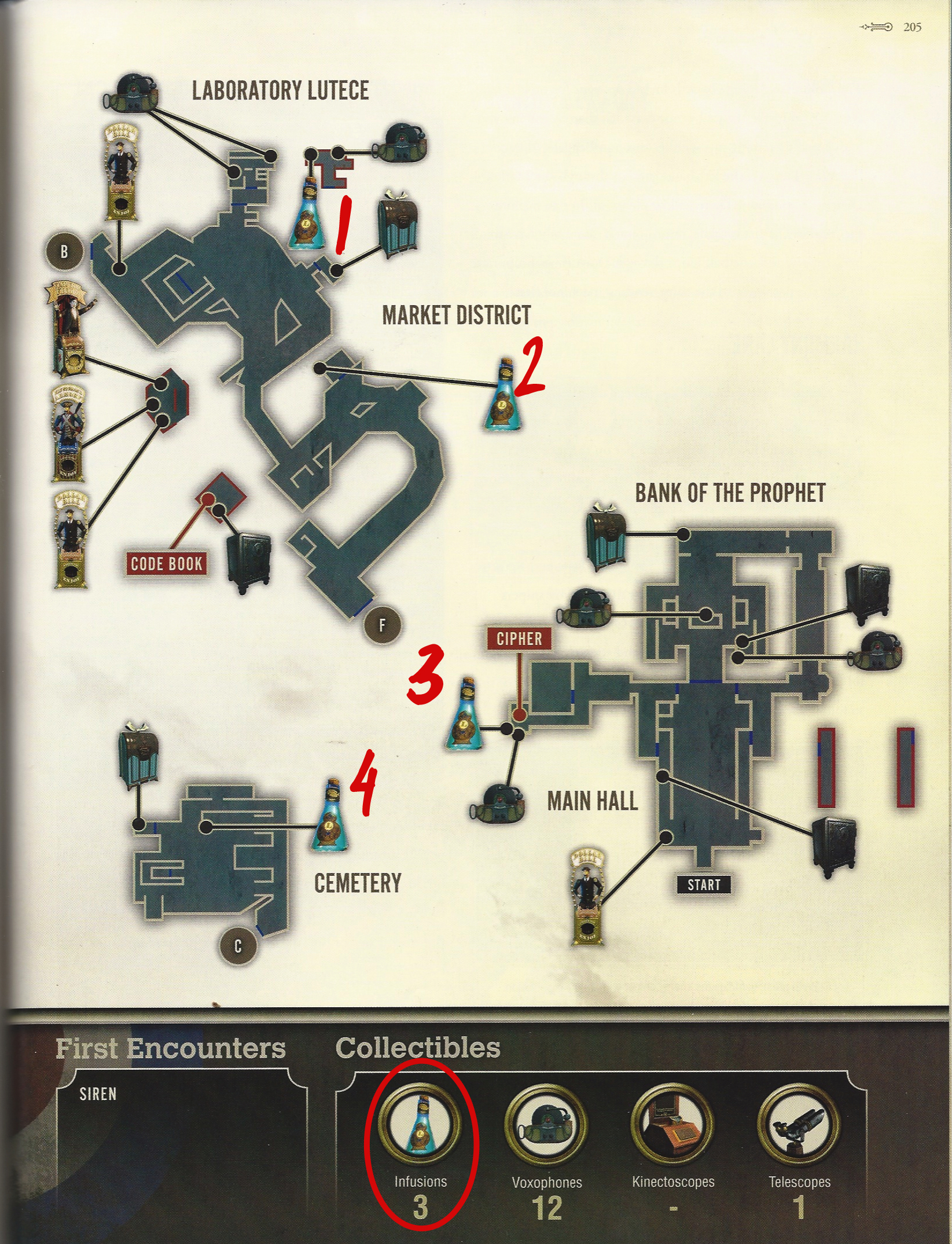
Infusion Problem with BioShock Infinite strategy guide

Something doesn’t add up…

That said, however, I never found every Infusion the game offered. When that Achievement didn’t unlock, I was honestly confused, as I could have sworn I found every single one the strategy guide pointed out. The game said I found 23 Infusions, and apparently there are 30, allowing players to max out all three levels for Booker. I assumed I didn’t follow the strategy guide as carefully as I thought, so I started to count the marked Infusions, and I noticed something rather intriguing.

  • Infusions marked on maps–22
  • Infusions listed in chapter summary (see bottom of image on right)–25
  • Infusions mentioned in written walkthrough–22

I counted each of these about three times, because I couldn’t believe how they didn’t add up. As I puzzled over it, I noticed that on a few occasions, the number of the Infusions shown on the chapter maps didn’t match the number listed in the chapter summary below the map, as shown to the right. No wonder I didn’t find them all; not all of them were even listed in the strategy guide! I had hoped that maybe there was an appendix in the back that listed all the locations, but no such luck.

I also can’t help but think if the guide writers or book designers had made call-out boxes in the written walkthrough depicting where each Infusion was hidden, like they did with the Kinetoscopes and Voxophones, perhaps the all of the Infusions would be properly marked. Then again, the walkthrough has so many call-out boxes as it is, perhaps it would have worsened the strategy guide’s overall presentation.

The strategy guide is divided by game chapters (which are separated by Achievements/Trophies), then again by mission objective and scene. Each new scene kicks off with its own map and collectible summary with the written walkthrough to follow. Sometimes the written walkthroughs for a scene are placed before the scene map, which makes following along with both the writing and the maps quite confusing. I couldn’t decide while playing if this was a result of how the game is and the book designers did the best they could or if this was just a bad strategy for the book. Sometimes it was definitely the former, the product of the game, and sometimes it was the latter. As a result, I found myself looking at the book more than I wanted, forcing me to pause the game more often than I wanted, just so I could attempt to find out where I was between the walkthroughs and the maps. I do blame how long it took me to finish the game on how much time I had to stop to read the strategy guide. I like strategy guides to make my game times more efficient, and I felt like this one greatly slowed me down.

The BioShock Infinite strategy guide is very, very hard for me to recommend. On the one hand, I found two-thirds of all of the collectibles with its help, unlocked all of the side quests, and I’m certain I found all the Gear in the game even though there was no Achievement to tell me so. I also really enjoyed the extra developer commentary that was sprinkled throughout, and I most likely didn’t die as often I would have without its help. At the same time, I’m really disappointed in the Infusion problem, and I can’t get over how often I got lost in the book, which took away too much time from the game. The BioShock Infinite strategy guide is definitely above average, but it’s not one of BradyGames’ best either.

SGR Rating: 3.5

Authors: Doug Walsh and Logan Sharp
Publisher: BradyGames
Editions Available: Paperback and Collector’s Edition
Acquired via Publisher
Filed Under: Strategy Guide Reviews

Gears of War: Judgment Strategy Guide Review

April 5, 2013 By Keri Honea 2 Comments

Gears of War: Judgment strategy guide reviewWhen Epic Games and People Can Fly announced that Gears of War: Judgment would implement a smart spawn system, thereby removing the possibility for players to memorize a level, I knew that the strategy guide writers for the game would have their work cut out for them. Whyile the smart spawn system wasn’t as extensive as I was led to believe, it still laid some tricky groundwork for the guide writers. Not to mention, each level would contain a Declassify mode, adding additional challenges for both players and the strategy guide writers to face. Of course, the strategy guide team at BradyGames was up for the challenge, and they knocked the Gears of War: Judgment strategy guide right out of the park. In fact, I enjoyed the strategy guide far more than I enjoyed the game itself.

In many ways, Judgment was structured similarly to past Gears of War games–large sections divided by smaller chapters. With Judgment, instead of breaking up the sections by scene, the sections are divided by who is testifying on behalf of the actions of Kilo squad. Within each bit of testimony, the section is broken up by 7-8 missions, which are more or less distinguished by scene. Each mission is extremely short by Gears standards; at the longest, they took me 10 minutes. At their shortest, especially if they were timed missions, they took less than four minutes. As such, you can see why the smart spawn system wasn’t as detailed as I had originally feared it to be; rather, what changed each time you visited the area was what enemies showed up. Don’t get me wrong, this still greatly changed my approach to getting through a level–defeating hordes of wretches is actually trickier than a team of drones and maulers. Because of this system, it was obvious that the writers played each level numerous times on the different difficulties so they could account for every possible scenario that would be thrown at the player. I would always know at the start of the mission what possible enemies could appear and where, even with the missions that had different waves of enemies.

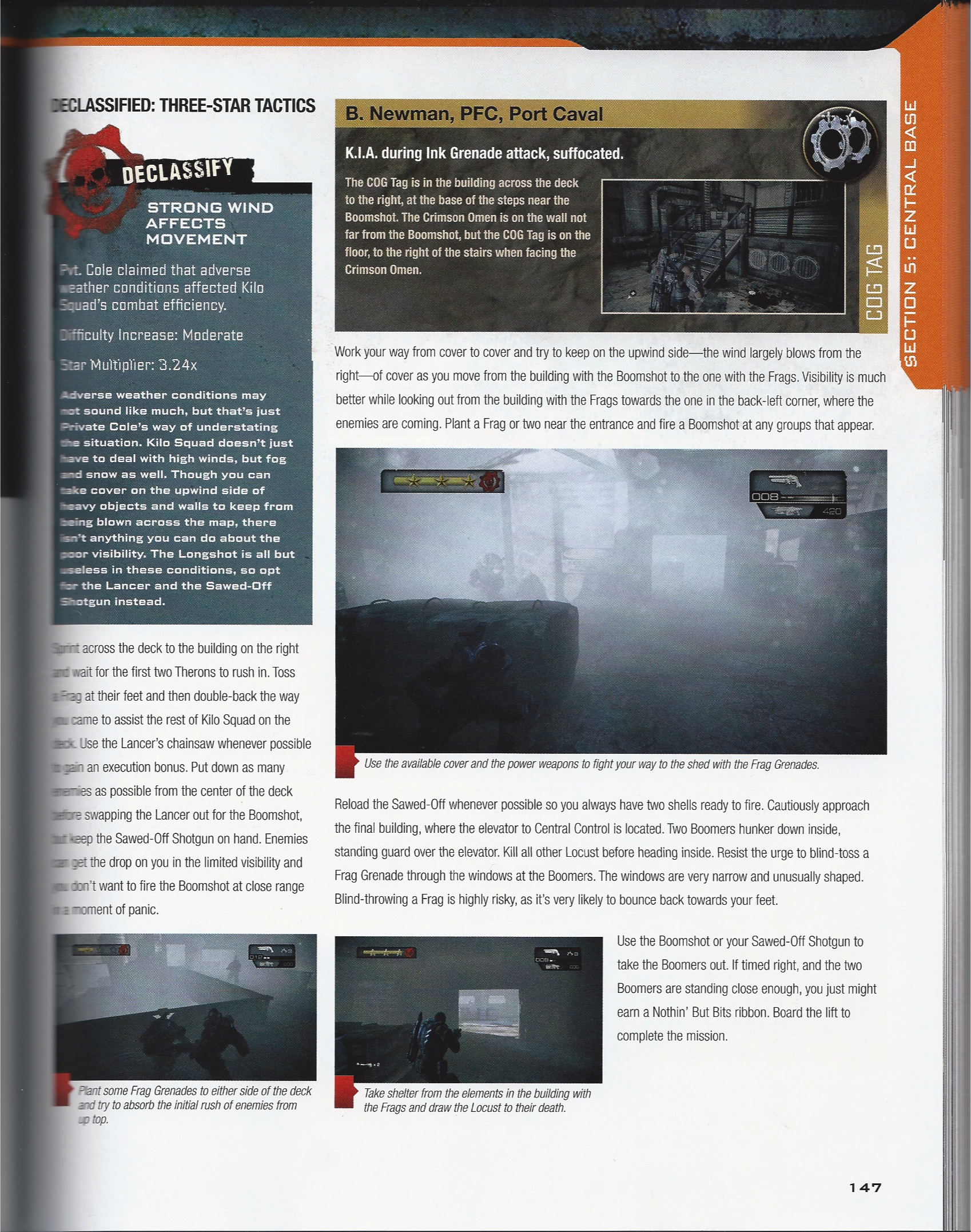
Gears of War: Judgment strategy guide

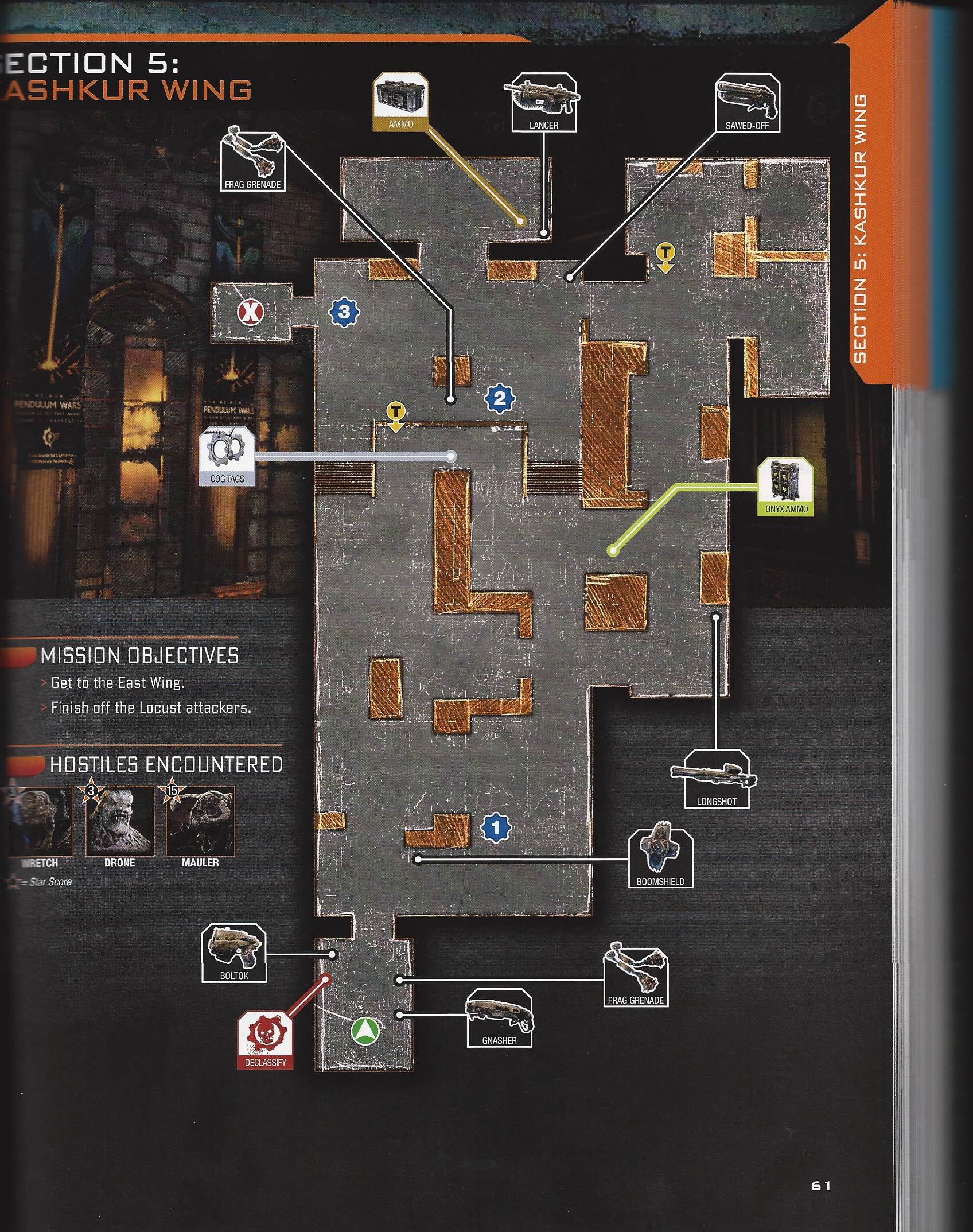
Declassify call-out box is super, super handy. Notice the call-out box for the COG tag? It will let you know if it’s feasible to snatch the tag during Declassify or not!

The point of Judgment is more of getting a three star award at the end of each mission for your performance than surviving the Locust forces, so the focus of the walkthroughs was on getting the highest ranking possible first, surviving second. It was kind of assumed that if you could get three stars, you would survive. Most importantly, the walkthrough always gave strategies for getting that three-star ranking without playing the mission as Declassified. When you turn the Declassified mode on, the stars fill far faster because the mode adds a greater level of difficulty. If you’re hunting for COG tags or you just don’t want to play Declassified right away, these strategies are crucial for filling up those stars. The fastest way to fill the stars is by earning ribbons, and the strategies are quick to tell you which ribbons are possible to obtain and the best way to earn them in rapid succession. Thanks to these tips, I was able to rack up at least two stars on every mission I played that I did not Declassify–as confusing as that probably sounds.

Since the Declassified mode added an extra set of parameters to each mission, such as adding a time limit, restricting weapons, reducing visibility, or adding more difficult enemies, the guide presented a separate call-out box with the Declassified mode details and its own strategies. I greatly appreciated this for two reasons:

  1. The strategy guide went into more detail about what the Declassified setting actually did than the game would. For example, the game, for one mission, said that Kilo had a reduced ammunition supply. The guide explained that this meant Kilo started with 30 rounds of ammunition for Lancers and there were no ammo boxes on the map.
  2. By knowing fully what I was up against beforehand, I could make an educated decision as to whether I felt like playing the level Declassified or not. I cannot stand time limits in any game, but I played a few of the Declassified missions that imposed time limits thanks to the strategy guide going over how difficult this challenge was, what the time limit was for each level of difficulty, and the level of gaming finesse you had to have to get through it. If the guide said you needed to be a master at performing head shots in quick succession, I skipped it. If the guide said you had to be fast, but by using this or this weapon, you could easily do it, I at least tried it. Believe it or not, I actually did most of the timed missions.

Gears of War: Judgment strategy guideAs I’ve said before, the missions are incredibly short, save for those in the Aftermath campaign, so the maps aren’t that entirely useful for the main campaign unless you’re hunting the COG tags or you REALLY REALLY REALLY need that Onyx Ammo box. That said, it didn’t stop the strategy guide team from creating some really detailed maps. I only found two flaws with all of the maps: one map was missing a COG tag marker, and another did not have the Declassify marker. At least it’s nearly impossible to miss the Declassify markers when traversing through the campaign, and I found that one wayward COG tag easily enough since all COG tags have their own call-out boxes in the walkthrough. (For the record, thanks to the strategy guide, I found all 48 COG tags in my first playthrough.)

Since Gears of War: Judgment itself is so incredibly short, and is not that difficult on a Normal setting with no Declassify modes activated, I cannot recommend the Gears of War: Judgment strategy guide if this is all you’re going to do with the game. However, if you want those COG tags (some are not easy to find, trust me) and you want those three-star ratings on harder difficulties with the Declassify mode turned on, then BradyGames’ strategy guide is your perfect companion to Kilo squad.

SGR Rating: 4.5/5

Authors: Doug Walsh, Michael Owen, Kenny Sims, Jim Morey
Publisher: BradyGames
Editions available: Collector’s Edition
Acquired via Publisher
Filed Under: Strategy Guide Reviews

Borderlands 2 Strategy Guide Review

October 11, 2012 By Chris Nitz Leave a Comment

Borderlands 2 Strategy Guide reviewAh Pandora, you do not even know how much I missed running around your barren lands while terrorizing your psychopaths. Now that I am back and causing Handsome Jack all kinds of issues, I can say I truly did miss the musing of CL4P-TP. Oh Pandora, what secrets do you have to hide this time around?

Well, now that I got that out of my system, let’s look at the Borderlands 2 strategy guide that BradyGames assembled for this highly praised sequel. The first few pages take players through the basics of the game. While I knew things like going for the headshot, elemental damage is a viable way to twiddle down health bars, and I need to shoot exploding barrels for extra bang per round, I did not anticipate the added notes and tables diving into greater detail and thus providing me an advantage before I even created my first character. This section is chock full of useful nuggets of info, and I returned a few times to make sure I understood the mechanics and utilized them to their full potential. There is a little something here for novices and veterans alike, so don’t skip it!

Damn the choices

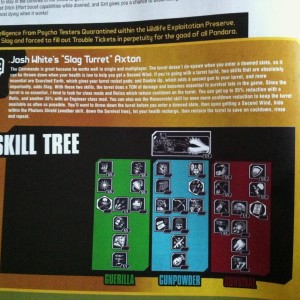
Next up in the Borderlands 2 strategy guide is the new Vault Hunters section, and this is something I encourage all players to spend a few moments with. Not only does this look at the four playable characters, but it goes into their skill trees and elaborates what the significance of each branch is and why one may want to invest points in it. This is immensely useful for preplanning, especially for anyone who wants to play with friends. Each character ends with a breakdown on strategies for solo play and co-operative play. The authors even dropped in a “suggested” skill tree to help ease indecisive players into the world of Pandora. I tested two of these suggested builds and found them to be fairly solid for both solo and co-op play. I did modify them after some time to suit my play style, but as a starting point, they are an easy way to alleviate some of the confusion on how to best optimize each character.

Now that a new Vault Hunter is born, it is time to scour the world of Pandora for clues, and this is where the walkthrough becomes as useful as one well placed headshot. Each new area starts with a map that details where to find items like save points, Cult of the Vault markers, bosses, and ammo/life/cars. The pages that follow go into how to obtain those accursed Cult of the Vault markers, how to battle bosses, and details for the main quest line in that area. A nice perk is that each new mission has a small blurb detailing the objective, XP, money, and suggested level, thus making it quick and easy to determine if this is something to tackle now or hold off on for a few levels.

I ended up using the maps in this section quite frequently. They not only helped me get to each Vault marker, but they aided me when I ran out of ammo for my favorite pistol or stumbled upon a data recorder. I did have trouble every so often understanding how I was supposed to get to specific points to nab a Cult of the Vault marker or hidden data recorder, but the included screenshots added visual reference points that eventually got me going in the right direction. Another nicety is that each boss encounter includes strategies for completing the specific challenges for all four of the playable characters, which is a great way to add just one more Badass Point to the list.

What did drive me nuts is that the optional missions don’t sit in the main walkthrough, but rather after it. This ended up leading to a lot of flipping back and forth so I could look at the map and then jump back to read details of each side quest. To add to that frustration, the optional mission section is listed in alphabetical order, and it makes for hunting down details on what to do almost as confusing as finding the Vault itself. I firmly believe that this should be incorporated into the main walkthrough as it makes for an easier time completing everything in one area before us completionists move onto a new segment of the game.

Classified my ass

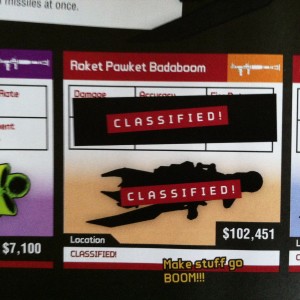
While I can excuse the segregation of main quests from side quests, I have a harder time when it comes to the weapons portion of this guide. There is some great info on what each weapon type does and why a player may choose it for various encounters throughout their time in the game. However, there is too much “classified” information in here. People that buy a strategy guide don’t do it to have chunks of info excluded, and that is exactly what BradyGames does with select items here. I want to know where I can buy the Raket Pawket Badaboom and the specs on it, not be shafted with knowing it exists but it is classified. The section is still nice, but that lack of info is just a punch to the face.

Redemption comes in the last few portions of the Borderlands 2 strategy guide, starting with a fairly complete Bestiary. I believe that every enemy I tried to find from the game came with a brief description along with a table breaking down how their life changed in multiplayer, damage, XP, critical hit area, and any weaknesses they may have. This also includes where the enemy resides and what, if required, optional quest it is on.

Following that is the secrets section, which includes how to unlock every new head for those who want to customize their characters even further. There is also a heap of tables breaking down all of the challenges in the game, and that includes all of the level specific challenges. Anyone looking to maximize their badass points, this is the section to study like a college kid cramming the night before a big final. Completing this is the obligatory breakdown of achievements/trophies and their associated point values.

There is a small portion dedicated to easter eggs that I am still trying to figure out how I feel. The guide mentions them, but it doesn’t tell you how or where to get them–AT ALL. On one hand, this is a strategy guide and I expect all information to be covered throughout the guide. On the other hand, finding an easter egg in the game is fun and adds to the exploration. The jury is still out on just how good or bad this is.

What I found this guide lacked the most was some form of index or detailed table of contents. Sure, the side missions come sorted alphabetically while the main walkthrough follows the game chronologically; however, there is still no easy way to quickly find specific info. This ultimately ends up with a lot more page flipping and hunting than is necessary in a guide with this much content scattered about.

Quotes from the devs are a nice touch

At the end of the day, I found the bulk of the Borderlands 2 strategy guide rich with detail and entertainment. I love the fact that BradyGames included character art and developer quotes throughout the pages. They once again did a great job making the guide feel as though it were part of the game and not just some secondary accessory. I still cannot excuse shafting players with “classified” info, but that is in a relatively small portion of the book yet it is still info that consumers pay for. However, this is a solid buy and I can still recommend it to any hunter. Now, I must go back to blowing the heads off some Psychos!

SGR Rating 3/5

Author: Doug Walsh & Joe Epstein
Publisher: BradyGames
Editions Available: Hardcover and Paperback
Acquired via Publisher

Filed Under: Strategy Guide Reviews

Diablo III Strategy Guide Review

June 21, 2012 By Blake Grundman Leave a Comment

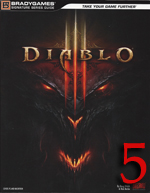
Diablo III strategy guide reviewWhen setting out to review a game with the depth and breadth of a Diablo III, the authors have to be approaching the task with a hole in the pit of their stomach the size of the Grand Canyon. Not only is this the highly anticipated sequel to one of the most successful–and still widely played–PC games of all time, but it also contains a level of complexity that is unparalleled amongst its peers. Oh, and let’s not so quickly forget that the game has been in development hell (no pun intended) for over a decade. Suffice to say that BradyGames had their work cut out for themselves with their Diablo III strategy guide.

By virtue of Diablo III randomly generating everything from level layouts to enemy positions to loot drops, it is amazing that the guide is as comprehensive as it is. Their key seemed to be setting aside the unknowns and focusing on what will always remain the same, namely, the different character (hero) classes, the numerous enemy types, and the seemingly never ending well that is Blizzard’s loot chest. From there, the authors continued to drill down until they hit pay dirt in a big way.

The book starts out by breaking down all of the game’s core mechanics in a level of detail that would leave even a Diablo virgin (God help your poor soul) feeling like a Rhodes Scholar. Among the key elements detailed are leveling, choosing what loot to gather vs. discard, managing and picking effective party members, and online coop play. There is even a specific section dedicated to ancillary party members, their specific perks, and what skills they will learn as players level. And here is the scary part: this section only represents roughly about 3% of the overall text.

Next up is the absurdly deep analysis of each of the five hero classes. Each hero is split up into sections discussing the character’s specific weaponry, armor, and skills. Further exemplifying the insanity of depth in the guide, every skill, both actively employed by the player and unconsciously applied to modify status effects, are given the utmost attention. Details passed along are things like levels unlocked, tactics that can be applied to its use, runes that will have an additional effect when equipped, and the five additional permutations to the skill that can be unlocked and applied throughout the leveling process. Everything is present to help players make the best possible decision with their characters, plus a little bit of added clairvoyance as to what can be expected as the game progresses.

What follows this up is the actual walkthrough of every one of the campaign’s thirty-one quests. Each mission is broken up into its individual objectives, with vague details about what can be expected intermixed throughout the text. It seems as if these sections are specifically worded to avoid being a specific “point A to point B” walkthrough. As a reminder, the maps, enemy positioning, and loot containers are randomly generated, so the only specifics that are passed along are new enemies that may be encountered, the steps in between objectives, and basic strategies for accomplishing each quest’s few scripted encounters. Be sure not to forget to pay special attention to the bonus objectives that are spelled out, because the additional loot drops and experience net could pay off down the road.

One thing that the guide does exceptionally well is calling out boss encounters and providing players with the best approaches to slaying the usually overpowered adversary. The enemy’s expected hit-point count, XP level, and attacks are spelled out explicitly, along with their special traits and resistances. This is one of the rare areas where specific strategy and tactics are provided to the player, which can in turn prove to be tremendously helpful.

After digging through four acts worth of campaign direction, players are most likely curious about how they can apply their specific skills and items acquired throughout. For this reason, it only makes sense that the next area breaks down the different artisans and crafting options at the player’s disposal. Though you can go through the entirety of the game using only dropped loot, sometimes it is good to know what other options are available and when these elements can be upgraded.

Did you know that all of those goofy generated item names like “Chilling Bow of Infinity,” actually mean something extremely specific under the hood? Despite sounding like complete gibberish to most, the next section breaks down every item, as well as its specific pre- and post-fixes, to paint the complex picture of what is nothing more than glorified spreadsheet math. For those with the propensity to dig into these agonizingly complex details, looking for the perfect piece of loot, there will be more than enough to sink your teeth into. Along with spelling out the specific item modifiers, each base weapon is examined, pointing out its required level for use, damage per second, and other min-maxing data that moisten the loins of gamers that work as accountants during the daylight hours. Lastly, all armors and legendary drops are examined, following the trend of providing more than enough numerical stats to make a hardcore fan’s heart skip a beat. Don’t get us wrong, having more data at our disposal is not a bad thing, it’s just an overwhelming amount of information to tackle when it’s staring back at you from the page.

The final major section of the guide is dedicated to the uncountable number of foes that can, and will, be encountered through the expansive campaign. Each and every named adversary is looked at, in alphabetical order, sharing critical information such as likely locations where they can be encountered, their levels and hit point counts, damage that can be administered, and special moves, all seperated by difficulty level. Once again, if you are a person that loves to pour over statistics, you will have years’ worth of digging at your fingertips.

While looking through the ridiculous amount of information contained in the book, despite it being downright impressive, it was hard to shake a single lingering worry: What if the first update turns all of this data on its head? The game has already seen three updates, one of which is supposed to address the balance and difficulty. It will be interesting to see if these figures still hold true six months, hell, even six weeks from now! But this is a risk that you have to be willing to take when investing in the medium of print.

Regardless of whether the statistics are still valid down the road, this is still a solid companion to anyone who would be considered to be a hardcore Diablo fan. The use of art scattered throughout is exceptional, the layout is streamlined and well thought out, and the written text reads like a well informed textbook. Simply put, this is a must-own for everyone who has eagerly started a second playthrough of the game or collectors who strive to expand their knowledge of the universe. There is more than enough to satisfy everyone, so get out there and raise some hell!

SGR Rating: 5/5

Authors: Doug Walsh and Rick Barba
Publisher: BradyGames
Editions available: Paperback and Collector’s Edition
Acquired via Publisher
Filed Under: Strategy Guide Reviews

NIER Strategy Guide review by Doug Walsh and Joe Epstein

May 22, 2010 By Keri Honea Leave a Comment

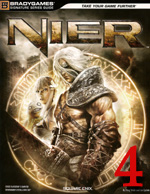
NIER Strategy Guide by Bradygames Strategy Guide Review Policy:

My goal for these strategy guide reviews is not to discuss whether one needs the guide to complete the game. Every gamer has different strengths and skills, and one may need every bit of a guide, another may need to look up information for quick assistance once, and another may laugh at the idea of ever using a guide, even the online freebies. My goal is to determine whether the guide is 1) helpful in the first place, 2) does it encompass gamers who need hand-holding as well as those who need a quick reference and 3) how much information does it really have.

Review:

NIER is pretty much a game about killing things, something Nier himself says numerous times. It’s mindless hack-and-slash most of the time; so much so that level grinding is not required. Doing as many sidequests as possible helps your stats for sure and gives you rather nice weapons, but Nier will get extremely powerful (or as the guide says, fiendishly powerful) on his own. As such, the guide doesn’t have that much to offer in terms of walkthroughs – which is fine because no one will really need them – so the authors, Doug Walsh and Joe Epstein, structured the guide to help players get the most Achievements/Trophies as possible. A large handful of the Achievements are focused on defeating the end bosses within a specific time limit, and one Achievement is strictly for beating the entire game in less than 15 hours. In other words, Walsh and Epstein focused on producing the quickest strategies possible.

For example, the sidequests slowly unlock throughout the game, and several unlock at times when you really can’t do anything about them at the moment because either the location hasn’t opened up or the person you need to talk to isn’t available at the time. The guide’s sidequest section is quick to point out when is the best time to take on each sidequest so Nier can do it immediately and not waste time. If he’s asked to go pick up some crystal, the guide will tell you not to travel to that person to activate the sidequest until Nier has access to the markets in Facade, where he can buy crystal instead of trying to hopefully gather it somewhere in the field.

There are also giant appendices in the back of the guide that provide stats, tips, and the fastest methods to become a fishing master or grow a green thumb. I did not try to grow the legendary Lunar Tear or cross-pollinate to create pink moonflower seeds, but I am sure if I followed the guide’s steps and tricks to speed up time, I would have had little difficulty (I still would have thought the process was a complete waste of time, but that’s a story for another day).

However, I did have a few difficulties with the guide, which is why it received a 4 instead of a perfect 5.

The first one was with a map of the Junk Heap in Part Two. The elevator was marked incorrectly on the guide map, and I was backtracking all over the place trying to find it. I became convinced that I was trapped in this section, because obviously, there was no way out. The one good that came of it was all the experience I received from smashing robots and all of the items I collected (I found enough broken antennas to build my own city). An inaccurately marked map is a rookie mistake, and it never should have happened, no matter that it didn’t get me killed or eternally lost.

I also had issues with two of the sidequests, and both were in Part Two. The quest “Contract for a Contractor” required Nier to pick up a few items that could only be found in the B2 level of the Junk Heap, but the guide never once said that Nier couldn’t reach that area until a certain point of the game when he acquires access to that floor. Yet again, I was running all over the place, trying to figure out where this mystery elevator was that could take me to B2. The second quest, “The Pride of  a Lover” needed some fluorite from the Barren Temple in the desert. The guide told me exactly where to go to find it and even provided a screenshot of the location, but after combing the room for far longer than I should have, it became apparent that the fluorite doesn’t appear in the same place in the Temple each time you play. I found it on a completely different floor than the guide suggested. I really can’t fault the writers for this, because they would not have known or even thought to have check that the fluorite was always there.

The fact that all these problems stem from Part 2 makes me think that the writers or even the publisher got a little rushed toward the end. Even though these problems did not ruin my experience with the guide or the game, it is the little things that keep the NIER Strategy Guide from perfection.

Filed Under: Strategy Guide Reviews

  • « Previous Page
  • 1
  • 2
  • 3

Follow us!

Subscribe!

Upcoming Strategy Guides

 Nothing here. Come back later. 😢

Latest Strategy Guide Reviews

The Walkthrough by Doug Walsh Review

Red Dead Redemption 2 Strategy Guide Review

Mega Man 11 Strategy Guide Review

God of War Strategy Guide Review

Far Cry 5 Strategy Guide Review

Friends of SGR

  • BradyGames
  • Dan Birlew – Guide Writer
  • Doug Walsh – Guide Writer
  • Future Press
  • Game Enthus
  • GameWires.com
  • Piggyback
  • Press the Buttons
  • Prima Games
  • Racing Games

Top Posts & Pages

  • Scribblenauts = Happy
  • Been Jonesing for some RPG Action
  • LEGO Star Wars III: The Clone Wars Strategy Guide Review
  • Monday Gaming Diary: Happy Memorial Day!
  • The Corner of Randomness: Extra Life is Done

Copyright © 2026 · Web crafted by Warkhammer


Loading Comments...