Titanfall Strategy Guide Review
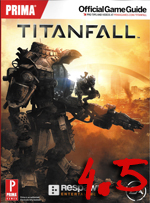 It goes without saying that the folks over at Respawn have been fighting an uphill battle since the studio’s inception. Originally birthed out of the strife and subsequent implosion of Call of Duty developer Infinity Ward, Respawn set out to create a new IP that bank in on what the team’s design strength: multiplayer. And thus, Titanfall was born, as an online-only multiplayer FPS. Can Prima Games’ Titanfall Strategy Guide manage to live up to the high standards established with their well crafted Battlefield 4 guide or will the print version fall victim to the constantly evolving state of online titles?
Before even cracking the cover of the Titanfall Limited Edition hardcover guide, it would be a tragedy to overlook how fantastic the exterior of this book looks. The sleek cover art spans across both the front and back of the binding, featuring an amazing rendition of a hulking Titan, with its pilot perched on its arm, overlooking a sun-bleached cityscape vista. The game’s title is the only typeface on the cover, and only appears in the top-right corner as an afterthought, probably in an effort to not draw attention away from the amazing piece of artwork
Cracking the cover treats the reader to a beefy behind the scenes look at Titanfall, clocking in at more than thirty pages. There are interviews with several key members of the development staff, including the likes of Respawn CEO Vince Zampella, Lead Artist Joel Emslie, and Game Director Steve Fukuda, just to name a few. The very thoughtfully constructed section provides an impressively candid look behind the curtain that runs the gamut from talks about the difficulty of starting a new studio and IP from scratch, to admissions of moral issues early on in the development process. Each interviewee has a series of questions that are structured around their specific role on the project, which ends up painting a very in-depth picture of the entire game, from damn near every angle possible.
Of course, both in-game assets and concept art are interspersed throughout the intro. The layout of this particular segment of the book is very flexible, adjusting margins and column sizes to give extra room for artwork to “breathe,” while still not giving the impression of excessive white space on the page. Overall, this turns out to be one of the better featurettes in recent memory.
After all of the fun has come to end, it is time to get down to the nitty gritty and tear into the actual introduction. The next fourteen pages initiate the reader into the game, its universe, and the mythos surrounding the conflict that players are dropped into. This wraps up with the actual campaign overview, which also marks the first actual advice that the book doles out, in the form of light team tactics recommendations on each stage of the “storyline.” The matter-of-fact presentation of this information almost trivializes the mission’s objectives, instead opting to point the reader in the best way to accomplish an overall victory by working together as a team. This guidance seems to work fairly well if team members are on the same page, but it is also far more effective when used in tandem with the later map section.
Ironically, all of this information has been dolled out, without ever explaining to the reader the core game mechanics and controls. That actually comes as the very next segment of the text. Though it can almost be assumed that if you are playing Titanfall this isn’t your first FPS rodeo, it still seems like this “Pilot Certification” section may have been better served appearing in the introduction, before actually delving into information about the campaign structure. Key concepts like the control scheme, and a rundown of each stage of the pre-game tutorial make up the majority of the next twenty six pages
An important area not to miss in “certification” is the breakdown of the new mechanics introduced by using Titans like effective shield use, the three different equipible tactical abilites, and titan auto-pilot. Also be sure not to miss out on information about the persistent elements such as burn cards, loadout customization and minion usage. There are several invaluable “Developer Tip” callouts that further detail what otherwise might be considered mechanics that you would have to experience in-game first, in order to fully understand. Newcomers should be sure to get all they can from these very valuable chunks of information. Lastly, the different combat scenarios such as “Titan vs. Pilot” or “Pilot vs. Minion” are all spelled out, from both side of the conflict. The tactical information provided is the kind of evergreen advice that would only otherwise come from logging countless hours of trial and failure. Taking a few of these notes to heart before stepping foot in the multiplayer will help to shave hours of unnecessary frustration from the reader’s life.
Tactical information then gives way to over fifty pages of information about the different pilot classes, their specific strong suits, and Titanfall’s impressive lineup of on-foot weaponry. Most firearms are given an impressive two pages of real estate, to give the reader an in-depth analysis of strengths and weaknesses, the in-game unlocks associated with the item and kill counts of how many shots it takes to kill equally sized adversaries, when aiming at either the head or torso. There are also performance charts that give general info about damage, accuracy, range and rate of fire, but there are no pieces of numerical data to back up the chart’s scale. Most likely this is a conscious choice, made to keep the information in the guide relatively correct, even after the development team makes balance adjustments, post-release. This is a clever way to get around this obvious shortcoming of print media in a digital age, but the lack of any sort of scale somewhat renders these graphs moot.
“Pro Tips” from the guide’s team of writers/pro gamers or developers usually lead off the second page, and contain key tidbits about how the weapon in question’s effectiveness can be maximized through uses of different modifications or burn cards. This is all concluded by a list of every challenge and the number of experience points that are rewarded for completing said task, for that given firearm. All-in-all, though some of the information is purposely vague to avoid being rendered invalid over time, there are still plenty of reasons to read up on your gear of choice, in order to craft the perfect loadout for the reader’s specific style of play.
Wrapping up the pilot analysis are a series of custom designed loadouts, meant to emphasize the different playstyles that can be used in teamwork scenarios. Featuring names like “Defender” and “Hacker,” it is pretty easy to figure out who these bundles are targeted. What is more interesting is checking out the profession players’ loadouts. These tend to be more eclectic hybrids, that straddle the line between playstyles, but provide much more flexibility in a evolving game scenario.
The same level of detail applied to the pilots and their weaponry is also applied to the different titans and their weaponry. Different customizable titan elements such as kits, chassis, and ordinance join the typical weaponry sections. These are laid out very similarly to their equivalents in the pilot portion of the text, with the exception of lacking the pro tips callouts. Easily the most valuable portion is once again the concluding loadout suggestions for each mech. Considering that this is a fairly new experience for multiplayer shooters, both newcomers and veterans of the genre will find plenty of new information to glean from these scant four pages. But good things in live come in small packages, right?
Then we get to the actual meat of the guide: maps. One hundred and eighty of this guide’s three hundred and thirty pages, which is well over half of the book for those of you keeping track at home, are tied up in map analysis. This is not a bad thing by any stretch of the imagination, especially given the lack of any form of genuine single player content in the game itself. It just helps illustrate how this guide very much lives by the mantra, “a picture is worth a thousand words.”
Every map in the game is led off with a two primer containing a kill/death heatmap, giving the reader a basic idea of where most of the slaughter will take place and a full page, top-down view of the map. From the map, there are a series of key landmarks that are called out in image form along the the binding of the left page, but not explained why they are so important. Be sure to remember those points, because they will come in handy in the pages that follow.
Once the foundation has been laid, the same layout of a blown up and numbered map on the first page, flanked with a legend at the bottom, and second page of tactics are repeated on loop five times. Why five times, you ask? This is done to emphasize the different strategies for each of Titanfall’s five core modes. It is a testament to Respawn’s forward thinking design that this is so necessary, but in each case there is very little repeat in the strategy sections between each mode. Make sure to take note of the pro tip callouts, because it tends to give a bit of a glimpse into the mind of a high level player. If readers can begin to think like like these skilled players, they will ultimately be a better teammate. Also, be sure not to miss the zipline location and parkour hints embedded throughout. Utilizing these moves take a bit of practice, but have the potential to provide players with an instant jump on the competition.
Bringing the guide to a close is the standard quick reference guide of achievements, experience scoring charts and reprints of details on the different burn cards. In one neat conclusion, the last page before the credits is crammed full of last minute developer tips, not already included in the text. Though some of these concepts are rather simplistic and almost, “well, duh…” there are enough gems scattered throughout to warrant a quick skimming.
The last of the lose ends in regards to Prima’s Titanfall Strategy Guide is their online based eGuide. Unlike the previously reviewed Plants vs. Zombies: Garden Warfare guide, it Titanfall counterpart seems far more up to date. All of the maps included in the Expedition map pack have been added to the guide, though they have notably left out strategies for the Attrition and Pilot Hunter gametypes. Maybe the maps don’t support these modes, but it would have been nice to see some sort of explanation in the primer as to why they are absent. It is also worth noting that Respawn went on the record at E3, stating that at least two new modes will be coming to the game this fall. Hopefully all of the existing maps included in the book, as well as in the DLC will be updated with new coverage pertaining to these modes. However, given their hit-or-miss updating history of eGuides, I am not holding my breath.
The sum total of the Prima Games’ Titanfall Strategy Guide ends up being one of the more helpful guides released, as of late, while still providing a very stylistic presentation. The book’s effective use of art to both illustrate key points as well as just showcase the game’s fantastic artwork is what helps set this apart from other, more lackluster efforts. When combined with the great guidance from professional players as well as the developers, this is the perfect companion to any aspiring Titan pilot. Hopefully its electronic incarnation will continue to evolve with new DLC and uphold the same level of quality put forward in this stellar guide.
SGR Rating: 4.5/5
Author: David Knight and Michael Cavanaugh
Publisher: Prima Games
Editions available: Paperback and Hardcover
Acquired via publisher
One A Wednesday: Favorite Turn-Based RPG
Lost Odyssey was the big reason why I wanted to get an Xbox 360, and I’ve never regretted any of it, especially not the 80+ hours I played nor the countless tissues I went through. No other game has affected me as emotionally as that one, and that includes The Walking Dead.
Watch Dogs Strategy Guide Review
 The world of Watch Dogs is a pretty big place. Start wandering the streets of Chicago as Aiden Pearce and it won’t be long until a compelling event draws the player’s attention. It could be a main story mission, it could be a side mission, it could be a mini-game that does it. It could be one of the mysterious investigation prompts scattered all over the city. It could be an online invasion or a digital trip. There’s so much to do in the city that it’s easy to become overwhelmed and a bit disoriented. How does one cut through all of the dazzle to the heart of a mission? Prima Games has put together a surprisingly detailed strategy guide for Watch Dogs which outlines not only every main story mission, but all of the extra side material as well. It may not be necessary for everyone, but the Watch Dogs strategy guide can be an indispensable companion to those who use it properly.
I wanted to explore Chicago on my own terms and at my own pace, so I made it a point not to over-rely on the strategy guide. I wanted to be surprised by every trick and curve the game tossed my way, so my method was to attempt a mission, feel free to fail it a few times, and only turn to the strategy guide if I was absolutely stumped. The first time I flipped open to a trouble spot, I was immediately impressed by the writing structure. The instructions don’t just outline how to complete a mission, they are presented in multiple play styles. Where applicable (which is most of the time), there are a variety of ways to complete a task based on the player’s preferred method. Do you go in guns blazing? Would you rather sneak around in the shadows to dodge enemies? Maybe you’re more the type that would rather climb up high, look down on the area, and remotely control the objects down below. No matter how you want to progress, the strategy guide lists a detailed set of directions for each mission and notes the approximate difficulty of each method. I was impressed by the attention to detail, and most of the book is made up of this section. Naturally there were parts of each mission’s guide that I did not use since I had to choose a method and see it through to the end, but I would rather be overprepared than underprepared.
There’s more going on in this strategy guide than just detailed directions. There’s a handy chart of all of the drivable vehicles in the game, a list of all key hacking locations, a guide to the online contracts mode, a set of basic tips for controlling Aiden, overhead maps of key areas marked with helpful icons to identify useful items and vantage points, and appendices listing available experience and skill points. Essentially, this strategy guide blows the game apart and details everything you’d need to know to take Chicago by storm. There’s even an access code included to reach the online ebook version of the strategy guide that is updated as new downloadable content and patches are released.
It’s difficult to criticize the strategy guide for its informational content, but I do have an issue with how it’s presented. There’s so much information packed within the strategy guide, so much splashed on to every page, that it’s difficult to find the exact mission I needed help in completing. I spent more time turning pages than I did actually reading them. Worse, when trying to pinpoint exactly which page I needed, I often overshot my destination and ran into spoilers. There are color tabs printed on the side of the actual book to give a quick guide to which section of the book is where, but all of the main mission pages are noted by the same yellow color. I’d have preferred for the mission pages to be further denoted by different colors for each act so I wouldn’t accidentally stumble across a major story point beyond where I intended to read. It’s a small problem, admittedly, but what good is information if I can’t access it easily?
Overall I found the Watch Dogs strategy guide to be highly useful if a bit difficult to locate what I wanted to know quickly. That said, with so much to do and so much ground to cover, it’s helpful to have a printed co-pilot offering advice when needed.
SGR Rating: 4/5
Author: David S.J. Hodgson
Publisher: Prima Games
Editions available: Paperback and Hardcover Collector’s Edition
Acquired via publisher
Mario Kart 8 Strategy Guide Review
 If there is one game worth putting a Wii U on the “Must Buy List”, I’d have to admit that Mario Kart 8 is that game. The amount of fun I am having with this title is ridiculous. Heck, it even brought on a rash of Luigi Death Stare videos. For kart racing fans new and old that, it’s time to practice your best drifting skills while checking out the Mario Kart 8 strategy guide from Prima Games.

They’re so cute when they’re young!
The guide starts with all the basics, and this is one stop everyone will want to take as the controller breakdown is here. This game allows for five different control schemes on three controllers, which can be daunting if you’re trying to figure out which setup is best for you. After that, it is all about the mechanics of the courses. Things such as boosting, gliding, the new hover mode, and item descriptions find blurbs here. What really impresses me are the charts detailing what the chances are of acquiring a specific item depending on race position and game mode. This is something I still come back to study as I try to work on my online score.
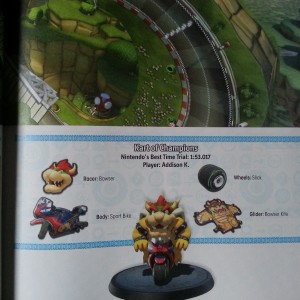
Once the basics are done, it’s onto the racers, karts, and kart customizations. Characters have small descriptions that give readers an idea of how that person will behave on the track. This also includes all the unlockable drivers. No Stig wannabe is complete without a killer ride, and this is where the kart area comes into play. I enjoyed seeing all the options I would have available, and it made me want to play more just so I could unlock a specific tire to go with my Wild Wiggler kart body. Of course all the bodies, tires, and gliders contain stats on where they excel and where they lack in performance or handling. If nothing else, this is just a fun area to look at and play master designer while eating a bowl of cereal.
The bulk of the guide goes into the races themselves. Tracks are broken down by cup and then by new or old course. Each stage begins with details on what to watch out for, such as no guardrails or obstructions on the road. Complimenting this is a suggestion on what the best racer and kart setup is. From there the track is then handled by Grand Prix more or Time Trial mode, both with correlating maps depicting the changes based on mode.
But Shy Guy is sooooo much better!
This is the area readers will want to pay attention to the small snippets of info. Those that are having a difficult time beating a specific stage will find where shortcuts are hidden, where the best points to boost are, and if it is worthwhile to glide a long distance or just land quickly to obtain a coin or item box. While nothing a book says can improve skills on the track, it is nice to see where the shortcuts are so I don’t look like a fool bouncing off something that I thought was an advantage, but was merely a fence….or worse, the ledge to the pit of doom.
The last few pages go to the battle mode and the maps correlating with it. Those who want to collect every stamp the game has to offer will also find a full list of those so you can keep track of what is left to collect.
My biggest issue with the Mario Kart 8 strategy guide is the navigation of it. I find it would have been useful to color code the sides of the pages to match what cup they were focused on. I spent too much time flopping around trying to find a specific cup, and then hunting down the track on top of that. It’s a small gripe, but one that would have made things easier on the reader.
To those who are just starting to consider jumping into this fun racing world, well, just buy the Mario Kart 8 strategy guide. Sure, your spot on the leaderboard will still depend on your ability to master the fundamentals, but you’ll be well ahead of the curve in knowing each track and how to tackle it. Even if it is as simple as picking the suggested character for a course while you unlock everything, this guide is well worth the investment. I think it’s time I go give more people that Luigi Death Stare!
SGR Rating 3.5/5
Author: Alexander Musa
Publisher: Prima Games
Editions Available: Paperback
Acquired via Publisher
- « Previous Page
- 1
- …
- 15
- 16
- 17
- 18
- 19
- …
- 40
- Next Page »