• Home
  • About Us
  • Podcast
  • Strategy Guide Wit
  • Contact

Strategy Guide Reviews

A Strategy Guide for your Strategy Guides

  • Reviews
    • Strategy Guide Reviews
    • Video Game Reviews
    • Mini-Reviews
  • Features
    • Interviews
  • News
  • Unboxing Strategy Guides
  • Columns
    • Gaming Diary
    • Corner of Randomness
  • Videos

Dungeon Siege III Strategy Guide Review

August 11, 2011 By Keri Honea Leave a Comment

Dungeon Siege III Strategy Guide ReviewDungeon Siege III is a creation of Square Enix and Obsidian, although neither worked on the first two games. There wasn’t a lot of hype for the game, which could be partly Uwe Bolle’s fault for producing a horrible movie about the original game, which is a shame because the action-RPG is actually quite fun. Despite many people’s misgivings about Obsidian’s hands in the game’s development, Dungeon Siege III turned out to be a beautiful and highly enjoyable game. Prima Games’ strategy guide for Dungeon Siege III turned out to be the same: beautiful and highly enjoyable.

The Dungeon Siege III strategy guide implemented my two biggest requirements for any strategy guide beautifully: maps and easy-to-follow walkthroughs that include sidequests.

Until I realized that I could turn off the auto-camera for the mini-map in my upper right corner, the maps in the guide were a godsend. Since the mini-map turned whatever way I was facing, I got turned around a lot, especially in the underground areas (*coughdungeonscough*). At least with the maps in the strategy guide, I could see that I needed to head west and then just follow the marks on the mini-map compass. The maps were clear, easy to follow, and all chests were clearly marked. Can’t really ask for much more than thatn.
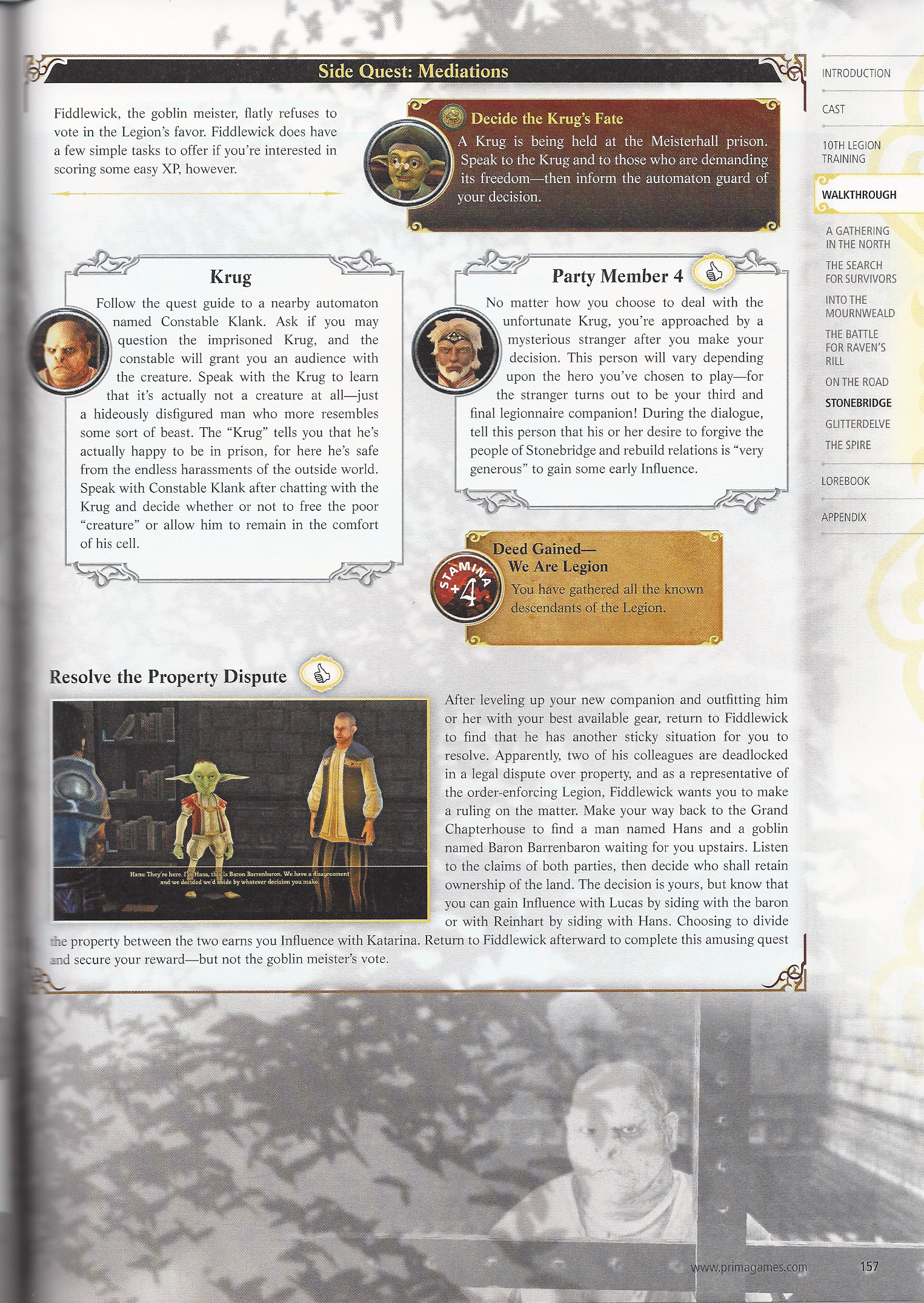
Dungeon Siege III strategy guide pageAs for walkthroughs, they were 100% spot on. DSIII is an action-RPG that is well, quite linear, so while it’s fairly impossible to not find where you’re supposed to go to advance the story, it is very possible to miss out on sidequests. And what is an RPG without loads of sidequests? A very short story that will be next to impossible to complete. If that isn’t enticing enough, there’s also a Trophy/Achievement for completing all of the sidequests along with completing the game. Here is where I put the strategy guide to the test, because if I missed out on that Achievement, well, I probably don’t need to paint that picture for you.

Long story short, I snatched up that Achievement with ease, and I owe a lot of it to the guide’s help. Numerous sidequests were in areas I didn’t think of going–even while exploring–and at times, I never would have found the goal of a sidequest due to its obscure location.

Another element the game focuses on is this idea of Influence with your party members. Players gain influence with other characters by the decisions they make, whether they are plot decisions or dialogue choices. Influence with particular characters rewards players with specific stat bonuses, such as Will or Agility. Every instance of where influence can be gained with a particular character is presented clearly within the cut scene sections of the walkthroughs, thereby making them very easy to find (see the scan of one of the pages to the right).

Following this idea of allowing players to pick which partymembers they want to “attach” to, DSIII also allows for players to customize their characters to fight the way that they like to play. As such, the guide does not advise players as to which character to select or which abilities to focus on for particular characters. In addition to the heavily detailed character sheets presented in the front of the guide–which list the characters’ abilities, strengths, weaknesses, and the like–the guide makes general suggestions for how to select a character’s proficiencies and talents, based on the player’s experience with playing. For example, one of the tips early on in the walkthrough advises newcomers to DSIII to focus on defensive and healing abilities until they are comfortable with the play style of the game. That’s really as far as it goes as to ability planning, which I particularly liked because I never felt that I was choosing the “wrong” character or the “wrong” abilities. The strategy guide never once said, “Use ___’s _____ attack,” allowing players to freely play the game how they prefer instead of using the author’s method as the only one. (See Final Fantasy XIII strategy guide.)

I’ve played games that allowed such deep character and party customization, but it’s not often you find a guide that follows suit and doesn’t try to pigeon-hole players into one character and one party.

Another point worth mentioning is that like the strategy guide for The 3rd Birthday, the Dungeon Siege III strategy guide proves that you can have an incredibly artistic design for the pages without detracting from the guide’s usability. As you can see from the page featured above, all space of the page is filled in with artwork, mostly screenshots. However, it’s done in a manner that doesn’t impede upon the guide’s text or walkthrough screenshots. It’s still very easy to pick out the walkthrough text that you need, and the screenshots aren’t sacrificed in terms of size or clarity to make way for the gorgeous artwork and even developer commentary (which is a fabulous bonus, by the way). Strategy guide designers, please look at both of these strategy guides as standards when trying to make the guides artistic.

With all of these fantastic elements, it pains me to point out that the Dungeon Siege III strategy guide grossly overlooked one pretty important appendix that all guides for current-gen consoles should have: a list of Achievements/Trophies with explanations and tips on how to obtain them. Even if all of the Trophies/Achievements are story markers and very obvious, every guide should contain a list of them at bare minimum.

As a result, this guide cannot be considered perfect. Highly recommended, though, to everyone looking to get the most out of Dungeon Siege III, especially those who are fans of the franchise and die-hard completionists.

SGR Rating: 4.5/5

Author: Stephen Stratton
Publisher: Prima Games
Editions available: Paperback
Acquired via Publisher
Filed Under: Strategy Guide Reviews

LEGO Pirates of the Caribbean Strategy Guide Review

July 7, 2011 By Keri Honea Leave a Comment

LEGO Pirates Strategy Guide ReviewOnce again, a LEGO game has two different versions for handhelds and consoles, and once again, Prima Games has risen to the task to document all of it. And like all of its LEGO predecessors, LEGO Pirates of the Caribbean focuses largely on collectibles first, gameplay second, and story third. The handheld version of the game plays pretty straightforward with the expected collectibles in virtually every LEGO game: ships in a bottle, red bricks, character tokens, and True Pirate statuses. The console version of LEGO Pirates on the other hand has an amazingly large number of collectibles to hunt down. There are red hats (red bricks) to hunt down in the ever expanding hub world, and the game world has the True Pirate statuses, ships in a bottle, and secrets that can only be revealed with Jack’s compass. Finding all the secrets awards players with yet another gold brick.

So it’s safe to say that the authors of the strategy guide for LEGO Pirates of the Caribbean definitely had their work cut out for them. For the most part, the guide was spot on with everything, particularly the handheld section. Unfortunately, the console section had some glaring, yet not crucial errors and it omitted one thing that I though was the most important.

The strategy guide’s biggest problem was the fact that NONE, and I mean none, of the True Pirate stud requirements were correct for the console version. All of them were off by 5-10k studs. Fortunately, they were off in that they were overshot, so in the long run, it didn’t really affect how I was collecting studs. I thought the goal was 70,000 studs and became pleasantly surprised that it was only 60,000. If it was undershot, it might have irritated me a little more than it did.

The other issue I had with the console portion was that none of the compass secrets were listed. Occasionally, compass secrets were mentioned in the walkthrough text, but I would have preferred to have a list of what secrets are available in each scene section of a story mission. Mentioning them in the blocks of text does not warrant a quick find when you’re trying to earn that last gold brick. It’s because of these compass secrets that I’m struggling to achieve the 100% completion, and I really hate that I have to pause the game and read multiple blocks of text to hopefully find a mention of which scene a certain secret lies.

On the flip side, the handheld portion is damn near perfect. Thanks to its help, I was able to easily 100% while in Japan. The only criticism I have is that I wish that the collectibles list presented in the beginning of every chapter would have been broken up into ships in a bottle, character tokens, and red bricks, instead of lumping them in all together as “collectibles.” I think it would have made a better design decision and would have helped make hunting down each type of collectible a little more efficient. But I admit that I’m just being over picky at this point.

The strategy guide for LEGO Pirates of the Caribbean isn’t perfect, but it will definitely help all completionists achieve that coveted 100% completion mark in both the console and handheld games.

SGR Grade: 4/5

Authors: Michael Knight & Nick von Esmarch
Publisher: Prima Games
Editions Available: Paperback
Acquired via Publisher

Filed Under: Strategy Guide Reviews

Brink Strategy Guide Review

June 29, 2011 By Nicholas Michetti Leave a Comment

Brink Strategy Guide ReviewBrink is the kind of FPS that some gamers may really want to buy a guide for, as Splash Damage has changed many of the typical rules of the genre. For instance, no single weapon is capable of killing a player in one shot (even if that shot is a headshot), players can change classes mid-match, and the game is completely objective focused. The Prima Official Game Guide for Brink does a good job of trying to help players adjust to the many changes introduced by this innovative title.

In the introductory sections, the guide details the pros and cons of each body type available for the player’s characters, tips on how to use the Mirror’s Edge-esque SMART movement system, and a breakdown of what each ability for each class does. The guide also provides much needed perspective into Brink‘s backstory, which really isn’t provided as much through the game’s cut scenes prior to each match. The introductory sections will help some gamers trying to get used to Brink be able to find their way around the game’s changes to the usual FPS formula.

The guide has two primary sections for maps, one for each of the game’s factions (Resistance and Security). Each section is broken down with sections for maps. Each map section opens with a map overview that details specific areas of interest, such as optimum placement for turrets and mines. The next page details the objectives, the best number of each class to succeed for each objective, the story briefing, and a list of the important locations in each map. Then, the guide moves on to primary and secondary objective descriptions with tips on how to approach each objective.

The layout and visual design of the Brink guide is too busy at times, with big tip boxes and screenshot boxes showing specific areas populating many pages throughout the guide. The guide also puts several pages of important locations before the primary and secondary objectives pages, making flipping through pages quickly to find information difficult. If the player isn’t familiar with a location listed in the primary or secondary objectives section, they must flip back and forth to find the name, description, and location. Also, the pages of the Brink guide are blue with black text on them, which is somewhat like the instruction booklet (blue pages with white text), but not the easiest to read.

The advice in the Brink guide is sound, but some strategies were difficult to test. The difficulty was due to not only having teams that are comprised differently and changing classes to different ones than the guide advises, but also due to teams not always going through the guide’s advised best routes for some of the maps as well. The team largely dictates the pace and direction of Brink, as buffing your team and helping them is often the best way to success and victory. If a team with voice chat played regularly practiced the guide’s strategies, though, they would likely have an upper hand.

The Prima Official Game Guide for Brink is a solid strategy guide that will be able to help new Brink players better understand the game’s rule changes and will help hardcore Brink players build strategies to gain the advantage against their opponents. The guide’s biggest hindrances are the black text on blue pages color scheme and number of pages between the first page of a map section and the objective strategies, which hurt the guide’s readability and accessibility factors. Overall, though, the guide is a solid companion to Brink that anyone who intends to be playing the game on a regular basis should consider picking up.

SGR Grade: 3.5/5

Authors: David Hodgson
Publisher: Prima Games
Editions Available: Paperback
Acquired via Publisher
Filed Under: Strategy Guide Reviews

In My Mailbox: the Strategy Guide Motherload

May 19, 2011 By Keri Honea 2 Comments

Am I showing off in this post? Most definitely. I love getting things in the mail, no matter if I purchased them or not, and I was overwhelmed at the sheer number of high quality books that came in this week’s deliveries.

Strategy Guides received 5/18

I haven’t decided which I’m keeping, which are going out for review, and which will take part in a fantastic new giveaway. A few have been decided, but not all. I wish I could play everything, but alas, my clone machine still isn’t up to snuff.

See anything you like? 😀

Filed Under: Unboxing Strategy Guides

Sad Week for Strategy Guides: Prima’s Let Down with Mortal Kombat

April 26, 2011 By Keri Honea 2 Comments

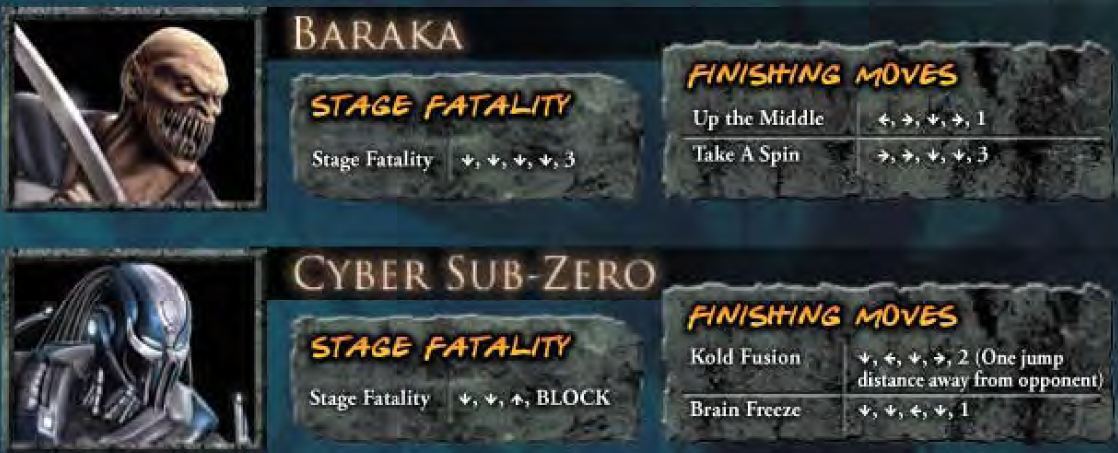
In case you haven’t heard the news, Prima Games’ Mortal Kombat strategy guide is apparently riddled with errors, inconsistencies, and useless information. To get a better idea of what is wrong with the guide, watch one disgruntled owner’s review below.

While I believe that this reviewer was a little immature with his antics–albeit, the language and funeral pyre were funny–I can’t deny that he was absolutely right with all of his points. The number of screenshots is overboard and ridiculous, and they’re to the point of not being useful to the user, especially in terms of efficiently finding what you’re looking for. The inconsistencies are also unacceptable, and what is up with the misprints for the control commands? Someone in QA obviously fell asleep at the wheel when this guide was approved for print.

Mortal Kombat Strategy Guide Problems

According to Kotaku, Prima Games will not reprint the guide due to fiscal reasons (somewhat understandable), but they will offer character cards as amends to unhappy guide owners.

“The cards will be complete with all moves, Fatalities and Babalities, and free to anyone who bought the Official Guide or the Kollector’s Edition Guide. To receive your copy of the cards, please send your name, address, and e-mail to feedback@primagames.com.”

This news has greatly saddened me for several reasons. For one, Prima Games is known for putting out high quality guides, and to let something like this slip through the cracks baffles me. Then again, I know I just ranted about their Mass Effect 2 strategy guide, so I am saddened even further. In addition, not only does this damage Prima Games’ credibility, it damages the reputation for print guides, period. Why would someone pay $20 for a risk of bad information? Not to mention, why would someone pay $20 for the promise of updated information? You can just wait for IGN Guides to produce their online guide for free and catch updates there anyway. For an industry that really wants to prove that print guides are still relevant for today’s needs, this is a huge step backwards.

Just like game developers can’t be expected to produce a triple-A game every time, the same goes for publishers with the quality of their books. The big question is if whether this trend will continue, or if this was Prima’s one bad guide of the year–like how Mass Effect 2 strategy guide was the bad egg for 2010. For both Prima’s sake and for the sake of my personal love of strategy guides, I hope this problem will be nipped in the bud for future publications.

On another personal note, a lot of the complaints about the Mortal Kombat guide echo my feelings on Prima Games’ Mass Effect 2 strategy guide. If I wasn’t such a huge Mass Effect and obsessive collector of things, I’d want to incinerate this guide as well. That also greatly saddens me.

Filed Under: Strategy Guide News, Strategy Guide Opinons

  • « Previous Page
  • 1
  • …
  • 29
  • 30
  • 31
  • 32
  • 33
  • …
  • 40
  • Next Page »

Follow us!

Subscribe!

Upcoming Strategy Guides

 Nothing here. Come back later. 😢

Latest Strategy Guide Reviews

The Walkthrough by Doug Walsh Review

Red Dead Redemption 2 Strategy Guide Review

Mega Man 11 Strategy Guide Review

God of War Strategy Guide Review

Far Cry 5 Strategy Guide Review

Friends of SGR

  • BradyGames
  • Dan Birlew – Guide Writer
  • Doug Walsh – Guide Writer
  • Future Press
  • Game Enthus
  • GameWires.com
  • Piggyback
  • Press the Buttons
  • Prima Games
  • Racing Games

Top Posts & Pages

  • Monday Gaming Diary: So LEGO The Hobbit for the Vita isn't Terrible
  • IGN Guides Turned Wikis - Review or Not?
  • Monday Gaming Diary: Why Does She Have to be Named Linkle?
  • Sonic Generations Strategy Guide Review
  • The Witcher 2 Strategy Guide Review

Copyright © 2026 · Web crafted by Warkhammer

Loading Comments...