• Home
  • About Us
  • Podcast
  • Strategy Guide Wit
  • Contact

Strategy Guide Reviews

A Strategy Guide for your Strategy Guides

  • Reviews
    • Strategy Guide Reviews
    • Video Game Reviews
    • Mini-Reviews
  • Features
    • Interviews
  • News
  • Unboxing Strategy Guides
  • Columns
    • Gaming Diary
    • Corner of Randomness
  • Videos

Gears of War Mini-Review

September 15, 2011 By Keri Honea Leave a Comment

Gears of War box artI know, I know…old game is still old. So one more opinion isn’t going to hurt anything.

If I hadn’t played a few chapters of Gears of War 2 first, I would never have gotten into the Gears franchise with the first game alone. In many ways, I wish I had just stuck with the second game and ignored the first, because the first game has soured my opinions of the series a little bit.

The gameplay was always fun, so don’t get me wrong there. However, I need a little more than that to go on to truly like a game. I picked up the original game because I wanted to learn more about what was going on in this post-apocalyptic world. What are the Locust? Where did they come from? While I understand why they didn’t go into all of these explanations with the first game, a little narration as to what is going on would have been nice. At the very least, it would have been nice to know what the hell they were doing at all.

I rolled along just fine with the first Act and about halfway through the second Act. At that point, I thought that the team was just trying to find a way to get back to base. I didn’t understand why they went underground until they planted the resonator. Then I thought, “Okay, now I just got to get them out alive and back to base.” Nope. Now we’re running through Fenix estate and boarding a train with a light bomb. I know I’m a natural blonde, but I shouldn’t have had that hard of a time figuring out what was going on.

The plot seemed to be so scrapped together as an after-thought, like the game was meant to be a shooter first and then the story was tacked on. And you know, that’s most likely what happened. I’m not saying that this makes it a bad game, just not a game for me. I like shooting things as much as the next shooter fan, but I like to know why I’m doing it other than kill them before they kill me (which really is a good reason).

So yes, unfortunately, Gears of War is not something I can recommend unless it’s a bargain bin purchase. That said, I’m still really looking forward to Gears 3‘s release as I approach completing Gears 2.
Filed Under: Mini-Reviews, This Has Nothing to Do with Strategy Guides!

Gears of War Strategy Guide Review

September 14, 2011 By Keri Honea Leave a Comment

Gears of War Strategy Guide ReviewI can already hear my friend @GreedyRaven yelling, “OLD GAME IS OLD!” in response to me even mentioning this game, but give me a break; I got into the Gears franchise a little late, okay? Even old games and old guides deserve reviewing.

This guide in particular became very handy when I fired my husband as my partner. Suddenly, the game became quite more difficult, even without Dom dying all the time (although, he kind of still did anyway–that guy has a death wish). On top of that, those COG tags were stuck in some strange places–or I guess I should say, former Gears died in strange places. So, if I hadn’t dredged up this book on the Amazon Marketplace, I most likely would have rage quit Gears of War shortly after I fired my partner–unless I swallowed my pride enough to beg him to come back.

While Gears itself is very straightforward, it’s not always easy to figure out where to go next thanks to its dark levels, shades of brown, and bad lightning. Even though the maps in the Gears of War strategy guide were also just as brown, I could easily pick out where I was, if I was heading in the wrong direction, where I needed to go next, and what COGs or weapons were available. In large, dark areas like the Stranded’s village, the Imulsion Factory, and the Fenix Estate, these were more than greatly appreciated.

The walkthroughs themselves were impeccable. Every time I followed the guide’s suggestions, I had very little difficulty–a/k/a I or Dom didn’t die as quickly–getting through the sequence. Or, if I used my own methods, I would find that my method that worked was coincidentally the same method the guide suggested. The best piece of advice came from the strategy for fighting the Corpser. The guide said that if you followed its instructions, you could defeat the Corpser in less than a minute, right before the Wretches appear to make your bad day even worse. I never could finish off that Corpser before the Wretches arrived and killed Dom. Once I followed this strategy, that ugly thing was gone in no time.

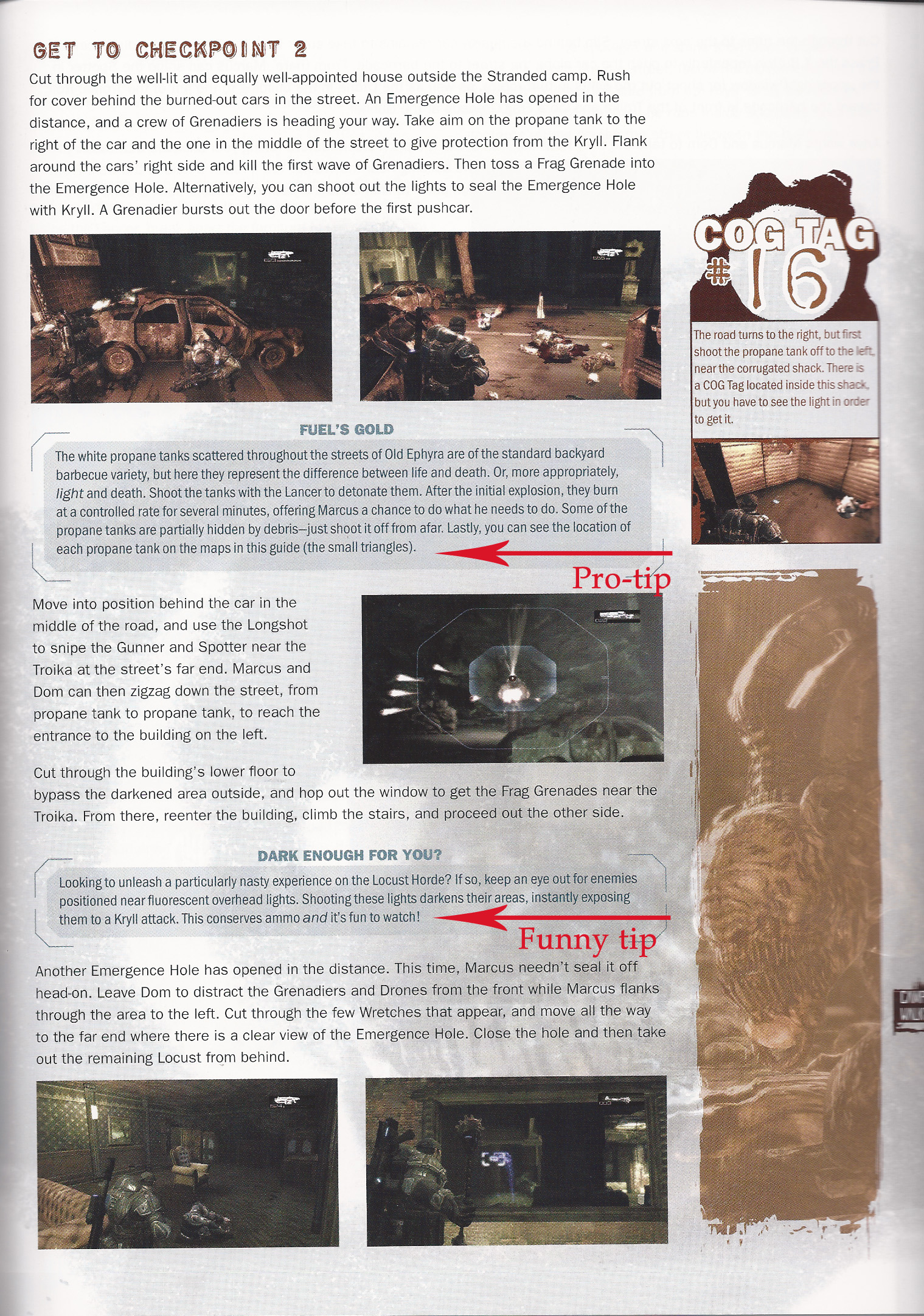
Page of Gears of War strategy guideMost impressive was the overall design and layout, as depicted in the image to the right. As you can see, the walkthrough paragraphs are neatly laid out, the COG tags are clearly marked and separated from the walkthroughs, special tips are segmented away from the walkthroughs, and there was even enough space for some game artwork that wouldn’t detract from the text. Once again, Brady Games has shown that guides can be decorative and artistic without impeding on function.

In addition, the writers were kind enough to throw in some humorous tips to help brighten up your dark journey. For example, one of the tips to the right suggests that you shoot at the lights above the Locust, as then the Kryll will swoop down to quickly feast on them. As the guide puts it, “This conserves ammo and it’s fun to watch!” Yes, yes it was fun to watch.

The guide also included small sections on the multiplayer aspects of the game AND strategies for co-op play, depending on the difficulty level that you choose. These aren’t half as in depth, but they really delve into how to fully take advantage of playing with a human over an AI for certain situations in each Act. With the main walkthrough already present, this was a nice touch that they didn’t have to include but is always appreciated.

As for a real bonus section, the guide includes interviews with the Epic Games developers. I’m not sure what it would have meant to me if I had played this game back then, but reading back on how inexperienced all of these famous devs were–like Cliff Bleszinski (CliffyB)–made them all the more endearing. It was a little fun to see how much all of them have progressed and grown from just a few years ago.

If you’re looking to get the most out of your very brief adventure with Marcus and Dom, the Gears of War strategy guide will not disappoint, unlike some of the game’s AI. For those who need every COG tag, who want to fight through the hordes of Locus without a partner, or need some assistance killing bosses on Insanity mode, you definitely won’t regret picking up this guide. And hey, if you just like to collect Gears memorabilia, then the interviews and the concept artwork should be more than enough to entice you to add this book to your collection.

SGR Rating: 5/5

Author: Doug Walsh
Publisher: BradyGames
Editions Available: Paperback
Acquired via Publisher

Filed Under: Strategy Guide Reviews

Dungeon Siege III Mini-Review

August 17, 2011 By Keri Honea 2 Comments

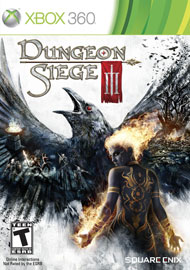
Dungeon Siege III box artBack when I originally dabbled in PC gaming–the Age of Mythology era–I had considered getting into Dungeon Siege when it first released, but I was warned that it wasn’t suited for newbies to PC RPGs, so I stayed away. I never heard anything from the franchise since, until I went to E3 in 2010, when Square Enix announced it was bringing the game back and was publishing it for consoles as well as PC. I wasn’t able to play Dungeon Siege III at that E3 or this past E3, but I was still intrigued by the demo. So I blindly purchased the game, and I was definitely not disappointed.

The best way I can describe Dungeon Siege III is that it is a hybrid of a linear action-RPG and Gauntlet. I say Gauntlet because it has the capabilities of supporting up to four people playing at once, and the combat reminds me a lot of Gauntlet:Seven Sorrows, but with a lot more depth. It’s definitely not a button-masher as combat requires a fair bit of strategy, but it’s not nearly as complex as typical action-RPGs.

My only complaint about the game is how short it is. Playing on Normal and finishing all the sidequests took me only 14 hours to complete. I believe the reason for this is that you have the opportunity to play as four different characters, which gives you different perspectives to the overall story and the opportunity to make different choices throughout the game. Decisions you make greatly affect the ending, which is half the reason why I’m already playing through again as a different character.

Another possible reason why the story is so short could be due to the co-op capabilities. Players can drop in and out of a co-op game at any time, but if you want to play with friends for the whole game, it’s a little hard to get four people to agree to set aside time to play a 30-hour game together. Fourteen hours is far easier to coordinate.

As for the story, it wasn’t the greatest RPG story on the planet, but it kept me guessing. I thought I knew what the twist was going to be, and I was pleasantly surprised to be wrong. RPGs have a knack for being rather derivative when it comes to story, so it’s always refreshing to have a wrench thrown into the gears.

Dungeon Siege III hasn’t had a lot of marketing or discussion since its June release, but it’s a sleeper hit that’s a must for action-RPG fans, especially action-RPG fans who have a small nostalgic pension for Gauntlet. If only there was a narrator telling me that my Archon needs food badly.

Filed Under: Mini-Reviews, This Has Nothing to Do with Strategy Guides!

Dungeon Siege III Strategy Guide Review

August 11, 2011 By Keri Honea Leave a Comment

Dungeon Siege III Strategy Guide ReviewDungeon Siege III is a creation of Square Enix and Obsidian, although neither worked on the first two games. There wasn’t a lot of hype for the game, which could be partly Uwe Bolle’s fault for producing a horrible movie about the original game, which is a shame because the action-RPG is actually quite fun. Despite many people’s misgivings about Obsidian’s hands in the game’s development, Dungeon Siege III turned out to be a beautiful and highly enjoyable game. Prima Games’ strategy guide for Dungeon Siege III turned out to be the same: beautiful and highly enjoyable.

The Dungeon Siege III strategy guide implemented my two biggest requirements for any strategy guide beautifully: maps and easy-to-follow walkthroughs that include sidequests.

Until I realized that I could turn off the auto-camera for the mini-map in my upper right corner, the maps in the guide were a godsend. Since the mini-map turned whatever way I was facing, I got turned around a lot, especially in the underground areas (*coughdungeonscough*). At least with the maps in the strategy guide, I could see that I needed to head west and then just follow the marks on the mini-map compass. The maps were clear, easy to follow, and all chests were clearly marked. Can’t really ask for much more than thatn.

Dungeon Siege III strategy guide pageAs for walkthroughs, they were 100% spot on. DSIII is an action-RPG that is well, quite linear, so while it’s fairly impossible to not find where you’re supposed to go to advance the story, it is very possible to miss out on sidequests. And what is an RPG without loads of sidequests? A very short story that will be next to impossible to complete. If that isn’t enticing enough, there’s also a Trophy/Achievement for completing all of the sidequests along with completing the game. Here is where I put the strategy guide to the test, because if I missed out on that Achievement, well, I probably don’t need to paint that picture for you.

Long story short, I snatched up that Achievement with ease, and I owe a lot of it to the guide’s help. Numerous sidequests were in areas I didn’t think of going–even while exploring–and at times, I never would have found the goal of a sidequest due to its obscure location.

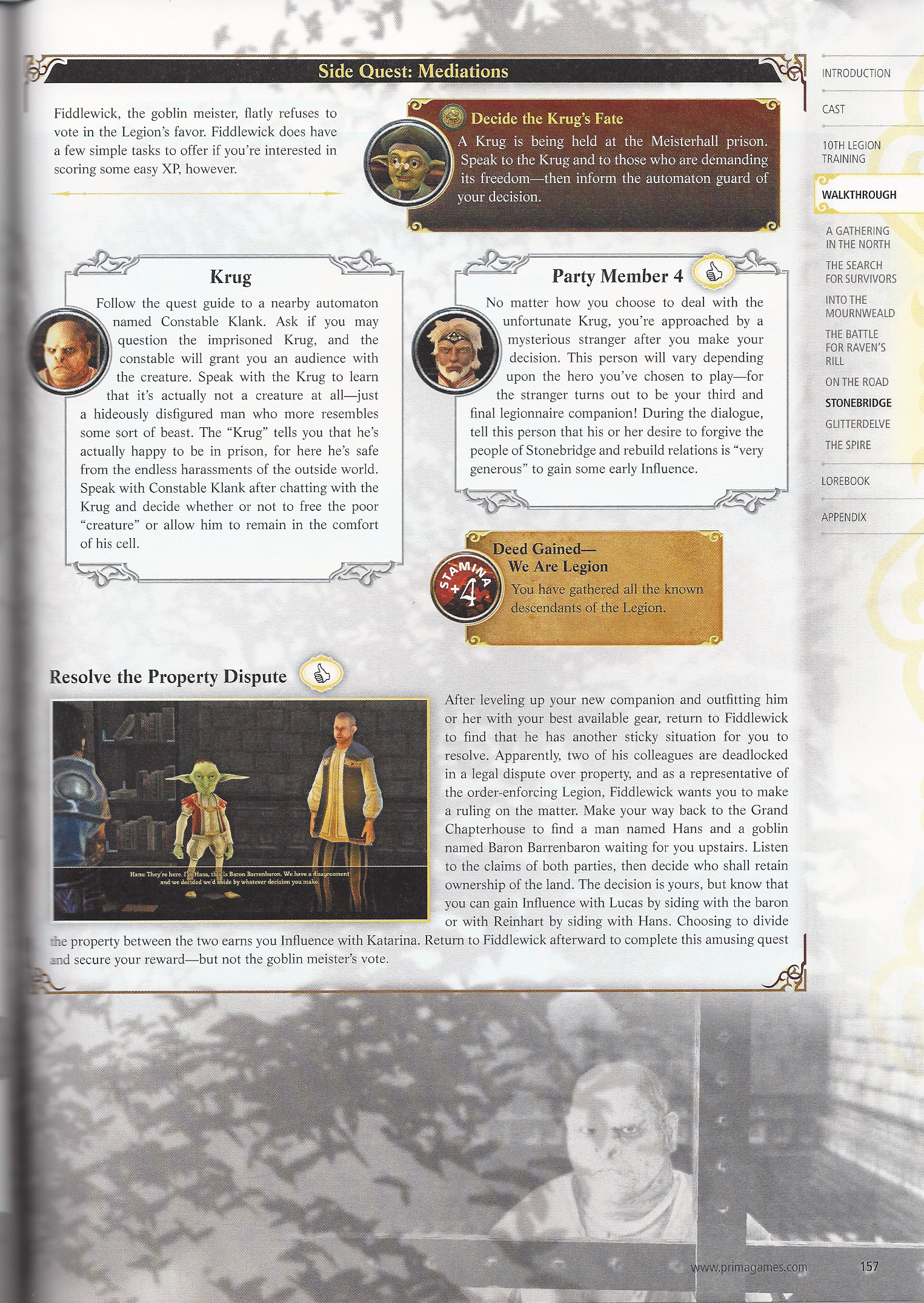
Another element the game focuses on is this idea of Influence with your party members. Players gain influence with other characters by the decisions they make, whether they are plot decisions or dialogue choices. Influence with particular characters rewards players with specific stat bonuses, such as Will or Agility. Every instance of where influence can be gained with a particular character is presented clearly within the cut scene sections of the walkthroughs, thereby making them very easy to find (see the scan of one of the pages to the right).

Following this idea of allowing players to pick which partymembers they want to “attach” to, DSIII also allows for players to customize their characters to fight the way that they like to play. As such, the guide does not advise players as to which character to select or which abilities to focus on for particular characters. In addition to the heavily detailed character sheets presented in the front of the guide–which list the characters’ abilities, strengths, weaknesses, and the like–the guide makes general suggestions for how to select a character’s proficiencies and talents, based on the player’s experience with playing. For example, one of the tips early on in the walkthrough advises newcomers to DSIII to focus on defensive and healing abilities until they are comfortable with the play style of the game. That’s really as far as it goes as to ability planning, which I particularly liked because I never felt that I was choosing the “wrong” character or the “wrong” abilities. The strategy guide never once said, “Use ___’s _____ attack,” allowing players to freely play the game how they prefer instead of using the author’s method as the only one. (See Final Fantasy XIII strategy guide.)

I’ve played games that allowed such deep character and party customization, but it’s not often you find a guide that follows suit and doesn’t try to pigeon-hole players into one character and one party.

Another point worth mentioning is that like the strategy guide for The 3rd Birthday, the Dungeon Siege III strategy guide proves that you can have an incredibly artistic design for the pages without detracting from the guide’s usability. As you can see from the page featured above, all space of the page is filled in with artwork, mostly screenshots. However, it’s done in a manner that doesn’t impede upon the guide’s text or walkthrough screenshots. It’s still very easy to pick out the walkthrough text that you need, and the screenshots aren’t sacrificed in terms of size or clarity to make way for the gorgeous artwork and even developer commentary (which is a fabulous bonus, by the way). Strategy guide designers, please look at both of these strategy guides as standards when trying to make the guides artistic.

With all of these fantastic elements, it pains me to point out that the Dungeon Siege III strategy guide grossly overlooked one pretty important appendix that all guides for current-gen consoles should have: a list of Achievements/Trophies with explanations and tips on how to obtain them. Even if all of the Trophies/Achievements are story markers and very obvious, every guide should contain a list of them at bare minimum.

As a result, this guide cannot be considered perfect. Highly recommended, though, to everyone looking to get the most out of Dungeon Siege III, especially those who are fans of the franchise and die-hard completionists.

SGR Rating: 4.5/5

Author: Stephen Stratton
Publisher: Prima Games
Editions available: Paperback
Acquired via Publisher

Filed Under: Strategy Guide Reviews

Marvel vs. Capcom 3 Guide Review

August 9, 2011 By Chris Nitz 2 Comments

Marvel vs Capcom 3 Strategy Guide ReviewMarvel vs. Capcom 3 (or MvC3 for short) is quite possibly one of the most anticipated fighting sequels to grace consoles in recent years, and it does not disappoint. With an abundance of characters, a new art style, and some HD love, this is certainly going to be creating frat house arguments for years to come. Those who want an edge up on the competition should look no further than the wonderful BradyGames guide, as this book is packed with helpful tidbits of combat love that is sure to aid your blistered thumbs.

The guide starts out with some excellent breakdowns and directions on how it all comes together. For example, it points out that all the moves listed are based off your character standing on the left side of the screen. The guide then goes into great detail breaking down the basics of combat terms like footsies, frame rate, hyper armor, and so much more. Seriously, there are five and a half pages of terms to brush up on. You may never use them, but it is worth reading and makes it much easier to understand the rest of the content.

Once your morning terminology reading is done, the guide goes into a good amount of depth on the basics of the various game modes and combat fundamentals. This is a section that should certainly not be overlooked by novices to this series, and veterans will find it valuable for learning the new combat systems in place. Remember, MvC3 may look like a fast and furious button masher, but there is a deep fighting system buried under all that chaos. If you have no idea how to combo break, crossover assist, or trigger a team hyper combo, this section is a must read.

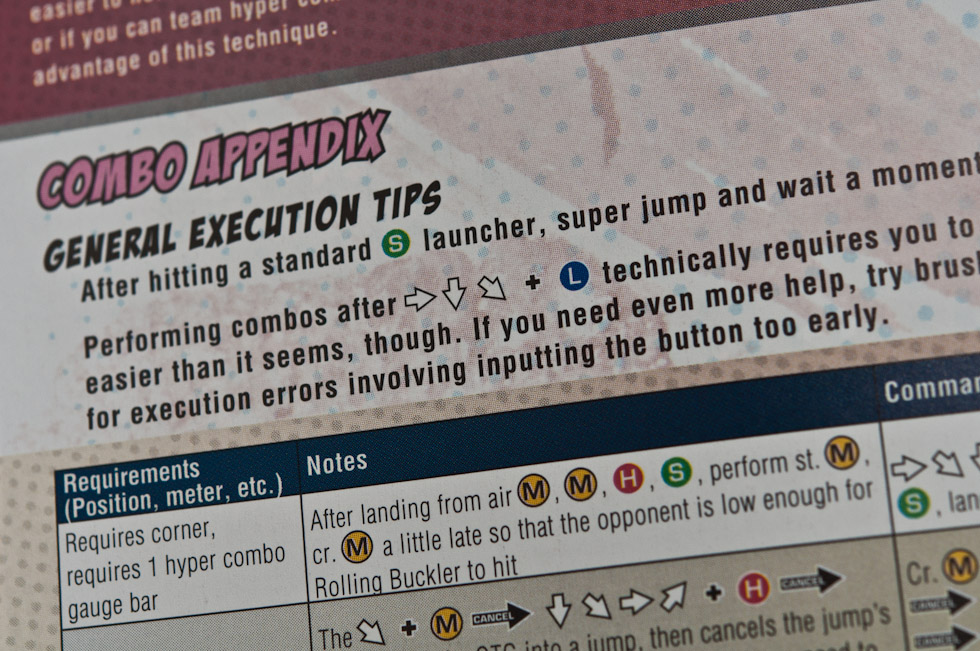
Finally we get to the meat and tatters portion of the guide: the character strategies. This is where BradyGames did a nice job when it comes to a fighting game strategy book. There is a fun profile giving a small chunk of bio information on each character, a power grid breaking down character stats, and even a display showing players what button to push to get various alternate costumes. It is basic, but nonetheless a nice touch.

A page from the MvC3 Strat Guide

Easy to grasp combos make you king of online tournaments.

The fighting moves start with basic attacks broken down by standing, crouching, aerial command, and crossover. Each section gives you a basic attack button to push, the hit count, damage, recovery time, and even a picture at the bottom to show you what the attack looks like. From here, special moves and hyper combos are detailed with descriptions on how they behave, like illustrating how the Plasma Beam from Dr. Doom will finish 15 frames faster if you use a Light Plasma Beam vs a Heavy Plasma Beam.

Finishing off the character section has some basic strategies and combos for players to add to their fighting repertoire. I did find this section to be useful for basics, but I would still turn to YouTube to watch the combos in action and pick up new tactics not detailed in this book.

The last section of the guide is reserved for Trophies, Achievements, icons, and titles. Trophies and Achievements are easily detailed on what you need to do, and I was able to acquire some basic trophies in a matter of moments thanks to the guide. The icons and titles are just as conveniently laid out, making it simple for fighters to quickly look up any title they want and see the conditions they need to meet in order to obtain said title.

Overall this is a great guide and I found little to no issues with the commands or tactics detailed for the various characters I tried. The part that will be inaccurate is not due to BradyGames, but rather Capcom and the player base. As specific characters are nerfed, and various combo strings adjusted, the damage numbers in the guide quickly become inaccurate. It is not a breaking point by any means, but remember that your favorite character may behave slightly different from what is in the guide. Outside that, this has become my bible for all things MvC3.

SGR Rating: 4/5

Authors: Joe Epstein, Adam Deets, Ian Rogers
Publisher: BradyGames
Editions Available: Paperback
Acquired via Publisher


A page from the MvC3 Strat Guide
Easy to grasp combos make you king of online tournaments.

MvC3 Strategy Guide Cover
Marvel vs Capcom 3 Strategy Guide Review

Filed Under: Strategy Guide Reviews

  • « Previous Page
  • 1
  • …
  • 42
  • 43
  • 44
  • 45
  • 46
  • …
  • 57
  • Next Page »

Follow us!

Subscribe!

Upcoming Strategy Guides

 Nothing here. Come back later. 😢

Latest Strategy Guide Reviews

The Walkthrough by Doug Walsh Review

Red Dead Redemption 2 Strategy Guide Review

Mega Man 11 Strategy Guide Review

God of War Strategy Guide Review

Far Cry 5 Strategy Guide Review

Friends of SGR

  • BradyGames
  • Dan Birlew – Guide Writer
  • Doug Walsh – Guide Writer
  • Future Press
  • Game Enthus
  • GameWires.com
  • Piggyback
  • Press the Buttons
  • Prima Games
  • Racing Games

Top Posts & Pages

  • Thursday Gaming Diary: Host Switching
  • Monday Gaming Diary: Keeping the LEGO Marvel's Avengers in Focus
  • Monday Gaming Diary: Getting Reacquainted with Handhelds
  • The Corner of Randomness: Bad Embargo Timing
  • Medal of Honor Warfighter Strategy Guide Review

Copyright © 2026 · Web crafted by Warkhammer

Loading Comments...