• Home
  • About Us
  • Podcast
  • Strategy Guide Wit
  • Contact

Strategy Guide Reviews

A Strategy Guide for your Strategy Guides

  • Reviews
    • Strategy Guide Reviews
    • Video Game Reviews
    • Mini-Reviews
  • Features
    • Interviews
  • News
  • Unboxing Strategy Guides
  • Columns
    • Gaming Diary
    • Corner of Randomness
  • Videos

The 3rd Birthday Strategy Guide Review

May 9, 2011 By Keri Honea 2 Comments

The 3rd Birthday Strategy Guide ReviewThe 3rd Birthday definitely isn’t your typical RPG from Square Enix. It’s fairly straight forward, there are difficulty settings, and your main character has a gun instead of a sword (it’s not even a gun sword!). It’s also short, which was evident to me as soon as the guide arrived on my doorstep. I’ve never, NEVER seen a Square Enix RPG strategy guide so thin.

However, beyond this appearance of simplicity, The 3rd Birthday actually has a lot of hidden gems for players to unlock–from secret endings to powerful armor–and the guide covers all of these flawlessly.

I honestly finished the game weeks ago, but I’ve had the hardest time sitting down to write a review for the guide because it was perfect. All I want to say is just that: it’s perfect. Perfect design, perfect advice, perfect organization. It’s really hard to elaborate on that, hence why it has taken me so long to write more than five words about it.

Every guide should follow The 3rd Birthday strategy guide’s structure. The first page of each mission has maps of the areas Aya will explore, all clearly marked with items, enemies, and exits. Each map is labeled as “Area #”, and then consequently in the walkthrough, each section marks which area Aya is in. It’s plainly easy to find exactly where you are at any given time. Also on this front page are a list of the mission’s Feats, which are sort of like the game’s Trophies–if the PSP had any Trophy support. The Feats are also mentioned again when the best time (or only time) Aya can accomplish them, and they are placed in clear, callout boxes so there is no risk of missing them.
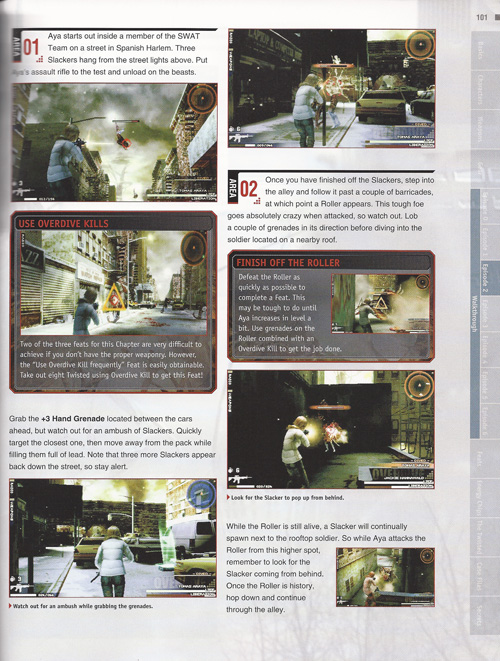
A Page from the 3rd Birthday strategy guideAll of the screenshots are clear, concise, and all serve a purpose. Large screenshots usually depict what Aya should be looking for or what direction she should be heading. For boss fights, they show her most optimal position for survival as well. Smaller screenshots are used to show sequences of actions, such as how to achieve a certain Feat or how to survive a sticky situation.

Put in simpler terms: I never had trouble quickly finding where I was in the game and guide and how to do what I needed to do.

The appendices relist all of the Feats and how to obtain them, and all of the hidden gems one would never expect this game to have. The 3rd Birthday is so short so that players will play it again and again, thereby unlocking additional weapons, costumes for Aya, and even secret endings and hidden scenes. When you finish the game the first time, you receive a new costume for Aya, so you become instantly aware that there may be others, but that’s the only unlockable that is obvious. I never would had fathomed most of the others.

As this is a Square Enix game, and it has a plethora of what Square Enix does best–cut scenes–there is an extensive amount of art in the strategy guide as well. Where so many guides try to combine art with the walkthroughs, The 3rd Birthday strategy guide handles its art as all guides should: outside of the walkthroughs. The front pages have plenty of art, and of course the back has some art samples, the pages with the walkthroughs are art-free aside from the screenshots. This is how it should be done, as now the writing and the screenshots don’t appear to take second fiddle to artwork.

So yes, I find The 3rd Birthday strategy guide to be perfect. None of the strategies led me astray, it was very easy to access and find information, and it still found a place for all of that gorgeous Square Enix artwork any fan of the developer would expect a guide to have.
SGR Rating: 5/5

Author: Michael Owen
Publishers: BradyGames
Editions Available: Paperback
Acquired by Publisher

Filed Under: Strategy Guide Reviews

Mass Effect 2 Strategy Guide Review

April 26, 2011 By Keri Honea 2 Comments

Mass Effect 2 Strategy Guide ReviewThe first Mass Effect strategy guide was also published by Prima Games, and since that one did so well, I had very high hopes for this one. The fact that Catherine Browne was the author of this guide only made me more excited. However, this guide ended up being a giant disappointment for me–as my big build-up should have already suggested.

A lot of what the guide has is great. It incorporated the same layout from the first guide, so everything is very easy to see at a glance, and the images are unobtrusive, significant, and won’t require users to squint. It’s also great that it makes little notes of who Shepard can romance (depending on gender) as well as how one can go about doing it. For example, romancing Jacob takes a lot of subtlety and gentle prying for him to come out of his shell. For Jack, you have to gain her loyalty and either side with her in her “disagreement” with Miranda or diffuse the argument with charm/intimidation. In addition, as someone who imported Shepard from the first game, I really enjoyed the little callout references to things that happened in the original, such as the explanation for why Wreav or Wrex might be the krogan leader.

However, despite all these design elements and the mostly accurate walkthrough, the guide is missing a lot of vital information. These omissions will cause problems and confusion for those who 1) want to snag all of the Achievements/Trophies and/or 2) imported their characters from the original Mass Effect.

The first omission that surprised me was a side mission Shepard can take on Illium. Shepard runs into Giana Parsini from Noveria Internal Affairs, a character only those who have played the first game will remember. She approaches Shepard and asks for help busting a weapons thief. It’s possible that this is a mission a player can only get with an imported game, but that’s really not an excuse for it to not even be mentioned in the side missions section of the guide. Since this was so small, I dismissed it.

But then, I reached the start of the endgame.

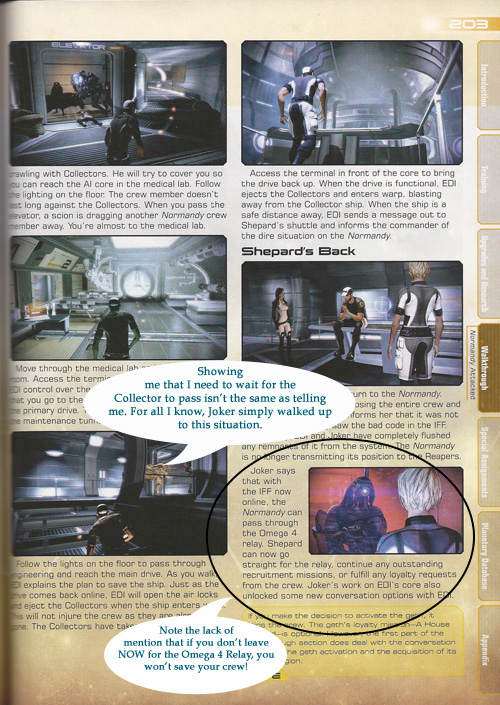
From the time I had to play as Joker until the end credits, I was finding holes in the guide. For the scene that you have to play as Joker, it really offers no guidance other than walk the path. However, at one point, if that’s all you do, Joker meets a nasty end. The guide showed a screenshot of what you should do at this point, but there were no captions or mentions in the paragraphs as to what the screenshot even meant. For all I knew, it was just a screenshot of Joker walking down the hallway. At the very end of this venture, when Shepard has a choice to go after the Normandy crew or continue sidequesting, the guide discusses all of these options, but never once says that if you don’t go after your crew immediately, they all die except for Dr. Chakwas.

Mass Effect 2 Strategy GuideThis isn’t the only time that users aren’t given proper warnings for who might die in Shepard’s crew. The guide does mention that if the ship isn’t upgraded properly, a crewmate will die in the ensuing crash, but that’s pretty much where the advice stops. In the Mass Effect 2 endgame, Shepard has to make choices of who is to perform a certain task, who will accompany Shepard, and who will lead a separate party. Shepard has to make these choices three times, and depending on who the Commander chooses, crewmembers will live or die. During this entire section, no suggestions are proffered. I would understand if the writer didn’t want to give too much away at this point, BUT, these suggestions should at the very least go with the Achievements/Trophies appendix, since this is where the “No One Left Behind” Achievement is described.

As a result with my playthrough, Mordin died at the very, very end and I had zero clue why. I stayed up another hour longer to read the guide from cover to cover, to make sure I hadn’t missed anything. No explanation. I ended up going to IGN Guides, and they explained exactly who Shepard had to pick for these tasks in order to keep everyone alive. When I replayed the ending with their suggestions–the only thing I didn’t do correctly was who to send with the Normandy crew survivors back to the ship–everyone survived. While it is possible that the guide writer picked the correct crewmembers instantly, surely the “No One Left Behind”Achievement would clue in the writing team that it’s possible for teammates to die.

This experience absolutely enraged me. Of all the information this guide should have had, every scenario of the endgame should most definitely have been included. If I had paid for this guide, I would be even more livid, which is perhaps the biggest disappointment to me.

I can only recommend this guide if you are a huge Mass Effect fan, just because the gorgeous cover and artwork within make it worth it. Otherwise though, save your money and stick with IGN for help with this one.

SGR Rating: 3/5

Author: Catherine Browne
Publishers: Prima Games
Editions Available: Paperback and Collector’s Edition
Acquired by Publisher

Filed Under: Strategy Guide Collector's Editions, Strategy Guide Reviews

Dissidia Duodecim Strategy Guide Review

April 21, 2011 By Keri Honea 1 Comment

Dissidia Duodecim Strategy Guide ReviewFinal Fantasy Dissidia Duodecim is an unusual fighting game in of itself, in that it’s a weird RPG/fighting hybrid. Instead of just climbing through the ranks via numerous battles in a 2D arena, these fighters have actual RPGing to do. There’s an overworld to explore, game boards (think checkers) to traverse and pick your fights, potions to collect, Limit Breaks to achieve, weapons and accessories to buy, and experience to be gained. Instead of teaching yourself button combos, you learn different abilities as your characters level up, just like one would in an actual Final Fantasy game. So in the end, the guide has two jobs: offer strategies for each character you battle and inform you how to max out your character.

Even though this strategy guide really does its best to fill both of these positions, its overall page layout detracts from finding any of this information efficiently.

By the time I received the guide, I had already gotten through about the halfway point of Scenario 012 and was ground instantly to a halt. I thought I would have to level grind to get further, but I also hoped that the guide would offer some strategies I hadn’t thought of, such as certain accessories or tips as to what the manikins and boss would do in battle. At the very least, it would have a suggestion for what level I needed to be. Most of these assumptions and/or hopes were wrong.

For starters, no level suggestions are ever given. If you look at the screenshots provided, the guide writers had their characters at level 100 for each level in the main story. I suppose that if I cared to level up my characters all the way up to level 100 I could soar through the levels as well, but I just wanted to minimalize my way through, even if it meant working hard. Sure beats the method of level grinding in this game. So when I saw the lack of suggestions for levels, I was enraged. After I calmed down, I took note of the chart that listed the enemies with their levels, and took those numbers as level suggestions. These are the same numbers you can easily find by scanning your game board, but by having the list in front of you, you can see what levels you should be thinking of before you even enter the board.

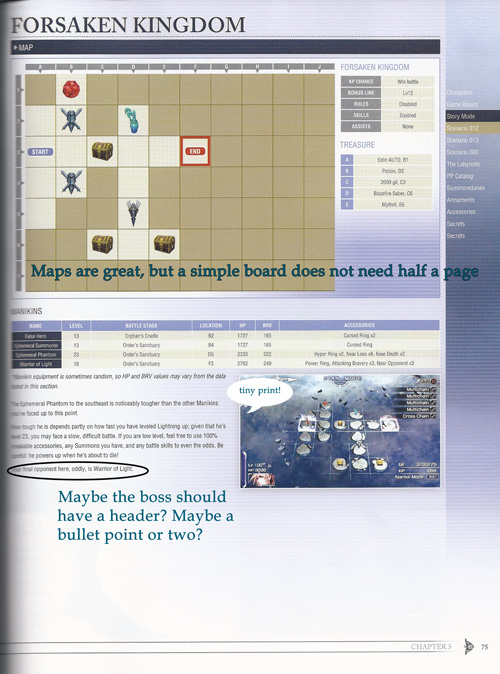
It was at that point that I realized what was really bothering me: while each page depicting each board holds a lot of information, the layout of the page hinders one from finding what they are looking for efficiently (save for the map of the board).

Dissidia Duodecim Strategy Guide Page

In addition, since the print of the text is so tiny, it forces the user to pick up the book and read instead of finding what they want at a glance. For a fighting game, that can be a little annoying for the user, unless the user is only using the guide when he or she fails a particular battle.

Other than this layout issue, the guide is packed full of all the information you never thought one little game would ever have. There are the usual charts of armor, items, accessories, and summons, just as one would expect. There is also a full PP Catalog (not unlike the fat volume JCPenney would send to your parents and grandparents) that lists everything one can possibly buy with PP and how much it costs. There is also a full listing of all the game’s Accomplishments–not that anyone really cares, I mean, unless they’re official Trophies, I doubt many will really try to get them all, but that’s my rambling two cents.

The most impressive appendix to me is the list of all the Moogle mail you can receive over the Mognet. The sender, letter contents, your reward for receiving the letter, and how you get the letter are all carefully explained. This is not for 20 or so letters; this includes hundreds of seemingly insignificant letters that consists of branching letters and chain mail. If the writers didn’t get this info directly from the developers, then God bless them for finding each one.

Despite all of this information, the guide completely lacks one feature that was advertised on the back cover:

Discover the best ways to power level your heroes, advance their abilities, and earn items.

I read this guide cover to cover, and I found no such information. As one who hates level grinding, I would have loved to have found these tidbits. Not sure if this was an oversight on the back cover design or if something got omitted post print, but it was still a huge disappointment.

All in all, for those who really want to get all of the RPGing out of Final Fantasy Dissidia Duodecim as humanly possible, then this guide will not disappoint. If you’re looking to just burn through the game, then the strategy guide will offer you little assistance. All of it is helpful, but not as meaningful for your purposes.

SGR Rating: 4/5

Authors: Phillip Marcus and Elizabeth Ellis
Publishers: BradyGames
Editions Available: Paperback
Acquired by Publisher


Filed Under: Strategy Guide Reviews

Dissidia Duodecim Mini-Review

April 13, 2011 By Keri Honea Leave a Comment

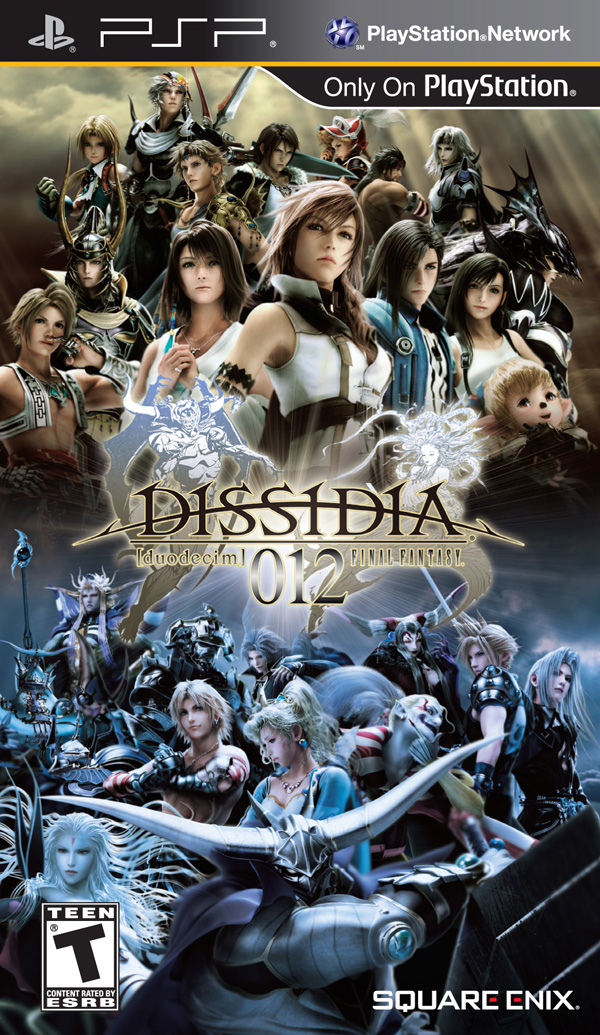
Dissidia Duodecim box artFinal Fantasy Dissidia Duodecim is one of the few games that I did not want to review, and it’s quite possibly the first Square Enix game I did not want to review. I did not enjoy the first game, and I assumed that this game would be more of the original. But when you’re assigned a game to review, you’re assigned to it. Within minutes of turning it on, I realized that my assumptions were a little right.

FFDD continues its tradition of incorporating the Bravery and HP attack system, which to be honest, you will either love or hate. There is nothing with the way it works; I just hate it. This was their method of making the fighting game more unique than your typical button mashing combos, and they definitely accomplished that goal, but it’s not for everyone.

There were some nice new changes brought into the prequel. For example, the ability to call in other characters for assist attacks is so incredibly useful, especially when the AI is just pummeling you into a corner. Actually having an overworld to run around in breaks up the monotony of having game board after game board after game board. I personally would have preferred that they ditch the whole game board idea altogether, but at least that’s not all I’m looking at in between menus and cut scenes.

The new character additions offer more unique stylings of fighting from your typical sword-toting brawlers throughout the game, especially with Lightning, Yuna, and Laguna. Yuna attacks exactly how she did in FFX: summoning aeons. Laguna’s heavy gun arsenal is immensely satisfying for players who prefer long range attacks and never really getting up close, and Lightning’s ability to actually Paradigm Shift is more than just a nod at the unusual battle system in FFXIII; it provides numerous options for players to customize how she attacks to their style.

Overall, FFDD is not a bad game. It does what it does very well, but it has carved out a very specific niche for its fans. Basically, you must be both a fan of Final Fantasy games and of the fighting game genre. I do not fit into this audience, so it was most definitely not for me. If you liked the first Dissidia game, you will more than likely love this one as well.

SGR Rating: 4/5

Filed Under: Mini-Reviews, This Has Nothing to Do with Strategy Guides!

God of War III Strategy Guide Review

April 6, 2011 By Mike Kennon 1 Comment

God of War III Strategy Guide ReviewAuthors: Michael Lummis, Peter McCullagh, Stacy Dale, James Manion, & Samuel Chartier
Publishers: BradyGames
Editions Available: Paperback and Ultimate Edition
Acquired by Purchase

Do you like Greek Mythology? Perhaps you enjoy a little bit of a revenge plot dabbled in action and adventure? God of War III features all of this along with a lengthy and full fledged adventure! But before you head out on this quest you will probably need some help and this is where the God of War III Collectors Edition guide makes itself known. Putting your enemies away has never felt better and now this guide tells you exactly how to do it with grace.

One of the fine points of this guide is its beautifully embossed hardcover, complete with Kratos’ likeness on the front and some beautiful images inside. The features in this book are really well done; it covers everything from the history of the story, maps, walkthroughs for each act, and an extensive collectibles guide, and it even features concept art with behind the scenes comments of the process by the development team. There are also concept images of the main characters as well as their story and a complete bestiary of all types of creatures/enemies in the game.

Starting off with this guide it really tells you everything you need to know about the game. This is one of those rare, really well-written guides that if you follow it you WILL get everything accomplished in the game. I am by no means the best video gamer in the world but accompanied by this guide, I was able to beat this game on my first play through on its hard difficulty (Titan) as well as collect every collectible I needed for their respective trophies.

Now that brings me to my next topic of this guide. It has what myself (along with Keri) think every guide should have, and that is an extensive Trophy/Achievement section. This guide tells you every single trophy in God of War III along with its value and how to get it along with other various details about the trophy itself and what part of the game it’s in. I myself am a “Trophy Hunter” on PS3 so I value that kind of information in a guide; it helps me earn that ever-so satisfying *ding* of a Platinum Trophy popping!

Those really tough boss fights keeping you away from getting to the next point in the game? This guide tells you strategies and weapons to use on each type of enemy and boss as well as their weaknesses, so next time you take them on you will know exactly where to bring on the hurt! It really helped me for some of the later fights in the game that can be a “pain in the Pandora’s Box.”

Another neat thing this guide does is when you do get to that boss fight, it gives you their back story along with pictures of them to really get an idea of their character. It also really gives you this feeling of really knowing everything about the game and its universe, even if you have not played the previous two entries in this series.

As you proceed through all of the acts of the game, this guide tells you every encounter and which enemies there are to deal with and how to dismantle them, which makes you feel like you know the game inside and out. When you go through each room, the guide tells you if there are collectibles in the room and how to reach them along with a map. There are also moments where you will probably need to read exactly how something is done but you don’t want to really spoil it completely, but this guide offers “Small Hints” and “Big Hints,” so you can try to figure stuff out for yourself unless you really get stumped and cannot continue on your journey.

Those features along with all of the art, story background, enemy information as well as the breakdown of how everything works, how to acquire every trophy in the game, and the overall design and composition of the book, really makes me recommend it to anyone who wants to pick up this great game and know everything about it and achieve everything you can. What better way to top off the “Ultimate Edition” of God of War III than with the Ultimate Edition Strategy Guide?

Filed Under: Strategy Guide Reviews

  • « Previous Page
  • 1
  • …
  • 46
  • 47
  • 48
  • 49
  • 50
  • …
  • 57
  • Next Page »

Follow us!

Subscribe!

Upcoming Strategy Guides

 Nothing here. Come back later. 😢

Latest Strategy Guide Reviews

The Walkthrough by Doug Walsh Review

Red Dead Redemption 2 Strategy Guide Review

Mega Man 11 Strategy Guide Review

God of War Strategy Guide Review

Far Cry 5 Strategy Guide Review

Friends of SGR

  • BradyGames
  • Dan Birlew – Guide Writer
  • Doug Walsh – Guide Writer
  • Future Press
  • Game Enthus
  • GameWires.com
  • Piggyback
  • Press the Buttons
  • Prima Games
  • Racing Games

Top Posts & Pages

  • Thursday Gaming Diary: Host Switching
  • Monday Gaming Diary: Keeping the LEGO Marvel's Avengers in Focus
  • Monday Gaming Diary: Getting Reacquainted with Handhelds
  • The Corner of Randomness: Bad Embargo Timing
  • Medal of Honor Warfighter Strategy Guide Review

Copyright © 2026 · Web crafted by Warkhammer

Loading Comments...