• Home
  • About Us
  • Podcast
  • Strategy Guide Wit
  • Contact

Strategy Guide Reviews

A Strategy Guide for your Strategy Guides

  • Reviews
    • Strategy Guide Reviews
    • Video Game Reviews
    • Mini-Reviews
  • Features
    • Interviews
  • News
  • Unboxing Strategy Guides
  • Columns
    • Gaming Diary
    • Corner of Randomness
  • Videos

Fuse Mini-Review

June 27, 2013 By Keri Honea Leave a Comment

Insomniac Games branched away from their PlayStation-only comfort zone to release their first multi-platform game, Fuse, a shooter with co-op properties where players wield alien tech for weapons. It was off my radar until I played the demo, of which I had a ton of fun for that brief 30 minutes.

The story is nothing mind-shattering; it’s a tale of four mercenaries working for Overstrike tasked to go clear out a compromised lab for a client. The lab happens to contain alien tech they call Fuse, which they’ve used to create some pretty fun Xenotech weapons. While there, trying to clean up the mess, the lab is invaded by an evil organization called Raven, who want to use the Fuse for their own diabolical means. The client now wants the team to recover the stolen tech from Raven, and the team is happy to do so as long as the funds pour in and they’re able to keep the Xenotech weapons they, uh, borrowed. Each team member has stolen a different weapon with different abilities that conveniently coincides with their own unique abilities.

This is where the shooter loses its “typical shooter” misnomer.
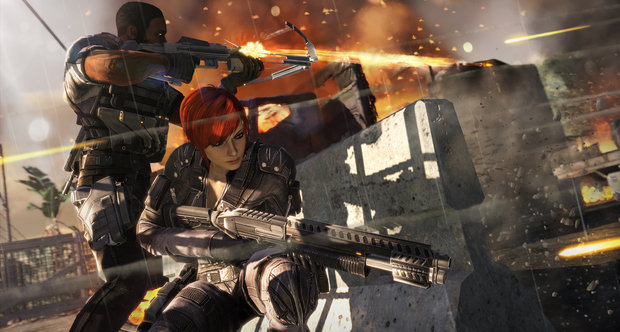
Fuse - Jacob and Izzy

As each teammate gains experience (several ways to do so), they can unlock their own unique abilities as well as their Xenotech abilities. For example, stealth extraordinaire Naya gains the ability to cloak herself and remain invisible for a few moments. Izzy gains the ability to throw med beacons for her team to heal them, which is absolutely crucial as you progress in the game. Players can “leap” between characters at any given moment (unless the current character they are inhabiting is down for whatever reason) and tap into these abilities to help them out during gameplay. For example, Jacob was my main sniper, so I would leap into him to get a faraway job done and then leap back into my main character, Izzy, so I could focus on shooting and healing my team. Whoever you’re inhabiting at the time will level-up faster than the others, so you will have to choose your characters and how you want to level them up carefully.

The biggest complaint I heard about the game from reviews and social media was that the game was only fun if you played with another person. I never once found Fuse to be impossible to play without a co-op partner. Were some parts really hard due to idiotic team AI? Oh you bet, which really hurt during the final boss fight. I screamed at my team to keep their heads down constantly, and I felt like I was healing them during this portion more than I was doing damage to the boss. I know I wouldn’t have had as difficult of a time if I had partners, simply for the fact that real people would have figured out pretty damn quickly that you keep in cover during certain attacks. Parts like this made certain fights hard, but not impossible, whereas with a game like Epic Mickey: The Power of Two, I felt the game was impossible without a partner.

The final boss fight, however, was really the only instance where I really, really wished I had help. Other situations, where I would have to leap back and forth between characters to maneuver through an area, didn’t bother me at all. Instead of being annoyed that I needed someone for help, I enjoyed learning more about the different characters to get the job done. Again, these situations never once felt impossible to complete alone.
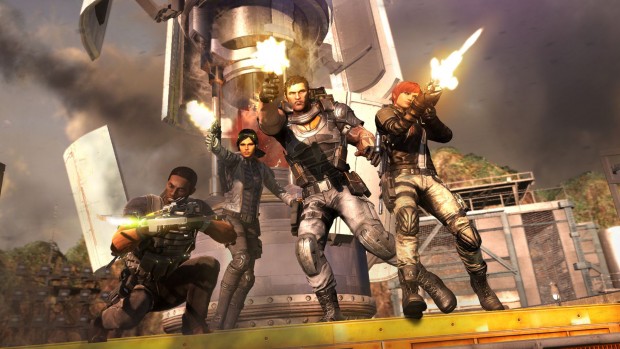
Fuse

Echelon mode, however, is pretty impossible alone, but that’s really the point of it. Fuse doesn’t have a traditional multiplayer mode, just a co-op mode that resembles Horde mode of Gears of War or even Spartan Ops missions in Halo 4. Unfortunately, I don’t have any friends who own this game, so I wasn’t able to try out Echelon mode in all of its glory. I’m hoping I can convince one or two people to buy it so we can play more Echelon mode or even the campaign on a harder difficulty.

I know reviews have been lukewarm at best for this game, but I liked it as much as I liked Binary Domain, another co-op shooter with an unusual plot and game mechanics. As of this mini-review, the demo is still available on the Xbox 360, so I encourage everyone to at least try it there (even though the demo is ten times harder than the actual game, thanks to the learning curve). The game ended on a lovely cliffhanger, and I would love it if Insomniac Games created a sequel.
Filed Under: Mini-Reviews

Fuse Strategy Guide Review

June 19, 2013 By Keri Honea Leave a Comment

Fuse strategy guide reviewFuse was completely off my radar until the demo released about a month before the game’s launch. I shouldn’t have been as surprised by it as Insomniac traditionally makes fun games, but for whatever reason, the game didn’t appeal to me until I played it. However, I had much higher expectations for the strategy guide, most of which sadly came up short. While the Fuse strategy guide did plenty very well–and I wish I had paid more attention to some things–a couple of aspects were not handled well at all and actually detracted from my game playing experience.

Unless the strategy guide is for an RPG, I rarely read the front few sections about the characters, enemies, etc. With shooters, it’s quite rare that you get to select characters with different abilities, much less characters that have skill trees. Fuse has both, so it’s actually vital to read this initial chapter to not only find out which of the four characters is best suited for your personal gameplay, but also how to optimally upgrade each character’s skill tree. The skill trees for the most part all look the same save for each character’s unique Xenotech weapon and ability, but it’s the character’s unique ability that dictates which skills are best for upgrading as soon as possible and which can be saved for later. I, sadly, did not read this section until about 2/3 of the way through the game, and I wanted to kick myself instantly. I knew off the bat that I had picked the wrong character as my mainstay, but to learn that I hadn’t leveled up my character as well as I could have was another blow. When I read the author’s explanations for why I should be upgrading Izzy this particular way, I nearly had an epiphany. Why hadn’t I thought of that? I will never ignore this type of section again when tasked with choosing characters, no matter how insignificant it may seem to be.

What bothered me the most was that the Fuse strategy guide contained zero maps. Having maps for each scene would have helped clear up massive amounts of confusion with some of the wording of the strategy guide for starters. The real reason why I’m miffed there are no maps is because Fuse has lots of collectibles, and one of them leads toward an Achievement/Trophy. Much like the Resistance games, Fuse has intel collectibles that offer a bit of background to the story, Xenotech, characters, etc. They aren’t vital to the game, but they’re interesting, and players who find them all will receive an Achievement/Trophy for doing so. Words cannot express how useful it would have been to have maps marking all of the intel as well as the other extremely useful collectibles (Like XP and credits! What I could have bought and leveled up by finding all of these…)

Fuse strategy guide

One thing is great. One thing is bad.

The intel were not even pointed out via handy call-out boxes complete with screenshots. Instead, they were mentioned in bold font in the walkthrough itself, as shown in the image on the right. As a result, I felt like I was reading the strategy guide more than I was actually playing, and it greatly affected how quickly I could get through a section. I was constantly pausing between gun fights/exploration to ensure I wasn’t missing intel. Even worse, not all of the intel was properly mentioned in the walkthrough. I was missing three pieces of intel at the end of the game, and in comparing the list of intel in the appendices in the back of the guide with the walkthrough, there are exactly three intel omitted from the walkthrough.

Specific Achievements/Trophies, however, did receive their own call-out boxes (see image on right), and thanks to them, I was able to earn all of the weird Achievements. These included odd little stipulations such as stealth-killing a soldier in a particular level while he’s using a urinal. Special mentions like these are always greatly appreciated.

In addition, the strategy guide had a nice little section in one of the appendices that offered suggestions for where to earn other Achievements. For example, the “Shots Fired!” Achievement requires players to pin 3 enemies within a 10-second time frame. The Achievements appendix advises which character to use and where in the game is easiest to accomplish this feat.

Fuse doesn’t have a traditional multiplayer mode like so many shooters do, but instead has a co-op mode, called Echelon mode, that functions very much like Horde Mode in Gears of War. However, players can play this extra mode solo, and the Fuse strategy guide devotes much of the advice in its Echelon mode section to how to survive on your own. I really think this is the first time I’ve found a non-campaign section of a strategy guide to be immensely useful. Each map for Echelon mode has its own tips and own suggestions for which characters to use to get through it alone.

My overall rating for the Fuse strategy guide may seem overly harsh, especially since the strategy guide does so many things very well. Its lack of maps and omission of a few collectibles ended up hurting my experience with the strategy guide the most. With these two issues fixed, the Fuse strategy guide would have been downright perfect.

SGR Rating: 3.5

Author: Michael Lummis
Publisher: BradyGames
Editions available: Paperback
Acquired via publisher

Filed Under: Strategy Guide Reviews

BioShock Infinite Mini-Review

May 15, 2013 By Keri Honea Leave a Comment

BioShock Infinite Wallpaper

I, like probably every other BioShock fan on the planet, had high expectations for BioShock Infinite. I expected a story that would blow me away like the first game did, I expected to be highly disturbed at every corner, and I expected some truly unique gaming elements. I also expected all three of these to possess high quality delivery. For me, only 1.5-2 of these were fulfilled. Maybe my expectations were too high, but I was expecting something akin to what I experienced with the first BioShock, and it never came together for me.

Reader beware…spoilers are within.

I greatly enjoyed the first half of the game. I loved not knowing what was going on, the exploration, and yes, even the combat. The combat in BioShock Infinite was exponentially improved upon from the first BioShock, although I really believe that since Booker was a more involved character, a more separated character from the player, than Jack, a third-person point-of-view might have been better. Nevertheless, the FPS mechanics were greatly improved from the first game, so I never felt that overly frustrated with aiming or with using the Vigors. Yes, the implementation of the Vigors felt kind of forced, but it’s part of BioShock‘s culture in many ways, so it didn’t really bother me. I never really mastered the sky-line combat, but I blame that mostly on my vertigo and not the game itself.

What I loved most about the first half of the game was the exploration of the world and slowly uncovering the story. There were combat sections, but they never felt heavy and they didn’t impede on exploring the insanity of Columbia. I loved taking my sweet time in the Brotherhood of the Raven building, growing more and more disturbed when discovering each room. I reveled in exploring individual houses and finding their racist propaganda and even anti-racist propaganda. Even when I had Elizabeth tagging along, I never felt pushed to move on or frantically fight my way through hordes of enemies.

About the time the Tears were introduced, the game began to drastically change. I couldn’t go anywhere without having to fend of hordes of Founders or Vox Populi, and gameplay started to feel more like a typical FPS. I started to understand why some people were calling the game “CoDShock,” although I think that label is a little unfair. As a result, gameplay started to go increasingly downhill in terms of both fun and game mechanics, particularly with the Lady Comstock’s Ghost boss fight (of which the concept was absolutely ridiculous, besides).

It was at this point where the story took a complete nosedive for me. At the point where Elizabeth could use her Tears to open doorways to alternate dimensions, I lost all interest in the story. I hoped it would redeem itself later, but it instead grew worse. I hate the parallel universe plot device with a passion. I find it to be completely lazy and it opens up more plot holes than it tries to fill. This is exactly why I lose interest in comic series; over time, they all seem to eventually devolve down into alternate dimensions. So once BioShock Infinite traveled down this path, I was done.

I have never been more let down by a game’s story. I thought Dishonored would hold that honor, but apparently my expectations for BioShock Infinite were higher and my hatred for parallel universes is greater. There is nothing anyone can say to turn me around on this game’s story. Trust me, my friends have tried. They’ve tried to fill the plot holes the same way I did after finishing the game (I stayed up half the night trying to fill in the plot holes in order to like the story and only opened up more questions), and I’ve been able to counter each explanation with another question they can’t answer. Also, please don’t suggest I didn’t get it. Like The Matrix trilogy, the game slaps you in the face with what is happening. I just flat out didn’t like it.

It’s always weird disagreeing with the massive majority on a game, but eh, it is what it is. I really hoped this game would be one of my contenders for Game of the Year, but it’s nowhere near my top ten. Then again, I haven’t exactly enjoyed a game that has released this year yet, so my list of contenders could be very, very short this year.

Filed Under: Mini-Reviews

Injustice: Gods Among Us Strategy Guide Review

May 10, 2013 By Chris Nitz 1 Comment

Injustice: Gods Among Us strategy guide reviewInjustice: Gods Among Us is not the first time gamers take on the role of some of their favorite DC Comics heroes and villains. However, this game is a bit darker thanks to its comic book source material and the story leading up to the game. While the game itself is a rock solid fighter, theInjustice: Gods Among Us strategy guide from Prima does need a few patches to help balance it out.

The first few pages are full of game mechanic basics. Anyone familiar with the Mortal Kombat series will feel right at home. There are some good nuggets of info pertaining to character types and each of the stage transitions. It also helps shed some light on how the wager system works and what interactive stage props make for good ancillary weapons. Give this section a few moments of time before digging into that favorite hero.

The bulk of the guide goes to each playable character. There is a brief intro along with what that character will do with various stage props. Following that is a description of their super move, character power, and a handy screen capture of their power meter. This is a prime location for some backstory on why said hero/villain is playing a role in this new universe, but sadly, that goes to the imagination.

How can I use this while some kid is kicking the crap out of me

How can I use this while some kid is kicking the crap out of me

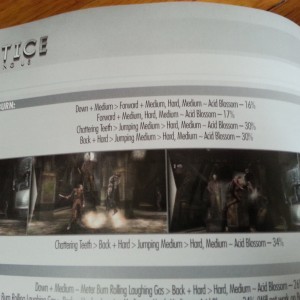
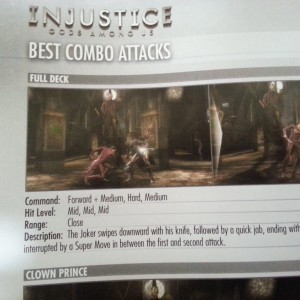
From here, things kind of fall apart. The strategy guide doesn’t list out every move, but instead opts to choose what they feel are the best moves from the arsenal. This same idea carries over into the combos. Accompanying the moves and combos is a brief set of frame-by-frame screenshots of the move/combo in action.

Each character receives a strategy section that helps new players understand their favorite fighter. While the strategies covered here are more a star

ting point, rather than an overall how-to, I found them useful in getting through the single player campaign with little to no issues while providing me some ground to start my multiplayer training. The idea here is to take those strategies into the training room and develop them into a fighting style that works for you.

At the end, there are some combo breakdowns, but I found these hard to quickly glance at in the heat of battle. Instead of some sort of easy button-to-button breakdown, they are all spelled out in long strings of text. It is easier to just bring up the in-game moves list and look through the combos there.

But what if I know what is best?

But what if I know what is best?

Following the character section is the single player campaign and S.T.A.R. Labs areas. The S.T.A.R. Labs portion is nothing more than a big checklist as all it provides is a synopsis of each goal and the three tasks for obtaining three stars. The single-player campaign is not much better, but at least each fight comes with a tip to help players from being caught off guard by some of the harder battles. These two sections feel more like fluff. The archives after these two portions will aid in unlocking that super cool 1960’s costume!

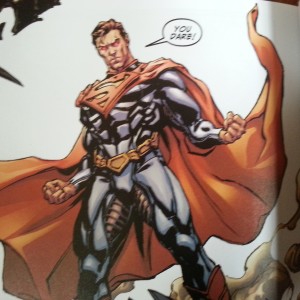
The last few pages totally stoked my fires. Anyone that knows me knows that I like art sections and this guide did not fail me there. There is some gorgeous game art to enjoy, so take the time to appreciate what the artists are capable of producing. For anyone who is reading the Injustice comic books, you will find a special comic tucked away at the very end. I still find myself thumbing through this area and enjoying the crap out of it.

I want to note that Prima realizes that fighting games go through changes and they appear to address that with a website that will contain updates to this guide. At the time of this writing, there was nothing there, so time will tell how well this strategy works out. What would really rock with this website is if they would include some pro-tips and tricks. Just a thought, Prima!

Oh yes I do!

Oh yes I do!

This is not the best fighting strategy guide to grace my desk, but it is not the worst guide to come across it either. Almost all the info on the pages is found somewhere in the game, and the combos are a bit rough to read through. Diehard fans will find the Injustice: Gods Among Us strategy guide a nice piece to add to their book collections, and anyone completely new to fighting games will find it rather valuable. Veterans, however, might want to just skip this on by.

SGR Rating 3/5

Author: Sam Bishop, Carl White, Emmanuel Brito, Bill Menoutis
Publisher: Prima Games
Editions Available: Hardcover
Acquired via Publisher

Filed Under: Strategy Guide Reviews

Gears of War: Judgment Mini-Review

May 8, 2013 By Keri Honea Leave a Comment

Gears of War: Judgment

After sitting down with Epic Games and People Can Fly this past year at E3, I was unbelievably excited about Gears of War: Judgment. I was excited to be able to play a Gears game starring my favorite character, I looked forward to the changes they discussed, such as random spawn system and the Declassified mission settings. I couldn’t wait to see why Baird lost his officer rank, which rolled into why he was initially so angry towards Marcus when his rank was reinstated after his time in the Slab. After being in such an unhappy gaming slump since November, I was overly eager to play a game I was honestly excited about. And then came the utter disappointment.

From what I understood about the Declassified mode of the missions, I believed this setting would unlock some hidden tidbit to Baird’s story. I was not expecting the mode to simply add on an extra set of parameters to make the mission more difficult. On the one hand, I enjoyed the Declassified settings because it forced me to use weapons I normally do not, which was fun. On the other, it added absolutely nothing to the story.

The story itself was done an awful disservice by the length of each mission. Each mission, at its longest, was ten minutes. Most were less than five minutes, and at the end of each mission, you were given a rundown of your performance, much like in an arcade version of the game–think Bayonetta or DmC: Devil May Cry. This wouldn’t have bothered me so much if the missions weren’t so short. Since the missions were so short, breaking them up with a report card really broke up the story, killing it of all chances really be anything cohesive. It honestly made the story in the first Gears of War look absolutely stellar.

In addition, what happened to Baird and Cole’s characters? Cole was virtually silent the entire game, which is completely not like him. There were hardly any funny quips from him, and I can say the same about Baird, save one comment he uttered that stood out. Sofia and Paduk had far more lines, far greater character development, which is fine on the hand that they are brand new characters, but they completely overshadowed Baird and Cole. In the other games, Baird and Cole were just as well developed as Marcus and Dom.

Also, I have to wonder if the writers of the game bothered to read any of Karen Traviss’ books, as her books and even the previous games, made it QUITE clear that Baird had a huge problem with women serving in combat. And yet in Judgment, he is overly nice to Sofia. Not one crass comment, not one sexist comment, and he never made fun of her. If you’ve played any of the prior games or read the books, you know that’s not Baird’s personality, whether it’s with men or women.

The best part of the entire game was the Aftermath campaign that unlocks after you obtain 40 stars in the main campaign. This campaign took place during Gears of War 3, when Baird, Cole, and Carmine separated from the rest of the group to hunt down a boat around Act III. Aftermath completely reverted back to the original Gears formula of gameplay, and was almost instantly more enjoyable. Baird and Cole even transformed back to the sassy characters we’ve grown to love over the first three games.

As a huge fan of the series and of Baird, Gears of War: Judgment was an incredible disappointment to me. If you haven’t bought it yet and are interested in the game, I strongly recommend a rental, as you can easily beat both campaigns in about ten hours time. I’m not going to actively pursue a 4-player team to play it on Insanity, and I doubt I’ll touch the multiplayer. I’d honestly rather play the first game again than Judgment.

Filed Under: Mini-Reviews

  • « Previous Page
  • 1
  • …
  • 25
  • 26
  • 27
  • 28
  • 29
  • …
  • 57
  • Next Page »

Follow us!

Subscribe!

Upcoming Strategy Guides

 Nothing here. Come back later. 😢

Latest Strategy Guide Reviews

The Walkthrough by Doug Walsh Review

Red Dead Redemption 2 Strategy Guide Review

Mega Man 11 Strategy Guide Review

God of War Strategy Guide Review

Far Cry 5 Strategy Guide Review

Friends of SGR

  • BradyGames
  • Dan Birlew – Guide Writer
  • Doug Walsh – Guide Writer
  • Future Press
  • Game Enthus
  • GameWires.com
  • Piggyback
  • Press the Buttons
  • Prima Games
  • Racing Games

Top Posts & Pages

  • Monday Gaming Diary: Keeping the LEGO Marvel's Avengers in Focus
  • Weekly Poll: How Many Video Games Do You Play at Once? Redux
  • Assassin's Creed: Brotherhood Strategy Guide Review
  • Ultimate Marvel vs. Capcom 3 Strategy Guide Review
  • A Eulogy for my Xbox 360

Copyright © 2026 · Web crafted by Warkhammer

Loading Comments...