• Home
  • About Us
  • Podcast
  • Strategy Guide Wit
  • Contact

Strategy Guide Reviews

A Strategy Guide for your Strategy Guides

  • Reviews
    • Strategy Guide Reviews
    • Video Game Reviews
    • Mini-Reviews
  • Features
    • Interviews
  • News
  • Unboxing Strategy Guides
  • Columns
    • Gaming Diary
    • Corner of Randomness
  • Videos

Luigi’s Mansion: Dark Moon Strategy Guide Review

May 7, 2013 By Nicholas Michetti 2 Comments

Luigi's Mansion Dark Moon strategy guide reviewLuigi’s Mansion Dark Moon is unique for a Nintendo game, in so far as it maybe being the closest thing to a point-and-click adventure title that they’ve ever created. Point-and-click adventure games, though, involve discovery, puzzle solving, and finding secrets. Because of those gameplay elements, I haven’t always been the best at those types of games, so I can very much understand how much some gamers (maybe younger gamers in particular) may need a strategy guide for some assistance with a game of this kind. Prima has a Luigi’s Mansion Dark Moon strategy guide though, that will be able to direct gamers through every mission in the game with next to no problems.

Dark Moon isn’t a complex puzzle game or anything–after all, it is a game in a Nintendo franchise–and it seems to have been designed with quite a lot of accessibility in mind, so the game doesn’t have any real puzzles per se. However, that doesn’t mean that the game doesn’t have any occasional moments where it might not be completely clear as to what the player should do next. For those moments and finding just about every secret the game has to offer, Prima’s strategy guide is amazing. The guide doesn’t only point out what players should do, it also directs them on a route through each mission that involves accomplishing all of the various mission goals, discovering hidden gems, and finding Boos as easily as possible. If there are easier or more expedient routes through the game’s missions that involve doing everything possible in a single playthrough, I honestly can’t imagine them.

Gamers who may be having problems with combat will be greatly helped by the strategy guide as well, especially later in the game when the strongest ghosts begin to emerge. The guide goes into as much as detail as possible, letting players know when they’re most likely to encounter which ghosts and also how and when to engage them. The notifications on when group ghost captures may be possible can be especially useful, as group captures can slice combat times into a fraction of what they’d be if the player had pursued individual captures. Speaking of combat, I slightly disagree with the guide’s occasional advice to capture Greenies (the most harmless ghosts) last, as I had tended to have major capture attempts interrupted by them from time to time. However, I also found instances where that advice was correct as well.

The multiplayer section of the guide is designated to just a few pages, which is apropos, since the multiplayer in Luigi’s Mansion Dark Moon is very straightforward, with few significant variations. The guide’s advice is as helpful as it can be and offers as many tips as it can, which will certainly be a welcome heads-up to players jumping into multiplayer for the first time or first few times. However, the multiplayer is so easy to grasp that with any kind of regular play, players will quickly learn how mostly everything functions. The guide does cover as much of multiplayer as possible, though, and the advice on some elements that the player might not know how to address at first glance (curses, for one) is welcome.

The layout of Prima’s strategy guide is very easy to navigate, with good-sized screenshots to let players know where they’re supposed to be or what they’re supposed to be doing. Gems, Boos, and general cautionary advice are contained in medium-sized call-out boxes that flow well with the layout of the guide. Big text indicates when the guide’s directions are shifting focus (i.e. from “Find the Poltergust 5000” to “Find the Strobulb”), so the text just isn’t sprawling down the page with directions. The guide has a fun, colorful design and bits of concept art are integrated nicely throughout some of the pages, instead of being gathered into a section in the back of guide. The guide’s design matches the fun/tiny bit scary mood of the game with appropriate bright and dark colors (i.e. green, purple, black, blue, and red) as well.

The guide does have a few minor trouble spots, though. Despite being mostly comprehensive, the guide had an odd few moments where it didn’t mention treasure that was available. For instance, the guide doesn’t mention that a stack of cash sits at the top of the West Garden area of the Haunted Tower and is available for players to collect for at least three missions. Another instance is the drill in The Old Clockworks, which can be vacuumed for coins for at least one or two missions. A strange instance also came up where the guide lists a mini-game in the Roundhouse Brawl mission as being available in the door of the northeast corner of the Canyon Narrows, but I was unable to find it there. Mentioning these errors is certainly nitpicking at an otherwise near-perfect guide, but they stood out because of the guide’s generally very high level of accuracy.

Curiously, while the guide doesn’t list the criteria or any general guidelines for gaining three-star ranks (the maximum rank) on missions, it does mention the factors that weigh in on how they’re graded. I’m not sure if the ranking information was available, as I occasionally found that some missions that I thought I had performed badly on were graded better than I expected and vice versa. (Maybe the game uses some variables to generate the grade?) However, I did generally find that following the guide’s advice and going through missions at a somewhat moderate pace had generally rewarded me with a two-star ranking, sometimes three.

The Luigi’s Mansion Dark Moon strategy guide from Prima is absolutely worth picking up, especially for those who might need help. The guide really doesn’t leave any stone unturned for the most part and is as clear and direct as possible with its instructions. From missions to boss fights to combat, the guide is just fantastic at directing players towards the fastest and easiest paths in the game. Plus, the guide’s advice is simple and straightforward, making it accessible to a wide number of players across age groups. Prima’s guide is able to help any Luigi’s Mansion Dark Moon player accomplish just about everything they’ll need to in the game and anyone in need of help from the guide definitely will not regret buying one.

SGR Rating: 4.5/5

Author: Nick von Esmarch
Publisher: Prima Games
Editions Available: Paperback
Acquired via Publisher

Filed Under: Strategy Guide Reviews

BioShock Infinite Strategy Guide Review

May 3, 2013 By Keri Honea 1 Comment

BioShock Infinite strategy guide reviewThe first BioShock took gamers to a disturbing utopia at the bottom of the ocean, and BioShock Infinite took players to an equally disturbing utopia high in the clouds. Both games were filled with well-hidden collectibles and plenty of venues for exploration, which is exactly why I wanted the strategy guides in the first place. The collectibles in both games included audio files that really fill in the overall story, and since I missed a few audio files with the first game, I really wanted to make sure I found them all the first time with BioShock Infinite. As such, I had almost as high of expectations with the BioShock Infinite strategy guide as I did the video game itself. While I was able to find all of the Voxophones in this game thanks to the guide, the strategy guide completely failed me on finding another collectible. Couple this with the fact that I had problems with the strategy guide’s overall presentation, I was almost as disappointed with the BioShock Infinite strategy guide as I was with the game.

Plenty of the strategy guide was absolutely fantastic. I admit that I rarely look through the front sections of strategy guides unless I need help choosing a character or class or if the game absolutely fails in properly teaching me the control scheme. However, as I flipped through the strategy guide one day, my eyes caught two tidbits that made me stop, turn back, and give the front sections more attention. The first was the code players could tap in to unlock the 1999 Mode, which traditionally unlocks after you complete the game for the first time. It turns out you don’t have to wait for the punishing difficulty level; you only need to enter in the world famous Konami Code. A few other websites posted this after the game’s release, but I was blissfully unaware (as usual) until I noticed this in the strategy guide, and yes, it garnered a chuckle.

The second thing that surprised me about the front section of the guide was the breakdown of Gear combinations to create specific builds for Booker. For example, for the Wizard build of Booker, the strategy guide suggests wearing the Storm Hat, the Blood to Salt Shirt, the Overkill Boots, and the Head Master Pants so that Booker can primarily focus on using elemental Vigors such as Shock Jockey and Devil’s Kiss. Since I focused on staying alive as long as possible, I wish I had looked at this section sooner, so I could have tried out the Defender combination, which looks like it would have been far more effective than the combination I used.

I primarily used the strategy guide to ensure I did not miss any collectibles in the game, since this is actually the most challenging portion of the game (unless you’re playing on the hard or 1999 difficulties). The world of BioShock Infinite is massive, and it’s incredibly easy to miss the large number of collectibles scattered about, especially since so many are hidden in high places or only appear after going through Tears. I am very pleased to say that thanks to the strategy guide, I did find every telescope, Kinetoscope, and Voxophone. There is absolutely no way I would have found them all without assistance, as there was more than one occasion that I would have overlooked them when coming through a Tear, while they hid behind signs on top of buildings, or as they popped up during high action sequences that spurred me to move on instead of exploring like I should have.

Infusion Problem with BioShock Infinite strategy guide

Something doesn’t add up…

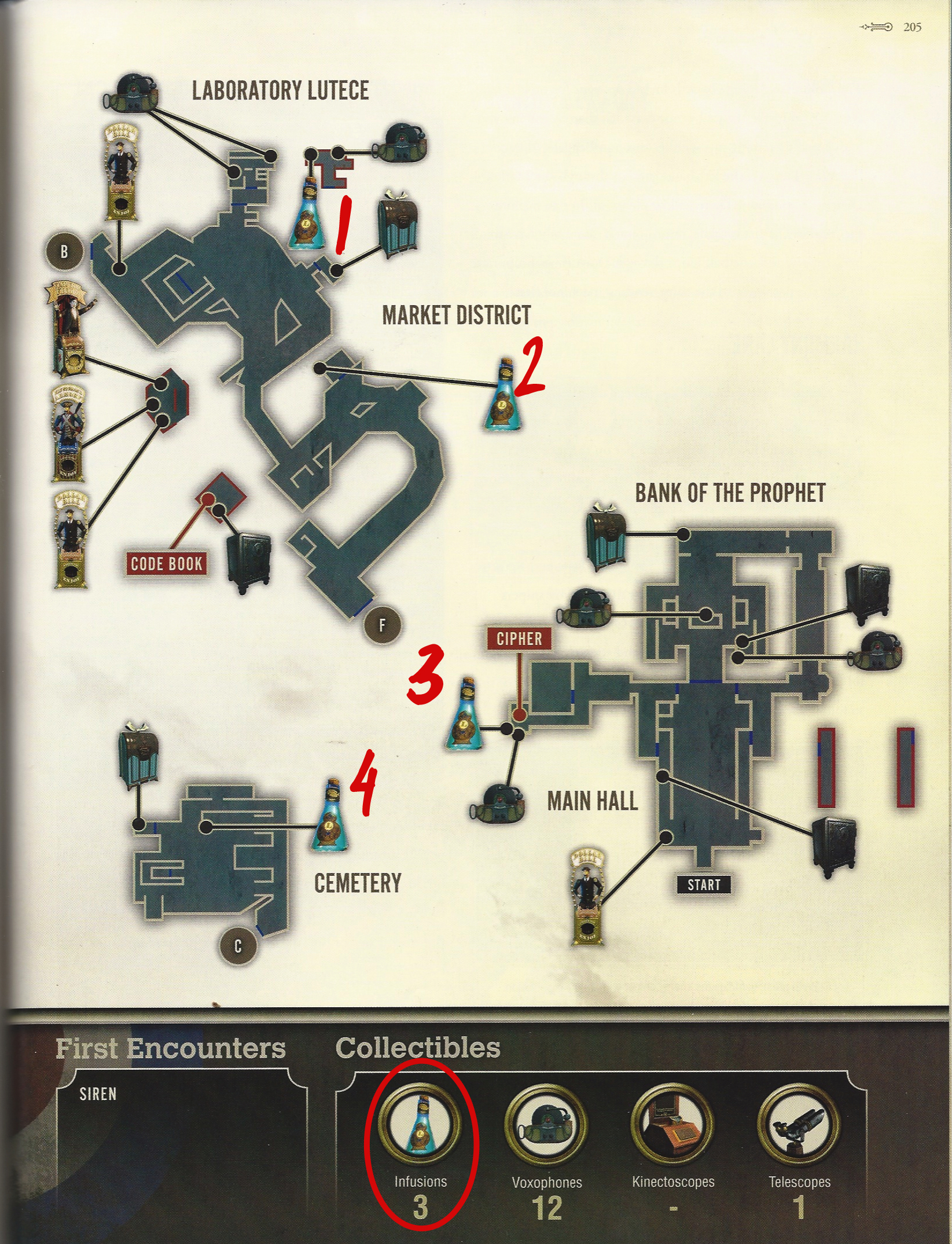
That said, however, I never found every Infusion the game offered. When that Achievement didn’t unlock, I was honestly confused, as I could have sworn I found every single one the strategy guide pointed out. The game said I found 23 Infusions, and apparently there are 30, allowing players to max out all three levels for Booker. I assumed I didn’t follow the strategy guide as carefully as I thought, so I started to count the marked Infusions, and I noticed something rather intriguing.

  • Infusions marked on maps–22
  • Infusions listed in chapter summary (see bottom of image on right)–25
  • Infusions mentioned in written walkthrough–22

I counted each of these about three times, because I couldn’t believe how they didn’t add up. As I puzzled over it, I noticed that on a few occasions, the number of the Infusions shown on the chapter maps didn’t match the number listed in the chapter summary below the map, as shown to the right. No wonder I didn’t find them all; not all of them were even listed in the strategy guide! I had hoped that maybe there was an appendix in the back that listed all the locations, but no such luck.

I also can’t help but think if the guide writers or book designers had made call-out boxes in the written walkthrough depicting where each Infusion was hidden, like they did with the Kinetoscopes and Voxophones, perhaps the all of the Infusions would be properly marked. Then again, the walkthrough has so many call-out boxes as it is, perhaps it would have worsened the strategy guide’s overall presentation.

The strategy guide is divided by game chapters (which are separated by Achievements/Trophies), then again by mission objective and scene. Each new scene kicks off with its own map and collectible summary with the written walkthrough to follow. Sometimes the written walkthroughs for a scene are placed before the scene map, which makes following along with both the writing and the maps quite confusing. I couldn’t decide while playing if this was a result of how the game is and the book designers did the best they could or if this was just a bad strategy for the book. Sometimes it was definitely the former, the product of the game, and sometimes it was the latter. As a result, I found myself looking at the book more than I wanted, forcing me to pause the game more often than I wanted, just so I could attempt to find out where I was between the walkthroughs and the maps. I do blame how long it took me to finish the game on how much time I had to stop to read the strategy guide. I like strategy guides to make my game times more efficient, and I felt like this one greatly slowed me down.

The BioShock Infinite strategy guide is very, very hard for me to recommend. On the one hand, I found two-thirds of all of the collectibles with its help, unlocked all of the side quests, and I’m certain I found all the Gear in the game even though there was no Achievement to tell me so. I also really enjoyed the extra developer commentary that was sprinkled throughout, and I most likely didn’t die as often I would have without its help. At the same time, I’m really disappointed in the Infusion problem, and I can’t get over how often I got lost in the book, which took away too much time from the game. The BioShock Infinite strategy guide is definitely above average, but it’s not one of BradyGames’ best either.

SGR Rating: 3.5

Authors: Doug Walsh and Logan Sharp
Publisher: BradyGames
Editions Available: Paperback and Collector’s Edition
Acquired via Publisher

Filed Under: Strategy Guide Reviews

Mass Effect 3 Citadel DLC Mini-Review

April 17, 2013 By Keri Honea 2 Comments

Citadel DLC

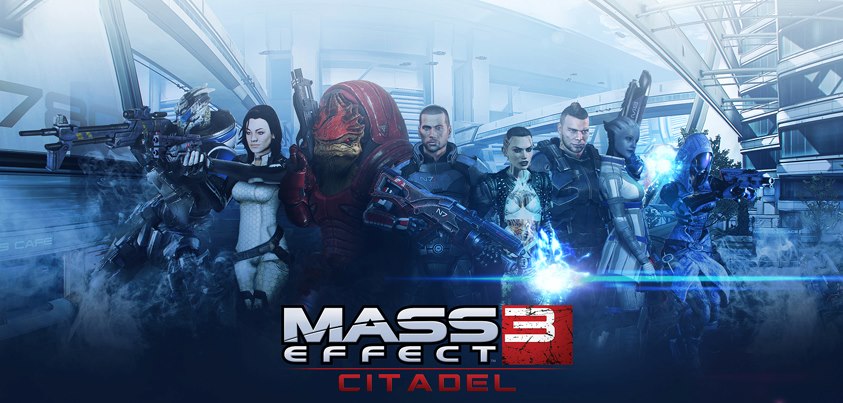
To be blunt, unlike the Leviathan DLC and even the Omega DLC, the story behind the Mass Effect 3 Citadel DLC is awful. Absolutely awful. When I learned who is trying to kill Shepard this time, I literally rolled my eyes. Thank God even the characters made fun of the story arc. And there, right there is why Citadel is a must-play for Mass Effect fans–it makes fun of everything Mass Effect.

I laughed all the way through the DLC, and it wasn’t just at the abysmal main plot. The dialogue between the characters is exceptional, and they make fun of everything you can imagine, from things Shepard says to the no love for the Mako to mini-games to the conversations characters had in elevators in the first game.

And the dialogue only gets sillier when you throw your party in your new apartment on the Citadel.

This was nothing but a love letter to all the fans who have loved the entire series, and as much as I normally don’t like these types of omake theater, I absolutely loved this. And as a side note, if your Wrex is still alive, take him with you everywhere. You will not want to miss anything he has to say.

I want to share some of my favorite snippets, but at the same time, it would spoil how great it is when your hear it for the first time. Trust me, you want it all fresh.

Citadel adds nothing to the overall story of ME3, but it’s so much fun, I can’t recommend it enough. This was a glorious send off for Shepard from BioWare, and it’s not one to be missed, even if you aren’t as huge of a Mass Effect fan as I am.

And yes, I will be replaying this DLC with my Shepard who has committed to Garrus. I MUST see those interactions.

Filed Under: Mini-Reviews

StarCraft II: Heart of the Swarm Strategy Guide Review

April 16, 2013 By Chris Nitz Leave a Comment

Star Craft II: Heart of the Swarm strategy guide reviewKerrigan is back and this time players get to guide her on her quest to remove Mengsk from power. I’ve looked forward to this game as the Zerg are my race of choice in the StarCraft universe, and Blizzard did not disappoint me with Heart of the Swarm. Adding to this fun was my opportunity to review the Heart of the Swarm strategy guide from BradyGames.

As all good guides do, this one starts out with some basics on game mechanics. I’ll just assume most everyone knows how StarCraft 2 plays at this point, but if you don’t, take a few minutes to acquaint yourself with this section. Veterans should skim over it as it does provide info on the changes between Wings of Liberty and Heart of the Swarm; however, the bulk of text here is fundamental base management, resource gathering, and combat tips.

Tips, everyone loves a good tip!

Tips, everyone loves a good tip!

Blizzard did make the single-player campaign a bit easier, so I found myself only hitting this portion of the guide when I was trying to complete a few side objectives. For example, I would hunt down the tips and maps on where certain items were scattered about a map so I could quickly snag them before a timer expired or I drove the computer to an early grave. The players who want to tackle the harder difficulties will find some solid nuggets of advice that will make dominating harder opponents that much easier. At the end, we find the evolution of the swarm along with some thoughtful reasons why a player may choose one mutation over another. Also, let’s not forget how nice it is to have maps that clearly show where that third base can go and where the enemy might be hiding! While I may not have relied on this portion too heavily, when I came here for advice, it delivered while it held my hand and gave me that achievement I lusted for.

From here, we move into the multiplayer area where I am still spending a whole lot of time. Not only does BradyGames provide a solid foundation for players to start their ladder climb with, but also there is some rocking advice for those that want to make their way from bronze to masters leagues. Everything from base management to military and economy receive plenty of attention and detail. I found myself relying heavily on the Tech Tree while I honed my skills as a Zerg player, but also to use this info to know what my opponents might be doing and how to effectively counter them. What really took my game to the next level was watching profession level players while studying the units, maps, and tips that fill these pages. Yup, I’m rocking some bronze level players, and I don’t even play that seriously. Thank you, BradyGames!

While I am still using the guide as if I were cramming for a final exam, there is one thing that hinders it, and all strategy books for that matter. This does a fine job of giving players a good foundation for both destroying the single-player campaign and some legs to stand on as they try to climb the competitive scene. What print cannot do is change as patches, or even the meta of the game, ebbs and flows from month to month. Don’t get me wrong; everyone should know their tech trees, basics of economy management, and units, but as players introduce new strategies while changing existing ones, the book cannot stay current. This is just the nature of the beast.

Know thy enemy!

Know thy enemy!

At the end of the day, I love this strategy guide. Just short of the Dark Souls strategy guide, I find that this is one of the most useful books to grace my desk in recent months. I should also mention that I am reviewing the collector’s edition, so it looks really sexy next to my Wings of Liberty guide and I have to keep fighting my wife away from the paper craft toys that came with the guide. While I would have loved an art section, BradyGames did a magnificent job with the page layouts, and bringing the Zerg aesthesis to the pages. Now I am super excited to see what they do for the Protoss expansion!

SGR Rating 4/5

Author: Rick Barba, Phillip Marcus
Publisher: BradyGames
Editions Available: Hardcover
Acquired via Publisher

Filed Under: Strategy Guide Reviews

Omega DLC Mini-Review

April 10, 2013 By Keri Honea Leave a Comment

Mass Effect 3 Omega DLC

Take all of the love I spouted for the Leviathan DLC for Mass Effect 3, and that is the amount of indifference I have for the Omega DLC. If you really only have funds for one or two DLC for ME3, you can skip the Omega DLC entirely. Your money or MSP is far better suited for the Leviathan and Citadel DLC–of which I will discuss very soon.

While playing the main campaign of ME3, you undoubtedly came across Aria hanging out in Purgatory and hating life since Cerberus ran her out of Omega. She mentions that she will take back her rock, but before the DLC released, you really had no idea what she would be doing, although you could be sure it would be of epic violent proportions. Thanks to the DLC, you can help her take back Omega from Cerberus, but the mission itself is about as exciting as any of the other Cerberus side missions found in the game. The main problem is that it is ten times longer than any of those side missions, so yes, boredom is almost guaranteed.

The second problem I had was that you couldn’t take any of your teammates with you. Aria doesn’t trust any of them–Garrus I could understand because he was Archangel on Omega, but no one else?–so you team up with pretty much just her throughout the mission. She’s not a team player, she doesn’t have anything interesting to say, and I wasn’t a fan of her powers.

About the only aspect of the mission I enjoyed at all was seeing a female Turian for the first time. You know females of other races exist (aside from the asari, anyway), but you never see any of them until ME3. First it’s a female salarian, then a female krogan. With the Omega DLC, you finally see a female turian–which really looked like General Grievous.

You also encounter a new form of Reaper, one that Cerberus created themselves and then let go out of control. As someone who read the books, I wondered if these experiments were phase two of Cerberus’ Reaper experimentation on Paul Grayson. If so, I feel for him even more than I did while reading. These things were both scary and looked absolutely painful in their existence.

Other than that, there are no strong main campaign ties to the DLC, and it honestly adds very little overall. As such, I really can’t recommend its purchase beyond the die-hard Mass Effect fan.

Filed Under: Mini-Reviews

  • « Previous Page
  • 1
  • …
  • 26
  • 27
  • 28
  • 29
  • 30
  • …
  • 57
  • Next Page »

Follow us!

Subscribe!

Upcoming Strategy Guides

 Nothing here. Come back later. 😢

Latest Strategy Guide Reviews

The Walkthrough by Doug Walsh Review

Red Dead Redemption 2 Strategy Guide Review

Mega Man 11 Strategy Guide Review

God of War Strategy Guide Review

Far Cry 5 Strategy Guide Review

Friends of SGR

  • BradyGames
  • Dan Birlew – Guide Writer
  • Doug Walsh – Guide Writer
  • Future Press
  • Game Enthus
  • GameWires.com
  • Piggyback
  • Press the Buttons
  • Prima Games
  • Racing Games

Top Posts & Pages

  • Monday Gaming Diary: Keeping the LEGO Marvel's Avengers in Focus
  • Weekly Poll: How Many Video Games Do You Play at Once? Redux
  • Assassin's Creed: Brotherhood Strategy Guide Review
  • Ultimate Marvel vs. Capcom 3 Strategy Guide Review
  • A Eulogy for my Xbox 360

Copyright © 2026 · Web crafted by Warkhammer

Loading Comments...