• Home
  • About Us
  • Podcast
  • Strategy Guide Wit
  • Contact

Strategy Guide Reviews

A Strategy Guide for your Strategy Guides

  • Reviews
    • Strategy Guide Reviews
    • Video Game Reviews
    • Mini-Reviews
  • Features
    • Interviews
  • News
  • Unboxing Strategy Guides
  • Columns
    • Gaming Diary
    • Corner of Randomness
  • Videos

Ni No Kuni Strategy Strategy Guide Review

March 5, 2013 By Chris Nitz Leave a Comment

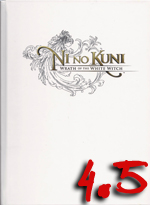
Ni no Kuni strategy guide reviewI must be honest in that I had no idea what Ni No Kuni was until I saw the cover art for the strategy guide from Prima. This simple glimpse had me digging for more info about the game and ultimately led to dropping some cash for a preorder. All I can say is that I am so glad I snagged this game, and even more so that I was able to use this guide throughout my many hours of playing in this unique and wonderful world.

To start, the Ni no Kuni strategy guide wreaks of quality. I don’t know what Prima did, but even just thumbing through the pages I noticed they felt thicker with a hint of a waxy coating. I found this hard to believe so I had my wife flip through it and she confirmed my feelings. Whatever Prima did, and factoring in that this may seem like a small detail to some people, it is a wonderful touch to bring up that quality feeling for the consumer.
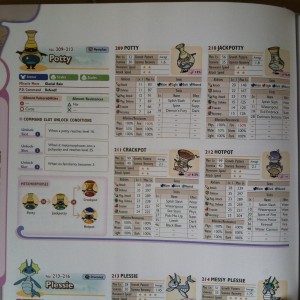
Yummy yummy details

Yummy yummy details

That attention to detail only carries over into the content that fills those waxy pages. While the game does a decent job of breaking down all the mechanics over the span of a few hours, the strategy guide provides a bit more detail. Anyone that might struggle with swapping familiars in and out or what to look for in enemies as to when to prep for a devastating attack, this section is the missing manual. I found myself reading through this a few times just to pick up more tricks to aide my combat skills. There is a lot to Ni No Kuni, so do not just skim over the first 22 pages, but rather take the tips and tricks to heart as they can save a controller from being thrown across the room in frustration.

Now usually the main walkthrough would start after the game basics, but Prima drops in the giant section for familiars. As these are the lifeline of the game, a lot of time goes into studying every drop of info here. Every familiar contains an easy to read breakdown of what they are capable of, their metamorphoses, unlock conditions, and strengths and weaknesses. Seriously, at 432 pets to collect, prepare to spend a good amount of time here. The last few pages provide a handy listing of all the fighting tricks these battlers are capable of performing.
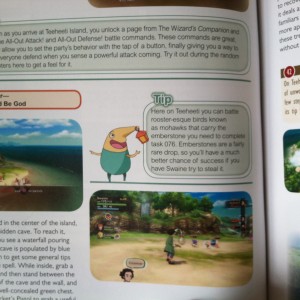
Mr. Drippy has all kinds of advice for you

Mr. Drippy has all kinds of advice for you

Finally, the walkthrough section begins. He we find not only a play-by-play of how the story unfolds, but some nicely detailed maps of where main quests, tasks, provisions, armor, and so much more might be found about the world. I also found the boss breakdown to be of great help as it prepared me for what to look for, what to avoid, and ultimately led to simplifying some very brutal battles. I should also note that this saved me some time in trying to get chests that I was not able to get until I acquired a new tool and trick.

What I did like is that the various tasks (side quests) not only have their own section (right after the main walkthrough), but they also have small blurbs about them in the main walkthrough. This saves a good amount of time flipping back and forth, as there is a lot of that already with the familiar area.

This does bring me into the task section. For those that may want more info on the abundance of side objectives, this section will make for a happy life. Any prerequisites, rewards, small descriptions of what to do, and when each task is unlocked may be found right here. The reward even details how many stamps one gets upon completion. I so loved this when I had limited time to play, but I only need two or three stamps to fill out my card.

The last section is an appendix that contains a thorough breakdown of enemies, items, important (see storyline necessary) items, and trophies. I didn’t spend as much time in here as I thought I would, but I did find myself coming here to find various weapon information as well as studying the various stats for some of the more difficult creatures in the latter part of the game.

I must also compliment Prima on their Heart of Ni No Kuni portion. This is at the very end of the book and it contains interviews and concept art for one of the most gorgeous games I have enjoyed in recent months. I recommend any fan take some time to read the interview portion as it really provides some meat to what it took to make this game and bring the vision to life, while the concept art is just a wonderful look at how the artists mind works when designing the assets.

Easy navigation for the win!

Easy navigation for the win!

One big thing to note here is how Prima even simplified navigating through the Ni no Kuni strategy guide. If you look at the side of the book, you will notice dark markings in a staggered pattern. These also correlate to a change in page colors. The main walkthrough, for example, is the middle marker on the yellow pages while tasks are the fourth marker down on green pages. While this may not seem like such a big deal, I found that I started to use this coding system for quickly jumping into the different areas of the guide if I had closed it during my play session.

I am extremely pleased with this strategy guide. If you are on the fence about this guide, just splurge and pick it up as it is worth every penny. The quality is superb and the amount of time it will save you in the long run is totally worth the investment. It also looks nice on the coffee table!

SGR Rating 4.5/5

Author: Howard Grossman
Publisher: Prima Games
Editions Available: Hardcover
Acquired via Publisher
Filed Under: Strategy Guide Reviews

DmC: Devil May Cry Strategy Guide Review

February 21, 2013 By Keri Honea Leave a Comment

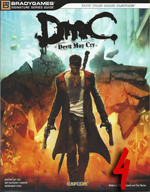
DmC strategy guide reviewDmC: Devil May Cry can really be summed up with two gaming elements: collectibles and massive boss fights. Okay, so it does have an emphasis on combos, but in terms of strategy guide meat, the combos are nice pieces of fluff that are more for each individual player’s benefit and play style. A strategy guide can’t really help players with combos, since players will prefer certain combos that are unique to each player’s gaming style. For example, I am terrible with executing well-timed combos (there’s a reason why I don’t review fighting games and their strategy guides), so any combos I saw that required a pause in button pressing was immediately ignored. Any combos that were a mash of buttons–particularly mashes of the same button–were instantly added to Dante’s repertoire. The only combos the DmC strategy guide called upon were the combos automatically given when Dante learned a new ability, and selfishly, I was most grateful for that. I might have thrown the strategy guide across the room if it called on me to use a specific combo I needed to purchase–especially because knowing my luck, it would be a combo I couldn’t master.

Now that I’ve completely digressed from the original point of that last paragraph, let’s get back to the two main elements of DmC: collectibles and massive boss fights. The game itself is pretty straight forward and doesn’t really host a fear of getting lost. There is some exploration in each level for collectibles, and like other DmC games before this one, several collectibles in each level aren’t accessible until you get a certain power later in the game. The strategy guide does a great job highlighting where to find each of these collectibles in the walkthrough. However, if you’re going back through the game or individual levels to open up areas you couldn’t before, obviously you aren’t going to want to re-read the walkthrough. That’s where the handy-dandy quick reference guide in the back comes in, which goes over every collectible and where to find it in a level. The quick reference also gives a nice heads up on all the secret missions (challenge doors), so you can read up on each mission and determine whether you want to partake in the challenge or not before walking inside.

As for the boss fights, it can be argued that the boss fights are a little force-fed as to what you need to do, especially the first real boss fight (the Succubus). While for the most part you could make that case, at least the DmC strategy guide never treated the player as such. Each boss was neatly laid out in their own separate walkthrough pages at the end of that particular mission. Each boss fight begins with a callout box listing the boss’s weak points, attack warnings, and basic tactics players should use against the boss. Think of it as a TL;DR section for those who don’t want to read the detailed strategy. Of course, I read the detailed strategy as I’m terrible fighting bosses. I found each strategy to be sound and they helped me get through each fight the first time and with little frustration.

As great as the DmC strategy guide is, I do have one complaint about it. The main walkthroughs really focused on obtaining every collectible possible, and sometimes snagging these required really convoluted paths, particularly the level in the soda factory. For those who aren’t out to catch ’em all, the directions may feel disorienting and lost-inducing, such as how to get through the soda factory. For the most part, this isn’t a huge problem as the levels are linear, but on occasion, it is easy to get turned around and confused as to where you need to grapple to next. If you’re trying to read the walkthrough, you’re only going to get more confused.

Since the DmC strategy guide really is for the collectible completionists anyway, my one complaint really doesn’t detract from the guide as a whole. The strategy guide is still the perfect companion for those who really want to get everything out of the game, and it nicely offers up extra assistance for those playing on the far more difficult settings.

SGR Rating: 4/5

Authors: Michael Lummis and Chris Burton
Publisher: BradyGames
Editions Available: Paperback
Acquired via Publisher

Filed Under: Strategy Guide Reviews

Paper Mario: Sticker Star Mini-Review

February 14, 2013 By Keri Honea Leave a Comment

Paper Mario Sticker Star Logo

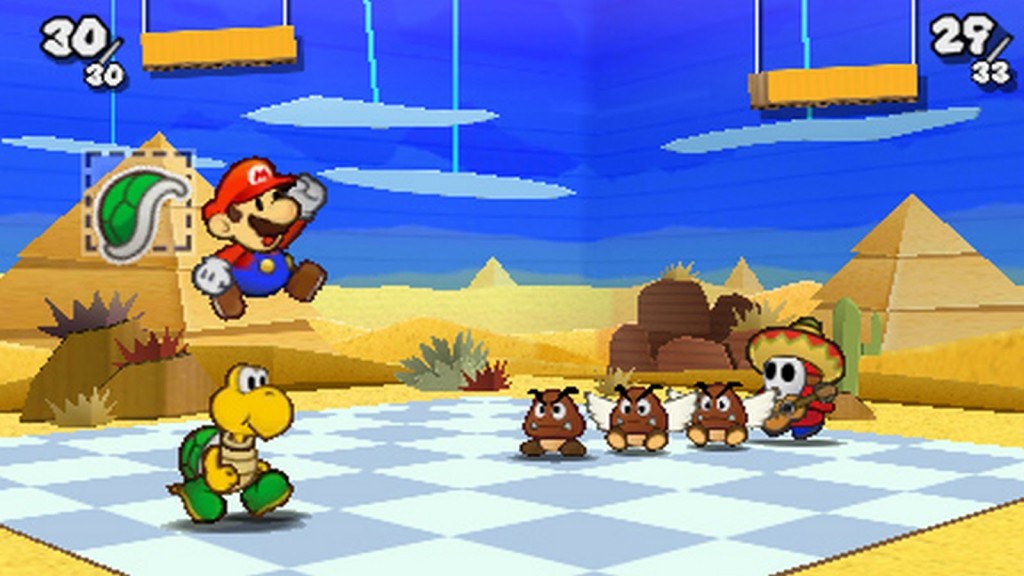
I finished Paper Mario: Sticker Star around Christmas-time, but I had to really mull on it after I finished to sort out my feelings on the game. I hadn’t really touched a Mario game of any sort since the NES days of Super Mario Bros. 3, so in many ways, I felt completely out of my element with this game. The Mario-verse has obviously evolved greatly since my last foray, and if it wasn’t for the strategy guide, I would have been absolutely lost and most likely would have rage quit halfway through World 2. After sifting through the pros and cons, my feelings when I first played and my feelings when I finished, and how much the strategy guide the held my hand, I have to say that while PMSS is extremely cute–at times downright adorable–and initially enjoyable, the experience does not hold-up enough for me to recommend it to anyone other than die-hard Mario fans (and they would have bought it anyway).

When I first started PMSS, I was elated. The game was so cute and clever with its presentation, gameplay, and interactions between characters. I had a great time planning out how to use my stickers, coming up with effective combos, collecting new stickers, and successfully executing those “Excellent!” attacks. I even found it charming how creative the developers were with how players can obtain the Things. For example, it was extremely clever to pick up a bowling ball Thing in one world and then remember that in a previous world there was an empty area that looked like a bowling lane. If you take the bowling ball Thing there and use it in that area, Mario hurls the bowling ball down the lane, striking pins that suddenly appeared. As a result, you can find a bowling trophy Thing in another level. Would I have ever figured that out 100% on my own? Oh hell no, I wouldn’t, but I appreciate how creative that idea was.

I also greatly enjoyed some of the cinematics and set-pieces of the game. The little poems that Kersti read after you defeated the main boss of each world were, for the lack of a better word, adorable. The Snifit or Whiffit Game Show was by far my favorite level of the entire game, so I really didn’t mind playing the gauntlet a second time with the Wiggler segment just for that Wiggler diary entry that really means nothing in the end. If that was a real game show, I’d most likely watch it (or at the very least, DVR it).

Paper Mario Sticker Star screenshot

While the gameplay was fun at first, by World 4, I found my enjoyment greatly lagging. Instead of playing several levels a night, I played one and then stopped because I was bored. Sometimes I would dedicate whole play sessions just to finding collectibles, just so I wouldn’t have to make my way through more repetitive gameplay. Halfway through World 5, I started to play the game maybe once a week instead of daily. By the time I started World 6, I had a hard time caring about playing at all.

This is honestly one reason why I’ve never finished a Mario game before. It’s partially because of the platforming, but it’s also partially because I get too bored with playing before I get near the end. The Legend of Zelda games have also suffered from a similar problem with me. It didn’t help that by the time you reached World 6, you needed to go back through some of the levels and “grind” a bit to restock your Sticker Album with the stickers that you will need to survive the regular fights you will encounter, much less the ungodly long fight with Bowser at the end. Maybe you’ll have enough coin to just buy the stickers you need, but most of the flashy stickers that you will need you cannot buy in shops, and they’re only found in specific levels.

Does it sound like your typical JRPG? Dear God, yes. So why can I hack something like Final Fantasy XIII but not PMSS? The only answer I have for that is that at least with other JRPGs, there’s a real story going on. With PMSS, the story is as bare bones as any other Mario game: Bowser has kidnapped Princess Peach. AGAIN. Granted, PMSS had a little more to it with the missing Royal Stickers fiasco, but that’s not enough of a story to keep me excited about mundane and repetitive gameplay.

Bowser - Paper Mario Sticker Star

I’m glad I ventured back into the world of Mario, no matter how brief my stint was, but I’m officially done with trying out new Mario games. I don’t like platforming, and even the RPGs don’t have enough story to keep the intrigue going. Mario and I are just not meant to be, and that’s fine. The Mario fanboys and fangirls out there are gleeful enough about Mario to make up for my indifference.

Filed Under: Mini-Reviews

LittleBigPlanet: Karting Strategy Strategy Guide Review

January 22, 2013 By Chris Nitz Leave a Comment

LittleBigPlanet Karting strategy guide reviewI am a big fan of kart racing games. Ever since Mario Kart first dropped on the SNES, my enjoyment of these games has spanned over eight consoles and covered everything from Crash Bandicoot to Diddy Kong. Now I get to take my favorite SackBoy for a romp in a kart through cardboard courses and collect stickers along the way, all thanks to LittleBigPlanet: Karting. It is sooooo much fun!

Prima also seems to like the world of imagination and racing because they pumped out a LittleBigPlanet: Karting strategy guide for us wannabe Mario Andretti racers. One would expect that cracking open the guide would immediately lead to the basics of how to control that amazing Bento Box, but this is not the case. Instead, we find concept art for stages, characters, and stickers. While this caught me by surprise, I loved it as it warmed me up the whimsical world I was about to partake. Don’t worry, the basics of braking, prize bubbles, and drifting come right after this, but take a moment to enjoy the art assets that the developers work hard at producing.

Better than GPS

Better than GPS

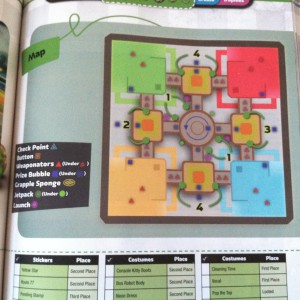
After the basics, it is time to dive into the story mode. The authors breakdown each new event type, how many prize bubbles are scattered about the track, and list all the rewards earned for that stage. This is where the detailed maps of every race come in handy as they show where one may find all the prize bubbles along with things such as launch points, jet packs, weaponators, and such. Concluding each race, they go into detail on what to watch out for during the event, how to obtain some of the harder to find items, and general tips on how to defeat the opponents. While this might be a racing game, I found that studying each event before I jumped into it in the game very helpful and led to fewer missed items and a lot less retries.

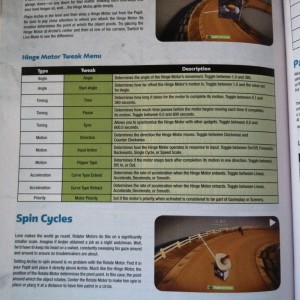
Scattered amongst the story section are the challenge races that unlock as the game progresses. Take some time to read these as they offer great advice on how to tackle each challenge, as these are no joke. For example, the first one that unlocks is a drifting course where the only way to unlock all the loot is to score 60,000+ points. The guide breaks down the course and offers up that it is best to use the first drifting boost instead of building it up to the maximum, as it takes far too long to snag that big burst of speed. Completing these challenges still ultimately comes down to player skill, but the advice offered here is invaluable.

LBP_Karting_Guide_Review_2

Excel, eat your heart out!

The last few pages go to the creation mode and end with the trophy list. Anyone who spent time in LittleBigPlanet 1 or 2 will immediately feel at home and so the creation section is more of a refresher on popit use as well as explaining the details behind the unique items available to track building. Newbies to this whole world building process will want to spend some time reading the pages here as they do offer up a bit more info than what the game does. There is good stuff here for all players, and master designers will find themselves coming back to this section during their building process.

There are a few potholes to all this, however. I found the guide took some time to sift through to find the current race I was on or the challenge mode I was tackling at the time. I also found a few prize bubbles I could not snag and the strategy guide said nothing about how to obtain them. These are far and few between, so they don’t necessarily constitute a deal breaker.

For a game that does not immediately feel like a strategy guide is necessary, I found myself using this a lot. Sure, there are a few points that I wish contained more detail on how to grab this or that, but overall this is fairly thorough and useful. Anyone that wants to have every sticker and kart customization piece available to them, the LittleBigPlanet: Karting strategy guide is your Bible!

SGR Rating 4/5

Author: Dean Leng and Ronald Gaffud
Publisher: Prima Games
Editions Available: Paperback
Acquired via Publisher

Filed Under: Strategy Guide Reviews

Far Cry 3 Strategy Guide Review

January 17, 2013 By Blake Grundman Leave a Comment

FC3-ratingIn this day and age it is legitimately rare for a AAA game to catch critics off guard. Probably the biggest exception to that rule in 2012 was Ubisoft’s late-November release, Far Cry 3. Not only did the game’s runaway success come completely out of left field, but many sites ended up considering it as a potential Game of the Year. Does Prima’s official guide live up to the same high standards, or does this open world shooter provide too many opportunities for details to slip through the editorial cracks?

First-person shooters tend to be extremely straightforward and provide a rigidly scripted experience for players. For this reason the idea of a guide for a game like Call of Duty is borderline laughable. All players really need to know for this brand of shooter is the continuous progression of, “see bad dude, shoot at bad dude, turn bad dude into fleshy meat blanket, follow blood trail to next pack of bad dudes.” Far Cry 3, in a refreshing vacation from the norm, exists on the polar opposite end of this spectrum. The game features a completely open world and mission structure that leave virtually all decisions in the hands of the player. For this reason, a game guide could prove to be an indispensable way to make the most of each session in the title’s massive sandbox of destruction.

Cracking the cover unleashes a bevy of developer access special features, which demonstrates how close Prima and Ubisoft worked in the production of the guide. Those that are fascinated by the development process will be in for a treat. Included are exclusive pieces concept art, straight from the team at Ubisoft Montreal. Along with a beautiful full two page spread for each of the game’s core characters, complete with fully page portrait, is a neat feature on how the studio came about the model design of the core villain, Vaas. Though most of the information in the descriptions could be gleaned through simply playing through the campaign, it is nice to read through these sections to get a good idea as to how each person fits into the overall universe of Far Cry 3. Plus, to put it bluntly, most of the portraits are a feast for the eye. Wrapping up the “Behind the Scenes” section is a collection of concept art highlighting different aspects of the tropical sandbox’s design. Accompanying the lush visuals are quotes from several key members of the development team, further explaining the images and how they fit into the game’s all-encompassing design.

Once the far too brief peek behind the curtain comes to a close, the introduction continues into the usual nitty-gritty basics of game mechanics such as different attack techniques, methods for reconnaissance, self-healing and a litany of other topics central to the success of a player. Following the predictable approach, this section is followed by breakdowns of each weapon’s stats. Just be aware that this contains details for both the freely available and unlockable firearms, as well as the criteria for accessing the aforementioned locked artillery. After the firepower is well in hand, the hunting of wild game, powering up abilities though the skill tree and the various forms vehicular navigation are all covered in sufficient enough detail to set a player’s mind at ease.

With all of the formalities out of the way, the guide wastes no time jumping into the campaign walkthrough. Early on it is noted that each of Far Cry 3’s thirty-nine story missions are open to being completed in many different ways, but the text tends to lean more towards a more patient, stealthy approach. Under most circumstances the sneaky method mentioned in each mission write-up not only provides the player with a good way to start each section, but along with it, the reasoning WHY it is the best way to go about accomplishing an objective. The additional narrative helps support the author’s logic, and also helps teach players the best way to handle similar scenarios. Also, pay close attention to the many “TIP,” “CAUTION,” and “NOTE” call-out sections, because oftentimes these share information that might not necessarily be pertinent to the specific mission, but may help save time down the road.

There are a couple of specific elements that the entire campaign walkthrough does exceptionally well. For one, the reader isn’t ever at a loss for in-game screenshots illustrating the specific points being discussed in the text. No need for image hunting here, because the layout is extremely effective in assuring the reader never has to look any further than the text margin. Tying up the up the layout with a neat little bow is the use of larger, most likely developer provided art assets, to fill what might have otherwise be unoccupied white space. Secondly, the body of commentary finds a way to strike a fantastic balance between effectively explaining how the mission fits into the context of the entire plot, while not allowing it to muddy the instructional portion of each set piece.

Along with the straightforward storyline comes a collection of additional missions that can be completed at just about any point during a playthrough of Far Cry 3. The individual missions are organized by their objective type, which include side story missions, scoring challenges, wild game hunts, and assassinations, just to name a few. Each quest is broken down in the most straightforward manner possible, many consisting of only a paragraph or two, along with what the payout or unlockable is upon completion. Most times this is really all that is necessary in order to steer the reader in the right direction.

As is usually the case with single player focused games of this nature, the multiplayer section is practically non-existent. After a brief description of each playable character in the co-op mode, key multiplayer concepts are tentatively delved into. Features such as leveling, airdrops and the flash drives awarded post-match are all afforded a couple of paragraphs, mostly consisting of restating the obvious. The last piece of the multiplayer breakdown is spelling out the objectives of the four match types. For some reason there are no specific multiplayer maps discussed. Perhaps maps are overlooked due to the map editor that ships with the game, but regardless, the complete lack of any sort of commentary or acknowledgement of the obvious absence seems odd.

Fortunately the disappointment of the previous four pages (yes, multiplayer is only four pages long) is short lived, thanks to the massively comprehensive outpost and radio tower segment. Every single one of the game’s thirty four outposts are analyzed concisely, showing both its location on the world map, as well as sharing valuable information as to the best methods of infiltration. Additional overhead shots of the area can further help players indulge their inner Paton, even planning out their own ambitious scheme of attack. It is worth noting that squeezing two outposts per page works well for a layout most of the time. However, when a given description is overly brief there tends to be rather large sections of the page left unutilized. The radio tower section unfortunately continues using this arrangement to breakdown most of the sprawling map’s eighteen key communication locations. Much like the outposts, these points are called out on a world map, along with a location screenshot and brief commentary on the most effective approach to scaling the tower. Though the design of these cumulative pieces tend to leave quite a bit of wasted space on the page, what is contained will be more than enough to set a player well on their way towards map navigation supremacy.

And what would a thorough guide be without a collectables section to round out the book? Each of the one hundred and twenty relics are numbered on the world map, which in turn ties into their number listing in the text. To go along with a textual description of each hiding place is a screenshot to provide players with additional context of where to look in regards to all of the foliage draped surroundings. Additionally, there are twenty letters from deceased military personnel scattered throughout. These are given the same detailed treatment of the previously mentioned relics.

Writing and designing a guide for an enormous world like Far Cry 3’s must assuredly be an exhaustively time-consuming task. Fortunately the author was more than up to it. Aside from the occasional lapse in page design, the book manages to provide extremely relevant guidance to the reader, without overwhelming them with too much information. Despite being slanted towards the stealth approach, much of the direction provided is useful to any gameplay methodology. Even when considering the blatantly transparent multiplayer portion, the quality of everything else more than helps it recover brilliantly. Those looking to venture into the tropical wilds of Far Cry 3 should definitely make sure to have this tome in their pack.

SGR Rating: 4.5/5

Author: Thomas Hindmarch
Publisher: Prima Games
Editions available: Paperback
Acquired via Publisher

Filed Under: Strategy Guide Reviews

  • « Previous Page
  • 1
  • …
  • 28
  • 29
  • 30
  • 31
  • 32
  • …
  • 57
  • Next Page »

Follow us!

Subscribe!

Upcoming Strategy Guides

 Nothing here. Come back later. 😢

Latest Strategy Guide Reviews

The Walkthrough by Doug Walsh Review

Red Dead Redemption 2 Strategy Guide Review

Mega Man 11 Strategy Guide Review

God of War Strategy Guide Review

Far Cry 5 Strategy Guide Review

Friends of SGR

  • BradyGames
  • Dan Birlew – Guide Writer
  • Doug Walsh – Guide Writer
  • Future Press
  • Game Enthus
  • GameWires.com
  • Piggyback
  • Press the Buttons
  • Prima Games
  • Racing Games

Top Posts & Pages

  • Monday Gaming Diary: Keeping the LEGO Marvel's Avengers in Focus
  • Weekly Poll: How Many Video Games Do You Play at Once? Redux
  • Strategy Guide Cover of the Week: Final Fantasy X
  • Why Should I Buy? Unboxing The Witcher 3: Wild Hunt Complete Strategy Guide
  • Halo: Reach Strategy Guide Review

Copyright © 2026 · Web crafted by Warkhammer

Loading Comments...