• Home
  • About Us
  • Podcast
  • Strategy Guide Wit
  • Contact

Strategy Guide Reviews

A Strategy Guide for your Strategy Guides

  • Reviews
    • Strategy Guide Reviews
    • Video Game Reviews
    • Mini-Reviews
  • Features
    • Interviews
  • News
  • Unboxing Strategy Guides
  • Columns
    • Gaming Diary
    • Corner of Randomness
  • Videos

SimCity Strategy Guide Review

April 9, 2013 By Blake Grundman Leave a Comment

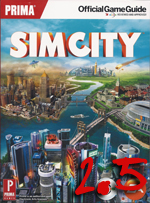
SimCity strategy guide reviewThose who are familiar with the most recent entry in Maxis’ storied SimCity franchise are probably just as familiar with its catastrophically terrible launch. Honestly, the only way you couldn’t know about the controversy was if you didn’t have an internet connection. But then again, you wouldn’t be playing SimCity either, right? Regardless of the politics of the matter, at the core of the conflict sits a game that is extremely complex and entirely redesigned from the ground, up. So what could better compliment the reboot of the brand than a SimCity strategy guide? Let’s just hope that the book fares better than its subject matter at culling the rage of PC gaming curmudgeons.

Sometimes it is hard to tread the thin line between being a strategy guide and a glorified manual that the player has to pay for in a bookstore. In many respects, the  SimCity strategy guide tends to have a bit of multiple personality disorder that precariously teeters in between the two very opposite ends of the spectrum. More often than not, item descriptions and specific details about elements in the world are torn word-for-word from the game itself. This might be somewhat unavoidable given the style of game it is trying to inform the reader about, but for Pete’s sake, the author should have made at least some attempt to pen original content. However, there are also whole dedicated strategy sections at the head of every city element sub-category such as roads, utilities, zoning, city services, mass transit, etc. Does the yin and yang manage to balance itself out? Probably not. But honestly, it would be hard to suggest solid play strategies to the player, without sounding a bit like a text box written by the game’s developers.

Actually, the developer Maxis’ aid in the creation of this book is very evident, both from a content perspective, as well as in the special features. For one, almost the entire introduction to the game and mechanics walkthroughs were penned by folks who actually designed the game’s core systems and interactions. Also, while it does seem like there is quite a bit of repeated information from within the title’s tool tips, at the end of each city element’s section there is a call-out featuring another member of the development team. In these areas the developer discusses pertinent hints, as well as topics about the items/landmarks being broken down in that specific part of the text. This was a nice touch that somewhat personalizes what could otherwise be viewed as semi-redundant data.

All of that said, there is a fair amount of explanation in each of these areas, talking about why certain landmarks are important to construct and how they can influence the rest of the city’s fragile ecosystem. It is far from the end-all, be-all, but it definitely provides a good jumping off point for those who are not familiar with how cohesively the entire city interacts with itself. The problem is that these extra detailed sections tend to be rather intermittent, depending upon what the writer deemed to be the most critical. There are far too many cases where whole chucks or page are left with vacant white space, accompanied by a literal copy and paste of text descriptions and statistical information straight from within the game itself.

Scattered throughout the text are the usual “Tip” sections that can be found in most current game guides. Though they might not always provide the most practical information, there usually tends to be some nugget embedded within that will tend to be very useful to even power players. Things like knowing to place different forms of mass transit within two hundred steps of each other, because the Sims are not willing to walk any further to make transfers are great clues that may not reach out and smack the player, but could drastically play a role in how one were to lay out a city. While not all suggestions are quite as useful as something like that, (and heck, it may even been something that is brought to the attention of the player by the game itself over time) getting the jump on this kind of information can help build a more thoughtful and appealing cityscape.

Another important section to pay special attention to is the “Disasters” portion of the guide. It may not be overly large, but anyone who has ever played a SimCity title knows how crippling these events can be, if not handled properly. This area outlines both what to expect when one of these disasters occur as well as what can be done to either brace/prevent the least amount of impact or how to recover in the aftermath. Achievement whores also take note, because all of the possible achievements that can be earned from surviving any particular onslaught are listed at the end of this section. Actually this holds true for pretty much every key section in the book, as well as listed in the “quick reference” at the end of the tome.

There are two main drawbacks from using a guide that is this closely tied to the developer. For one, most of the text about specific game elements tends to be borrowed from the source code, which has been mentioned ad nauseam earlier on. Secondly, with all of the sections written by members of the Maxis team, it is hard to distinguish between what is legitimately helpful information and what is PR-filtered fluff, that provides very little benefit for the lay user. With both of those criticisms in mind, what probably stands out the most is that this is a guide that is very much targeted at new SimCity players. Those that have had experience with prior iterations in the series will be able to learn about some of the newer nuances, but in most circumstances the text is regurgitating common sense.

One last unsettling note about the book is that at the beginning of every new section, there is a call-out in the bottom left corner of the page, reminding the reader to redeem their code for the digital guide. Thankfully this is included at no extra cost, with the purchase of the print guide. Given the nature of SimCity being an online-required game, it stands to reason that anything printed on the parchment could be rendered useless by a single update. Reasons like this tend to play more into the hand of electronic guides, and even though Prima already has one, why wasn’t this strategy guide electronic-only to begin with? At the end of the day it would seem that it would be the more logical and economical approach for all parties involved.

Prima’s official SimCity strategy guide manages to be competent enough to benefit the reader, yet not impressive enough to truly warrant a recommendation. Simply put, there are millions sites on the internet that provide far more up-to-date analysis and guidance, without the burden of a making space on your bookshelf for a mediocre work that often reads more like a curated press release than useful guidance. As is the case with most online centric games, readers may be better served turning to the forums.

SGR Rating: 2.5/5

Author: David Knight and Dorothy Bradshaw
Publisher: Prima Games
Editions available: Paperback and Kindle Edition
Acquired via Publisher
Filed Under: Strategy Guide Reviews

Gears of War: Judgment Strategy Guide Review

April 5, 2013 By Keri Honea 2 Comments

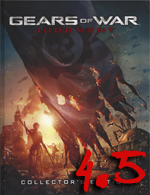
Gears of War: Judgment strategy guide reviewWhen Epic Games and People Can Fly announced that Gears of War: Judgment would implement a smart spawn system, thereby removing the possibility for players to memorize a level, I knew that the strategy guide writers for the game would have their work cut out for them. Whyile the smart spawn system wasn’t as extensive as I was led to believe, it still laid some tricky groundwork for the guide writers. Not to mention, each level would contain a Declassify mode, adding additional challenges for both players and the strategy guide writers to face. Of course, the strategy guide team at BradyGames was up for the challenge, and they knocked the Gears of War: Judgment strategy guide right out of the park. In fact, I enjoyed the strategy guide far more than I enjoyed the game itself.

In many ways, Judgment was structured similarly to past Gears of War games–large sections divided by smaller chapters. With Judgment, instead of breaking up the sections by scene, the sections are divided by who is testifying on behalf of the actions of Kilo squad. Within each bit of testimony, the section is broken up by 7-8 missions, which are more or less distinguished by scene. Each mission is extremely short by Gears standards; at the longest, they took me 10 minutes. At their shortest, especially if they were timed missions, they took less than four minutes. As such, you can see why the smart spawn system wasn’t as detailed as I had originally feared it to be; rather, what changed each time you visited the area was what enemies showed up. Don’t get me wrong, this still greatly changed my approach to getting through a level–defeating hordes of wretches is actually trickier than a team of drones and maulers. Because of this system, it was obvious that the writers played each level numerous times on the different difficulties so they could account for every possible scenario that would be thrown at the player. I would always know at the start of the mission what possible enemies could appear and where, even with the missions that had different waves of enemies.

Gears of War: Judgment strategy guide

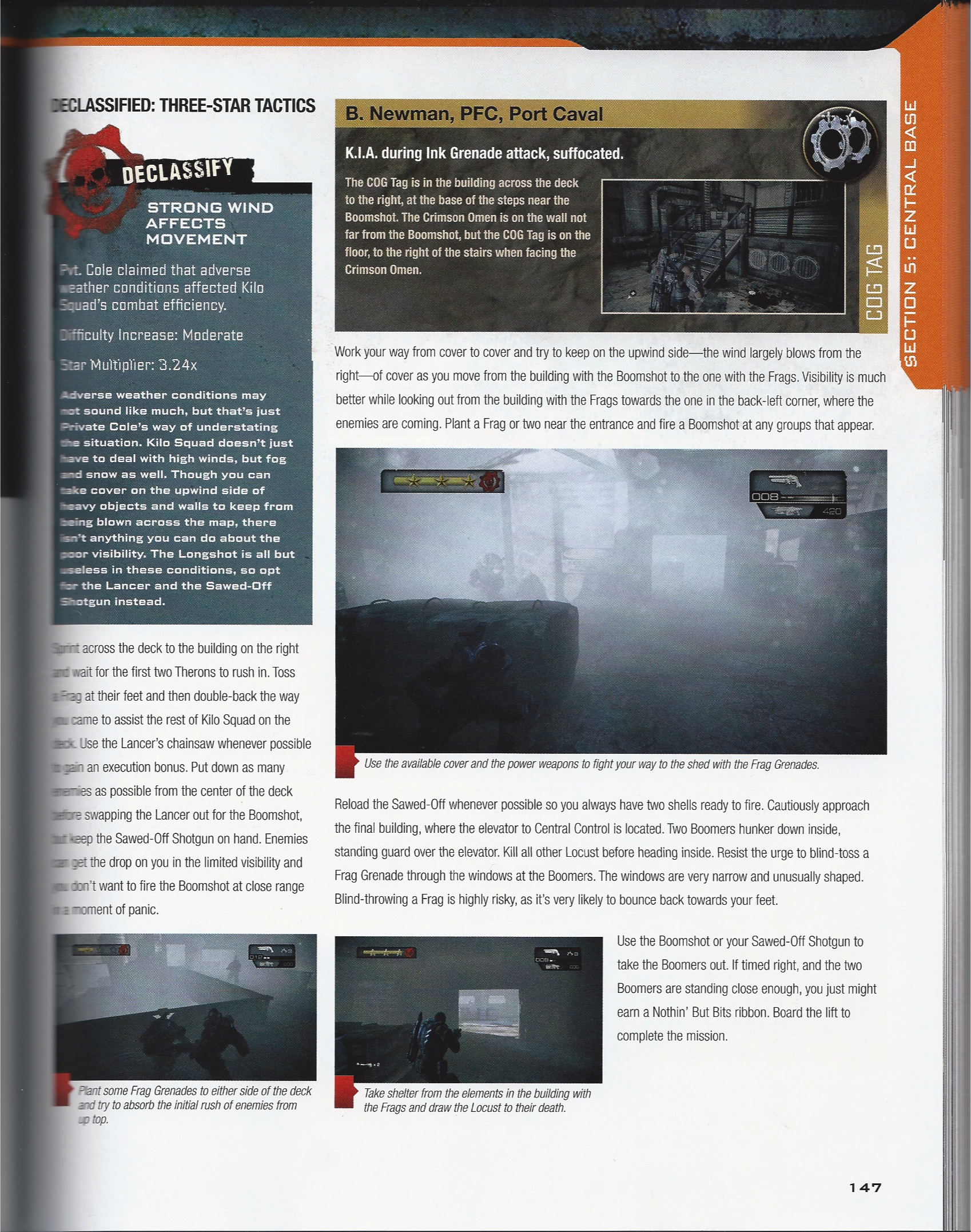
Declassify call-out box is super, super handy. Notice the call-out box for the COG tag? It will let you know if it’s feasible to snatch the tag during Declassify or not!

The point of Judgment is more of getting a three star award at the end of each mission for your performance than surviving the Locust forces, so the focus of the walkthroughs was on getting the highest ranking possible first, surviving second. It was kind of assumed that if you could get three stars, you would survive. Most importantly, the walkthrough always gave strategies for getting that three-star ranking without playing the mission as Declassified. When you turn the Declassified mode on, the stars fill far faster because the mode adds a greater level of difficulty. If you’re hunting for COG tags or you just don’t want to play Declassified right away, these strategies are crucial for filling up those stars. The fastest way to fill the stars is by earning ribbons, and the strategies are quick to tell you which ribbons are possible to obtain and the best way to earn them in rapid succession. Thanks to these tips, I was able to rack up at least two stars on every mission I played that I did not Declassify–as confusing as that probably sounds.

Since the Declassified mode added an extra set of parameters to each mission, such as adding a time limit, restricting weapons, reducing visibility, or adding more difficult enemies, the guide presented a separate call-out box with the Declassified mode details and its own strategies. I greatly appreciated this for two reasons:

  1. The strategy guide went into more detail about what the Declassified setting actually did than the game would. For example, the game, for one mission, said that Kilo had a reduced ammunition supply. The guide explained that this meant Kilo started with 30 rounds of ammunition for Lancers and there were no ammo boxes on the map.
  2. By knowing fully what I was up against beforehand, I could make an educated decision as to whether I felt like playing the level Declassified or not. I cannot stand time limits in any game, but I played a few of the Declassified missions that imposed time limits thanks to the strategy guide going over how difficult this challenge was, what the time limit was for each level of difficulty, and the level of gaming finesse you had to have to get through it. If the guide said you needed to be a master at performing head shots in quick succession, I skipped it. If the guide said you had to be fast, but by using this or this weapon, you could easily do it, I at least tried it. Believe it or not, I actually did most of the timed missions.

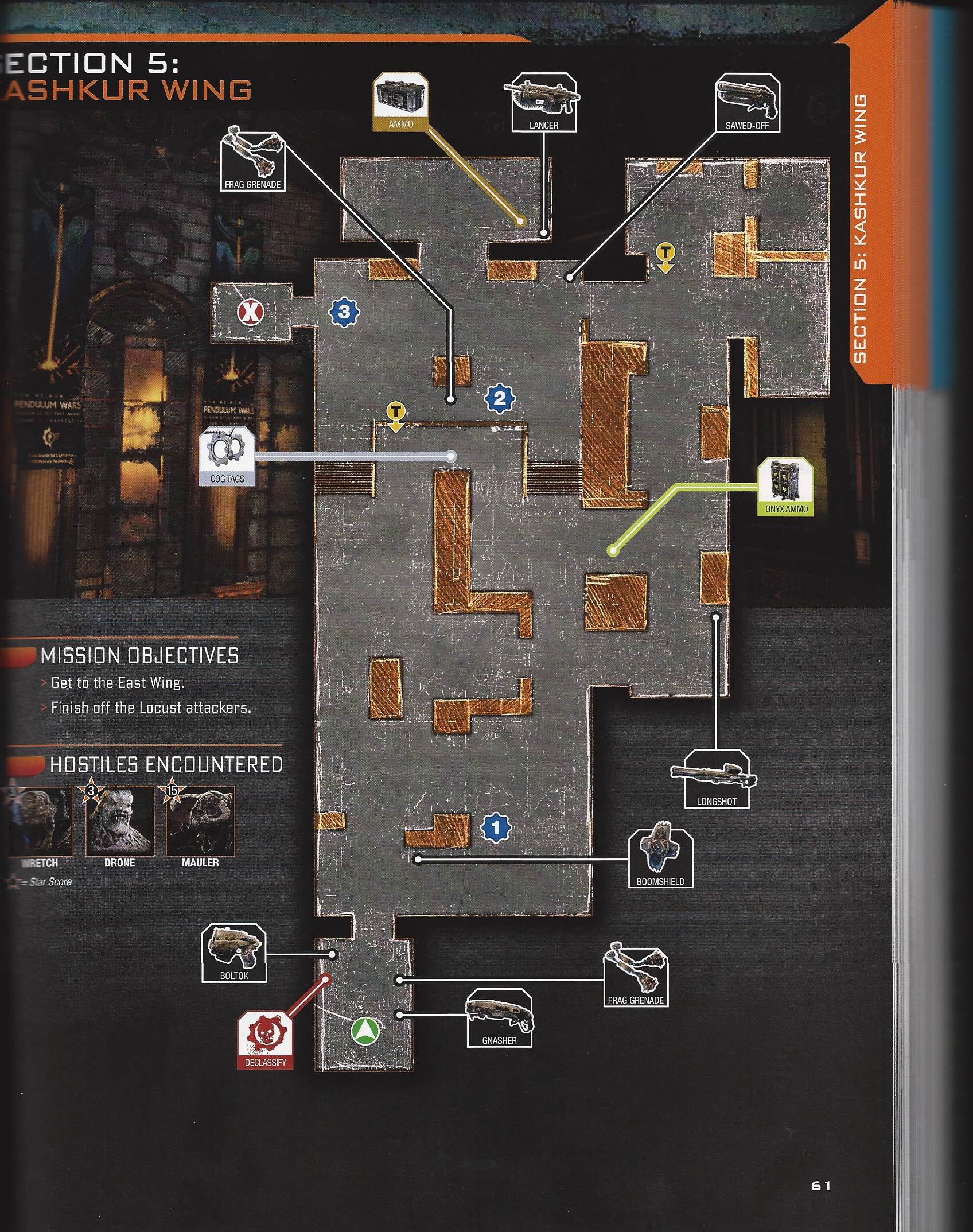
Gears of War: Judgment strategy guideAs I’ve said before, the missions are incredibly short, save for those in the Aftermath campaign, so the maps aren’t that entirely useful for the main campaign unless you’re hunting the COG tags or you REALLY REALLY REALLY need that Onyx Ammo box. That said, it didn’t stop the strategy guide team from creating some really detailed maps. I only found two flaws with all of the maps: one map was missing a COG tag marker, and another did not have the Declassify marker. At least it’s nearly impossible to miss the Declassify markers when traversing through the campaign, and I found that one wayward COG tag easily enough since all COG tags have their own call-out boxes in the walkthrough. (For the record, thanks to the strategy guide, I found all 48 COG tags in my first playthrough.)

Since Gears of War: Judgment itself is so incredibly short, and is not that difficult on a Normal setting with no Declassify modes activated, I cannot recommend the Gears of War: Judgment strategy guide if this is all you’re going to do with the game. However, if you want those COG tags (some are not easy to find, trust me) and you want those three-star ratings on harder difficulties with the Declassify mode turned on, then BradyGames’ strategy guide is your perfect companion to Kilo squad.

SGR Rating: 4.5/5

Authors: Doug Walsh, Michael Owen, Kenny Sims, Jim Morey
Publisher: BradyGames
Editions available: Collector’s Edition
Acquired via Publisher

Filed Under: Strategy Guide Reviews

Metal Gear Rising: Revengeance Strategy Guide Review

March 25, 2013 By Nicholas Michetti 1 Comment

Metal Gear Rising: Revengeance Strategy Guide ReviewMetal Gear Rising: Revengeance marks a distinct gameplay departure from the MGS series. Instead of a stealth game, Raiden’s spin-off offers fast-paced stylish action similar to games such as Devil May Cry and Bayonetta. Gamers who are following Raiden from his roots in more traditional Metal Gear games to MGR:R may encounter some difficulties, especially with a game that has experience points so strongly tied to battle rankings. Piggyback’s Metal Gear Rising: Revengeance strategy guide, though, is a one-stop resource that should be able to help players get the best battle rankings and all of the Battle Points (MGR:R’s XP) that they need.

Two of MGR:R’s big gameplay focuses are Zandatsu (the game’s signature finishing maneuver in Blade Mode) and parrying (how attacks are countered). The strategy guide will let players know everything that they need to in regards to these mechanics, especially what enemies can be hit with a Zandatsu immediately or what damage qualifications are necessary to get one, what enemy attacks can or can’t be parried, and what signs players should look for to be ready to parry an attack. The information can be invaluable at times and can help players significantly increase their rank.

Speaking of increasing rank, the strategy guide’s advice for specific combat situations is focused on players gaining an S-Rank in every ranked battle. The guide also assists players with engaging in the right styles of combat, helping them learn effective techniques that can be used when facing enemies in future battles. Following the guide’s advice closely or even just keeping specific points of advice in mind can be the difference between a B rank and an A or S rank. Performing better in battle results in earning more Battle Points, which further results in players being able to give Raiden more upgrades and access more weapons. The guide even makes recommendations about what specific upgrades players should invest in before moving on to the next chapter, which are virtually spot-on. The level of accuracy for the guide even extends to item locations, as mostly everything is exactly where the guide says it is, with rare few exceptions.

The official guide also has a vast amount of data in it, from how the scoring system works, what parts of an enemy are strongest or weakest (down to color labeling representing the strongest and weakest areas), how much damage enemy attacks do, the stats for each weapon and sub-weapon, and more. For players who would eventually like to master MGR:R, the guide provides all of the relevant data necessary to assist them with their goal. Tables containing information on how a battle is graded (time, Zandatsus, kills, etc.) accompany every ranked battle and the guide also has No Damage and No Kills tables available when applicable. Finding information in the guide is very easy as well, as the pages have very clean layouts and call-out boxes are well implemented. The guide’s item discovery/level layout sections are separate from the battle sections, which may see gamers flipping pages back and forth a bit, but that’s ultimately a minor nitpick.

If the strategy guide has one downside, though, it’s that the S-Rank only strategies may be intimidating for some players to pull off, especially those players who are new to this style of game. The guide admits that pursuing S-ranks right away isn’t a good idea, saying that on a first playthrough, gamers should just play for fun and familiarize themselves with the game’s core techniques. While most of the guide’s advice can be used quite well for an initial playthrough, newcomers may struggle a bit trying to keep up and there are occasional sections that recommend equipment that players won’t have on their first-run playthrough or may not have unlocked yet. However, the guide’s advice also will immediately become much more clear and perhaps even more accessible on a second playthrough. (A second playthrough on MGR:R is easily accomplished with a game length of around ten hours or so, which can be shortened even further by skipping cut scenes.)

As for the Collector’s Edition value, MGR:R’s CE guide has a sixteen-page artwork section with comments from staff from Kojima Productions and Platinum Games who worked on the game. The section isn’t particularly a must-have, but it provides a nice look at some of the artwork that went into the game and may be a plus for players looking to pick up the great Yoji Shinkawa textured paper lithograph depicting Raiden that comes with the guide. The guide also has a nice hardcover with an image of Raiden on the front, split down the middle with an electrically charged blade. Fans less enthusiastic about Metal Gear may not enjoy the extras as much, but for the Shinkawa lithograph and the additions to the CE, the $10 difference in comparison to typical paperback guides will be worth it for hardcore fans of the franchise.

If someone is new to playing MGR:R and seeking advice or is looking for advice on how to get S-ranks in every battle in the game, the Metal Gear Rising: Revengeance strategy guide is absolutely worth picking up. The guide is packed with as many bits of essential information as imaginable to help players figure out how to defeat an enemy that they’re having difficulty with, get through boss battles with greater ease, get the best possible ranks in combat, and have an easier time playing the game all-around. Regardless of experience level with this type of game, the guide is more than capable of helping players beat or best MGR:R. Piggyback’s guide is simply a must-have for anyone who might be looking to pick one up for Metal Gear Rising: Revengeance.

SGR Rating: 4.5/5

Publisher: Piggyback
Editions available: Hardcover Collector’s Edition
Acquired via Publisher

Filed Under: Strategy Guide Reviews

Mass Effect 3 Leviathan DLC Mini-Review

March 20, 2013 By Keri Honea Leave a Comment

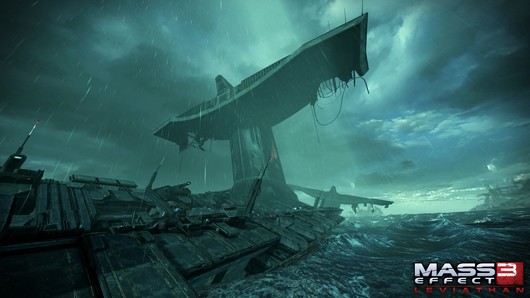
Leviathan DLC

When BioWare released their single-player DLC for Mass Effect 3, I rather stupidly did not have a save that would allow me to access any of it. I kept 3 save points, and I kept rotating which ones I saved over, therefore all my saves are from Earth. Once you’re on Earth, there’s no going back. Literally. Cortez crashes the shuttle shortly after dropping you off, so yeah, that ship has sailed, so to speak. Now that all of the DLC is out and Shepard’s story is officially over from BioWare’s standpoint, I decided to start over my game and finally play some of this DLC. First up, the Leviathan DLC.

I knew nothing about the Leviathan DLC, and I’m glad I did not. The basic story behind it is that an Alliance scientist has been tracking rumors of a beast that possibly killed a Reaper by itself. When Shepard visits the scientist to get more information on how to recruit this beast as a War Asset (it’s all about the War Assets, don’t forget), the scientist’s assistant becomes indoctrinated and kills the scientist. So now Shepard has to find the beast, if it indeed exists, all on her own.

I had an absolute blast playing this DLC, primarily because it is structured almost like a murder mystery. Shepard has little information about what or where this beast is or where the scientist’s other assistants may be doing research, and since the scientist is quite dead, she must search for clues in the lab herself and whittle down where she should go next. Not every clue she finds is relevant to the case, which made it all the more fun and the sleuthing not as “easy.”

Spoiler alert, there is such a beast, and when Shepard finds it, she is treated to an incredible history of the Reapers that I never once fathomed. I’m fairly certain my jaw was dropped during the entire sequence with the Leviathan itself. I am doubly pleased that the Leviathan’s tale became part of my Mass Effect codex so I can read it at my own pace and digest it further later. The history of the Leviathan and the Reapers is actually so incredibly important to the overall story that I’m disappointed this wasn’t part of the original game. Then again, that could just be me, since I love backstories to pretty much everything.

My only complaint about it is that the sequence where James Vega suddenly appears in the research lab is abrupt and feels really unnecessary. I still have no idea why he suddenly showed up and why he suddenly left. I talked to him at every chance I had, and I never really got a good answer as to why he was there. Even when he was part of a particular cut scene, I didn’t feel like his presence was necessary. However, this randomness lasted a total of 30 seconds, and he was quickly forgotten after I said out loud, “That was weird.”

While playing on casual difficulty, the Leviathan DLC took me approximately 2 hours and 45 minutes to get through, which I think is a damn good bargain for 800 MSP ($9.99). It’s also definitely not as tedious as the Overlord DLC from Mass Effect 2 was, so I can heartily recommend this one to friends as well as say I will not grumble about replaying it with future playthroughs (definitely can’t say the same about Overlord).

Filed Under: Mini-Reviews

Crysis 3 Strategy Guide Review

March 19, 2013 By Blake Grundman Leave a Comment

Crysis 3 strategy guide reviewCrysis is a brand of first-person shooter that has become synonymous with pushing PC technology to the point that it taps out in virtual agony. Though never the most challenging or impressive gameplay wise, the unique wrinkles that it provided to the traditional shooter had helped the developer Crytek etch out a corner of the market where high production values were paramount above all else. As is the case with most FPS games, it would seem that the “run-and-gun” mentality of most titles would not lend themselves well to strategy guides. If you commonly think this way, oddly enough, this time you couldn’t be more wrong with the Crysis 3 strategy guide.

If chess and the garden variety first-person shooter were to have a baby, the result would be Crysis. Combining the diversely different tech found in the player’s nanosuit with all of the different weapons at the player’s disposal renders the game approachable in virtually every way known to man. Like getting the jump on enemies? Slap on the invisibility perk and shank those bastards like you are the new kid in the prison yard. Prefer to run into the middle of the fray and unleash all hell? Fire up the hardened shell and start throwing some ‘bows. The other two primary skills of speed and strength also work to compliment playing through the campaign in either a stealth or action mode. In response to this flexibility, the Crysis 3 strategy guide’s walkthrough is actually covered twice in the text, breaking down both gameplay options.

Splitting the walkthrough into two pieces is by far the best approach to covering the single-player component. This also makes it easy for the player to switch back and forth between gameplay approaches, on the fly. As long as you are familiar with how a table of contents works, you should be good to go. One important thing to note when comparing these parallel commentaries are that rather large chunks of text are re-used in both sections. While this isn’t really all that horrible considering it is more story based synopsis or observations, it might have been nice to have a different dialog between versions. Regardless, the writing is solid enough that it isn’t that big of a deal in the broad scheme of things.

I personally found the descriptions of interactions throughout the campaign breakdown to be extremely amusing. Using phrases like “start popping heads” to describe sniping is just one of many examples of text used to provide cheeky, yet completely worthwhile analysis of a situation. The call-out sections are also extremely useful when learning how to down specialized (and primarily alien) enemies for the first time. There is both important information that applies to that specific encounter, as well as any others that may come later on down the road. Be sure to pay close attention, because understanding these key concepts pay dividends in the long run.

Thankfully, the enemies are tightly scripted in Crysis 3 . This means that virtually every aspect of the walkthrough is spot on. Everything from weapon drops to enemy locations are spelled out in detail and can be either dispatched or avoided (depending upon which approach the player is using) by following the directions to the T. Rarely ever is there a case where something in the text proves to be inaccurate, which says quite a bit about the time that the author invested in the game. Sure, it is one patch away from rendering the walkthrough nothing more than expensive kindling, but as of right now things seem damn near spot on.

As useful as any guide can be helping a player through the single player campaign, rarely do you find a strategy guide that is even remotely as useful when it comes to the multiplayer portion of the game. The Crysis 3 tome is a rare exception to this rule, dedicating a staggering quarter of the entire text to the often neglected mode. Considering that this is where many would argue that the meat of the overall game lies, it is an extremely welcome change from the norm.

The author really had their work cut out for them in trying to concisely describe each of the title’s numerous multiplayer modes. If you are familiar with online shooters, most of this section will be old hat, but in the case of Hunter and Extraction mode, even seasoned veterans would be wise to take note of some of the knowledge dropped on the pages. It could make the difference between digital life and death. Another nice touch are the different suggested player roles in a team, as well as suggested loadouts for these respective positions. Additionally, every single perk and power-up is discussed, which should help the inner strategist in everyone.

In one final victory for the reader, each map has a full page dedicated to the a top-down view of layout, with certain specific locations called out for spawn points, weapon drops, or other places of interest. These maps are then complimented by a half page writeup, which discusses both strategy and the kind of gotchas that would only come from hours of trial and error. The smart gamers out there would be wise to take all of these pieces of commentary to heart if they plan on getting a leg up on the competition.

If there were one downfall to this otherwise exceptional guide, it would have to be the lack of pages dedicated to showing off the fantastic art assets of the game. Crysis 3 is the type of experience that looks beautiful, so why this wasn’t taken full advantage of is a bit baffling. Yes, these sections are certainly not crucial to the overall value of the book from an actual “guiding” perspective, but why not give the reader the chance to stop and smell the proverbial roses?

Players that are looking to improve on all aspects of their Crysis 3 experience should look no further than this strategy guide. It provides more than enough guidance to the audience, while not inundating them with useless information. Plus, the addition of a stellar section dedicated to multiplayer makes this far and away the most comprehensive guide for a first-person shooter that I have ever encountered. So what are you waiting for? Get down to business and send those aliens packing, thanks to a little help from your buddies over at BradyGames!

SGR Rating: 4.5/5

Author: Michael Lummis
Publisher: Brady Games
Editions available: Paperback
Acquired via Publisher

Filed Under: Strategy Guide Reviews

  • « Previous Page
  • 1
  • …
  • 27
  • 28
  • 29
  • 30
  • 31
  • …
  • 57
  • Next Page »

Follow us!

Subscribe!

Upcoming Strategy Guides

 Nothing here. Come back later. 😢

Latest Strategy Guide Reviews

The Walkthrough by Doug Walsh Review

Red Dead Redemption 2 Strategy Guide Review

Mega Man 11 Strategy Guide Review

God of War Strategy Guide Review

Far Cry 5 Strategy Guide Review

Friends of SGR

  • BradyGames
  • Dan Birlew – Guide Writer
  • Doug Walsh – Guide Writer
  • Future Press
  • Game Enthus
  • GameWires.com
  • Piggyback
  • Press the Buttons
  • Prima Games
  • Racing Games

Top Posts & Pages

  • Monday Gaming Diary: Keeping the LEGO Marvel's Avengers in Focus
  • Weekly Poll: How Many Video Games Do You Play at Once? Redux
  • Strategy Guide Cover of the Week: Final Fantasy X
  • Why Should I Buy? Unboxing The Witcher 3: Wild Hunt Complete Strategy Guide
  • Halo: Reach Strategy Guide Review

Copyright © 2026 · Web crafted by Warkhammer

Loading Comments...